The response to our 2025 Science Without Borders® Challenge has been overwhelming! We’ve been blown away by the sheer number of submissions we received from aspiring young scientists and artists worldwide. Last week, we proudly unveiled the finalists in the 11-14 age group, and now, we’re ecstatic to announce the finalists in the 15-19 year-old category.
These gifted students come from all over the globe, including The Bahamas, Canada, China, Greece, Japan, Indonesia, Korea, Thailand, and the United States. Their artwork brings the 2025 theme, “Marine Keystone Species,” to life in extraordinary ways. From intricate illustrations of krill and coral to impactful portrayals of sharks, sea otters, polar bears, mangroves, and more, each piece highlights the essential roles these species play in maintaining ocean balance and biodiversity.
Without further ado, please meet our talented 15-19 year old finalists! These exceptional artists have not only showcased their incredible talents but also their unwavering passion for marine conservation.
15-19 Year-Old Finalists
"The Sea's Yggdrasil" by Daniel Yu, Age 17, United States of America
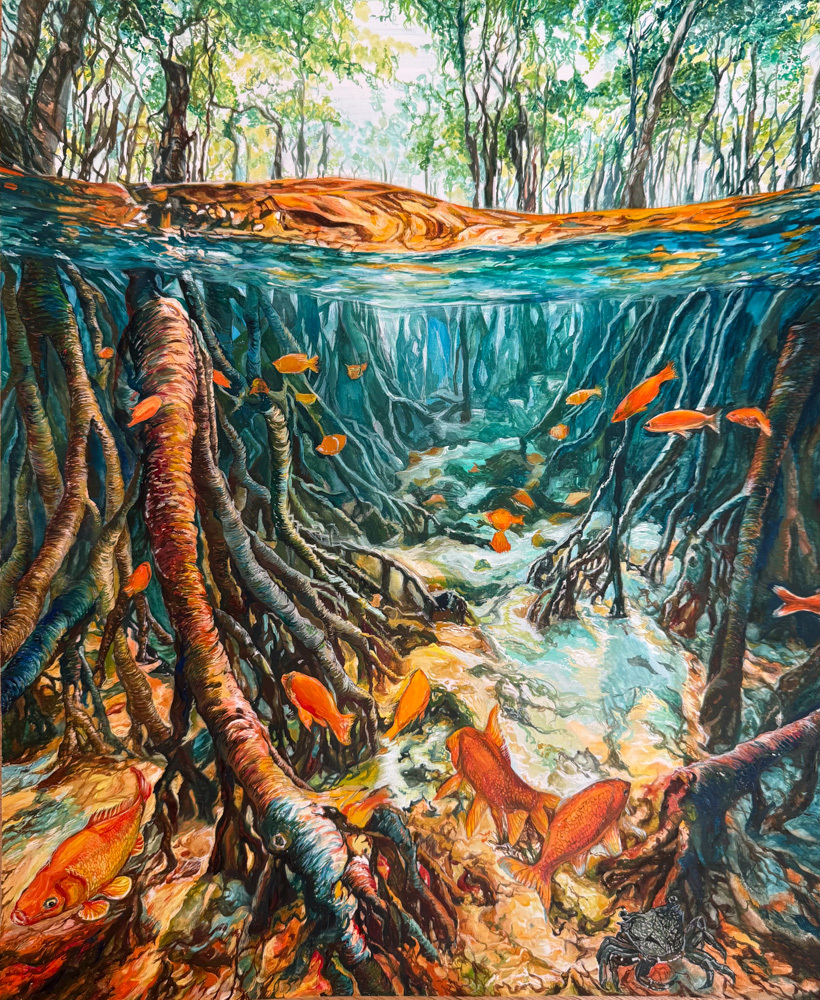
ARTIST'S STATEMENT: Mangrove trees are not just plants; they are foundation species that create and sustain entire marine habitats. Their complex root systems serve as nurseries for a wide range of marine life, including the Aratus pisonii and goldfishes depicted in my artwork. Mangroves play a crucial ecological role by stabilizing coastlines, preventing erosion, and filtering pollutants from the water, protecting the health of surrounding marine ecosystems. Many creatures rely on mangrove forests as a safe haven during their juvenile stages before venturing into open waters. These intricate webs of roots are teeming with life such as small fish, mollusks, and juvenile sharks, supporting biodiversity and food chains in tropical and subtropical waters. I conveyed this complexity by layering tangled roots in the foreground with bold textures, while those in the background fade into cool blues. Without this keystone species, biodiversity in the oceans would drastically decline and coastal ecosystems would collapse.