
search-icon
The Legacy Site – What Will the Future Tell?

The Khaled bin Sultan Living Oceans Foundation works on a global scale to improve our understanding of coral reef health and the ecological integrity of coral reef ecosystems. Pollution, coastal development, overfishing, climate change, disease, and predation can negatively impact coral reefs. To see how reefs change over time as a result of these and other factors, scientists set up “Legacy sites”, observational areas that can be compared over time. These sites can provide incredible insight into the future of coral reefs, and their resiliency to ecological disturbances.
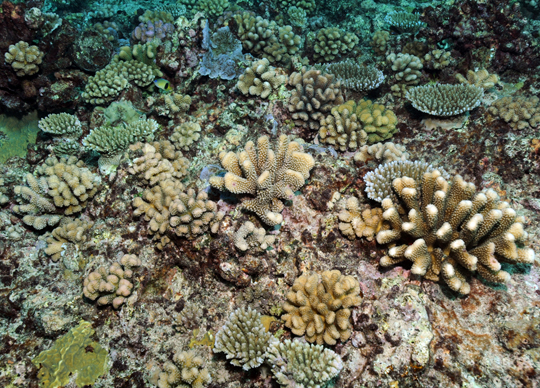
Society Islands Legacy Site

The Living Oceans Foundation has set up Legacy sites in six locations: two in the Bahamas, two in St. Kitts, and two during our current mission to the Society Islands of French Polynesia. The ones in the Society Islands were chosen because of the amount of visible damage done by the crown of thorns sea star (COTS), a destructive coral predator. By returning to the Legacy site in five years, the Foundation can assess whether the reef can rebound from these types of predators.
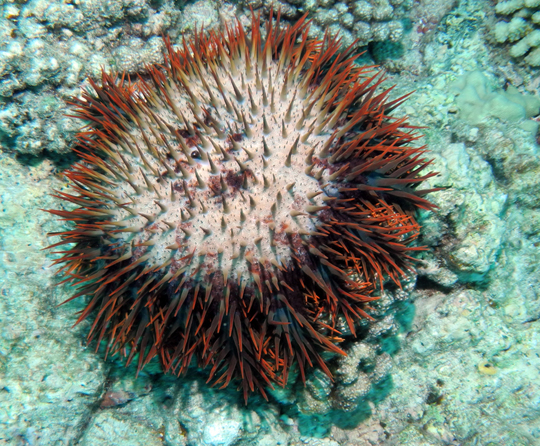
 

Crown of thorn sea star wrapped around a coral.

Laying out the ten square meter Legacy sites quadrat is an impressive endeavor involving the cooperation of several researchers. I floated above the site as Dr. Bruckner measured out the area to be studied. Divers carefully hammered four metal stakes into the rock foundation to permanently mark the corners of the site, and installed a meter that records temperature every 30 minutes for the next five years.  Other researchers began collecting visual data of the reef biodiversity, including the cover of coral and algae, benthic properties, and fish density. Several hundred overlapping high resolution photographs were taken of the entire Legacy site to create a mosaic that will serve as a permanent visual record of the baseline condition of the site when first established. The dive team worked together with the precision of a symphony.


Nick Cautin, Dive Safety Officer, hammers in a stake to mark the Legacy site.

As I observed them, I began to ponder the name, Legacy Site. My thoughts moved from scientific to personal. What will be our legacy? Will these reefs disappear? How will future generations be affected by the loss? Given the current decline in coral reefs, a part of me worries about what these sites will show us in five years. But then again, as more organizations such as the Living Oceans Foundation continue to work towards coral reef protection and preservation, the Legacy sites may document the positive results of our efforts – a legacy worth passing on. Only time will tell.

A sea star clinging to a coral head.

(Photos by: 1 and 2 Dr. Andrew Bruckner, 3 and 4 Candice Jwaszko)

To follow along and see more photos, please visit us on Facebook! You can also follow the expedition on our Global Reef Expedition page, where there is more information about our research and team members.
Related Posts

2025-2026 B.A.M. Student Voices

Throughout the Bahamas Awareness of Mangroves (B.A.M.) and Jamaica Awareness of Mangroves in Nature (J.A.M.I.N.) programs, we evaluate each phase of the mangrove education and restoration process to better understand how students are learning, growing, and connecting with their coastal environments.

Before the programs begin, students share what they already know about mangroves and how they feel about them. As the program progresses, we continue to gather feedback to see how their knowledge evolves from identifying mangrove species and understanding food webs to recognizing the role mangroves play in coastal protection and climate change mitigation.

But the surveys go beyond science content.

We also ask students…

Read More

Ten Years of B.A.M.: Rooted in Partnership, Growing in Purpose

Ten years ago, the Bahamas Awareness of Mangroves (B.A.M.) program began with a simple but meaningful commitment: to connect Bahamian students with the mangrove ecosystems that shape and protect their island home.

Since 2015, B.A.M. has been implemented in partnership with Friends of the Environment, whose dedication to environmental stewardship in Abaco has made this program possible year after year. Together, we have worked alongside Patrick J. Bethel High School and Forest Heights Academy to bring hands-on mangrove science into classrooms and out into the field.

What makes ten years remarkable is not just longevity — it is consistency…

Read More
Privacy Overview

This website uses cookies so that we can provide you with the best user experience possible. Cookie information is stored in your browser and performs functions such as recognising you when you return to our website and helping our team to understand which sections of the website you find most interesting and useful.  You can view our complete Privacy Policy here.

Strictly Necessary Cookies

Most of our cookies are used to improve website security and reduce spam. These cookies should be enabled at all times. They also enable us to save your preferences for cookie settings.

3rd Party Cookies

This website uses Google Analytics to collect anonymous information such as the number of visitors to the site, and the most popular pages. Keeping this cookie enabled helps us to improve our website.