search-icon
“Let’s name the zones, the zones, the zones of the reefs…of Raivavae and Tubuai”

Coral communities on the first two islands in the Australs were very unusual, compared to all other reefs we looked at in French Polynesia. Unlike other fore reef communities, a very wide shelf surrounded each island, extending from the reef crest, adjacent to the lagoon, hundreds of meters offshore before plunging steeply to the depths.
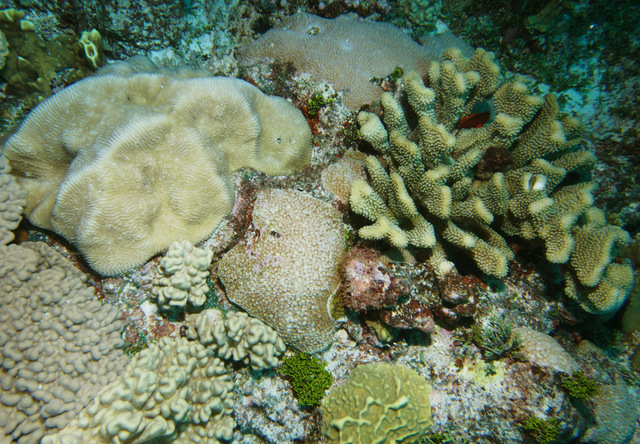
Austral Coral Communities of Raivavae and Tubuai: A typical mid depth assemblage of hard (Leptoria, Astreopora and Pocillopora) and soft corals

Austral Coral Communities: Raivavae and Tubuai

The shallow reef transitioned from a high energy reef crest dominated by branching corals, mostly stout finger corals and thick tables of Acropora and cauliflower corals (Pocillopora), to a spur and groove structure with narrow scoured hard-bottom channels and wide flattened spurs. The spurs in shallow water (to 10 m depth) were constructed mostly of low-lying massive star corals (Astreopora), with some larger outcrops containing other massive species such as Favia and a brain coral (Leptoria) seen previously only in Mangareva, along with short, stout branched and digitate Acroporids and Pocillopora.
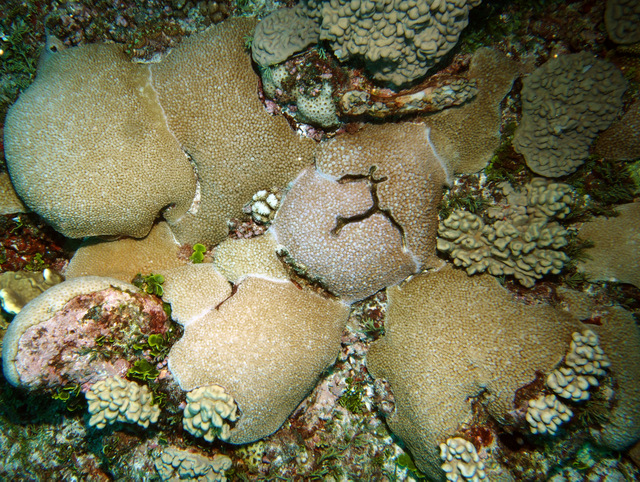
Astreopora becomes more dominant in about 8 meters of water


From 10-15 m deep, the grooves were colonized by small pore corals (Porites) and an unusual massive coral we had not seen before (Hydonophora), while other encrusting, plating and boulder corals were found on the tops of the spurs. We also found another unique coral which forms potato-chip shaped colonies and extends its yellow to lime green polyps in the day (Turbinaria) and several other sheeting corals on the sides of spurs.
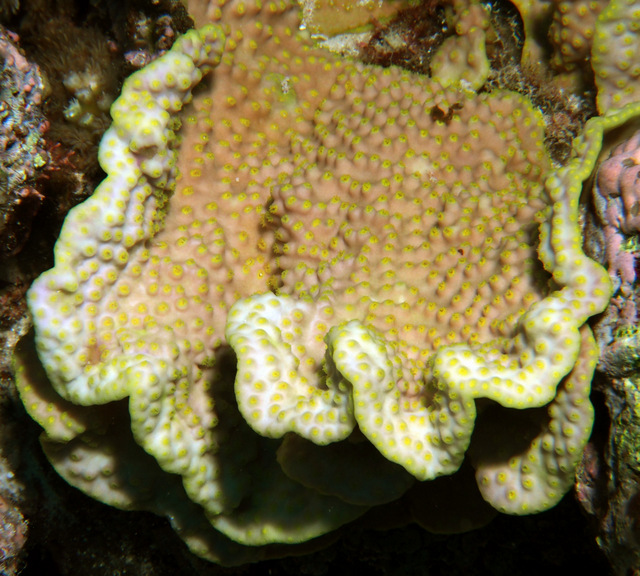
A colony of Turbinaria


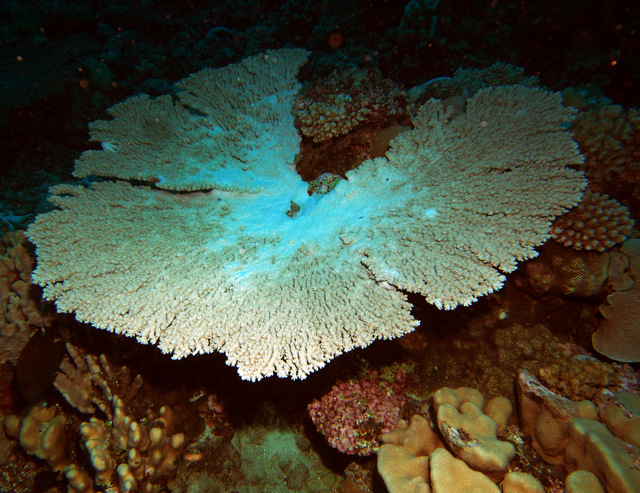
Many areas from 5-15 m depth had high numbers of soft corals, many of which were over 2 m in diameter. In deeper water, the reef gradually transitions from Astreopora to a community with very dense cover of large massive and lobate corals (Favia stelligera, Pavona clavus), flower corals (Lobophyllia) and dense thickets of stout-branched staghorn corals (Acropora). At 20-25 m deep another species that forms large tables (Acropora cytherea) becomes abundant; the only other place we observed this species was in Mangareva. Still deeper, these are progressively replaced by large flattened domes of pore coral (Porites), some that are over 5 m in diameter and centuries old.
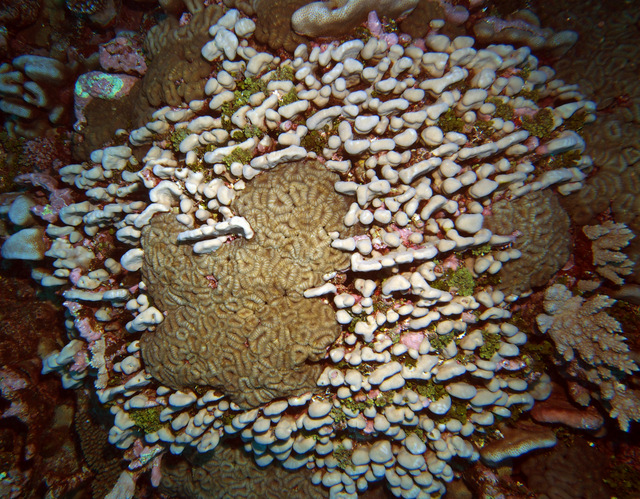
Pavona surrounding large colonies of Lobophyllia
A big table of Acropora cytherea

(Photos by Andrew Bruckner)

To follow along and see more photos, please visit us on Facebook!
Related Posts

From Dialogue to Action: Ocean Foundations Gather in Stockholm

What can philanthropy accomplish when foundations working across ocean science, conservation, and sustainable development come together around a shared purpose?

That question was at the heart of the 6th UN Ocean Decade Foundations Dialogue, held September 7–9 in Stockholm, Sweden. The Khaled bin Sultan Living Oceans Foundation joined philanthropic organizations from around the world for three days of discussion, collaboration, and planning focused on accelerating progress during the second half of the UN Decade of Ocean Science for Sustainable Development.

Facilitated by UNESCO’s Intergovernmental Oceanographic Commission (IOC), the UN Ocean Decade Foundations Dialogue is a growing network of more than 30 philanthropic organizations committed to advancing ocean science, collaboration, and action. Since its creation within the framework of the Ocean Decade, the Dialogue has provided foundations with a space to exchange ideas, develop partnerships, and explore how philanthropy can help advance a healthy and resilient ocean.

Hosted by the Voice of the Ocean Foundation (VOTO), this year’s gathering began with From Depth to Action, an Opening Forum that brought nearly 100 leaders from the Swedish and international ocean community together at…

Read More

Meet IFAN: Helping Bring Navigate with Care to the Next Generation

If you’ve ever seen a lighthouse flashing from the shore or a brightly colored buoy bobbing in the water, you’ve seen Aids to Navigation at work.

Aids to Navigation, often called AtoNs, help mariners navigate safely. They can mark channels, warn of hazards, help vessels determine their position, and provide other information people need to make safe decisions on the water. Around the world, these systems help guide everything from small recreational boats to large commercial or container ships. 

But safe navigation isn’t only about protecting vessels and the people aboard them. The choices mariners make can also affect the animals and ecosystems beneath and around them.

That connection between maritime safety and ocean conservation is at the heart of this year’s Science Without Borders® Challenge—and of our partnership with this year’s theme sponsor, the International Foundation for Aids to Navigation (IFAN).

Read More

Privacy Overview

This website uses cookies so that we can provide you with the best user experience possible. Cookie information is stored in your browser and performs functions such as recognising you when you return to our website and helping our team to understand which sections of the website you find most interesting and useful.  You can view our complete Privacy Policy here.

Strictly Necessary Cookies

Most of our cookies are used to improve website security and reduce spam. These cookies should be enabled at all times. They also enable us to save your preferences for cookie settings.

3rd Party Cookies

This website uses Google Analytics to collect anonymous information such as the number of visitors to the site, and the most popular pages. Keeping this cookie enabled helps us to improve our website.