
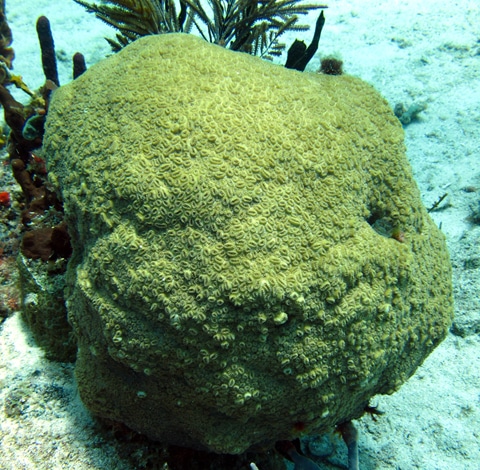
Our morning dives were located at Monkey Shoals, a submerged bank that lies about 3 miles offshore between St. Kitts and Nevis and west of the Narrows. The reef structure is reminiscent of a Pacific atoll, without the typical emergent land encircling its perimeter. The top of the shoal extends about 1 mile across, consisting of a relatively flat hardground habitat between 10-15 m in depth. A well-developed reef system encircles the perimeter, sloping gradually from about 15 m depth to a sand terrace at 30-40 m depth, before plummeting into deeper water. This reef had a high amount of topographic relief, with many crevices, ledges and channels, mostly due to an extensive build-up of lobate and mountainous star coral. These corals were often several meters in diameter, although most had died and were covered in fleshy algae, sponges and other encrustations. Nevertheless, smaller colonies of these species abound and living patches of tissue survive at the bases of the larger corals and are beginning to regrow. The reef substrate and dead skeletal surfaces of the star corals were also colonized by smaller brain corals, flower coral, cactus corals, finger corals, lettuce coral, mustard hill coral, and several other species, most of which were in excellent health.
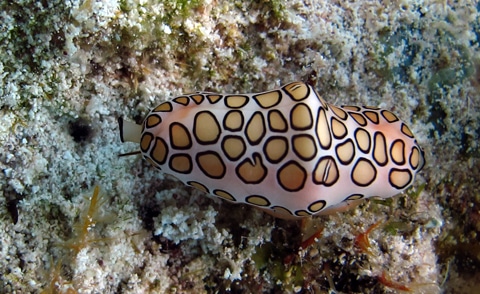
Sea fans were also common at Monkey Shoals, but other species of soft corals showed signs of a recent die-off. All that remains of these is the hardened brownish central axis, which was often covered with fire coral. We were told that the mortality event was due to an outbreak of flamingo tongues (Cyphoma gibbosum), an unusual gastropod mollusk with a creamy white mantle covered with irregular-shaped orange spots with black outlines. This snail prefers to feed on soft corals, but usually leaves small feeding scars that rapidly heal.
We anchored on the top of the shoal in a large circular sand patch for our second dive, in an area called “the donut”. In the center of the sandy area was a small patch reef with a vibrant fish community dominated by schools of grunts, small snappers, squirrelfish, parrotfish, wrasses and many other species. At the edge of the sand, in about 10 m depth, was an undercut ledge about 50 cm in height that provided habitat and shelter for resting schools of snapper, grunts, glasseye snapper, soldierfish, highhats, nurse shark, and other reef fishes, as well as lobsters, crabs and other motile invertebrates. Check out the video of these fish hanging out on YouTUBE.
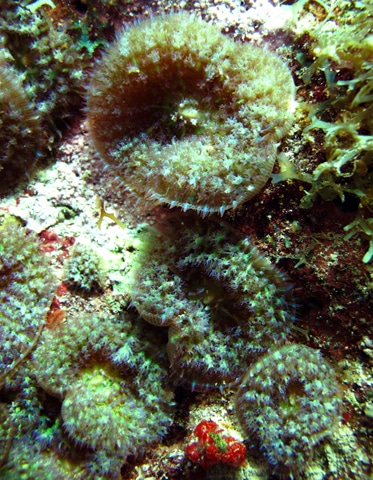
Auston, our dive operator, pointed out several large patches of false corals here at Monkey Shoals that had overgrown parts of the ledge. This is an unusual species of colonial sea anemone known as a warty corallimorph (Discosoma sanctithomae) that has the same structure as a coral, but it lacks a limestone skeleton. In many locations it is harvested for the aquarium trade, and populations have disappeared. Auston has never seen these anywhere else in St. Kitts, noting that they first appeared last year. Fortunately, the collection of marine species for ornamental purposes including home aquaria is prohibited.
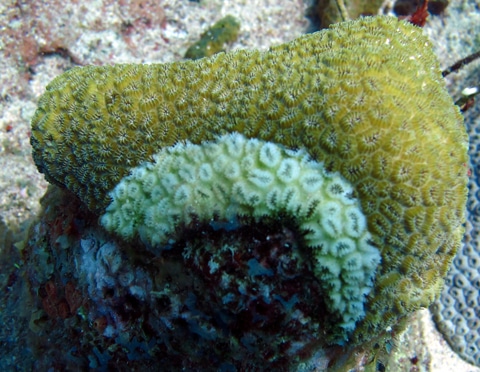
The reef structure at Monkey Shoals, which is a flat, limestone terrace, was colonized by small corals, sponges and other invertebrates. Large numbers of elliptical star coral (Dichocoenia stokesii) occurred on the terrace, most in excellent health and unusually large in size. This was the first time we had seen this species in St. Kitts. During the mid-1990s, this species exhibited a precipitous decline in many locations due to a particularly virulent disease known as white plague. The disease still affects this species (and many other corals), but only one colony showed recent tissue loss from this condition.
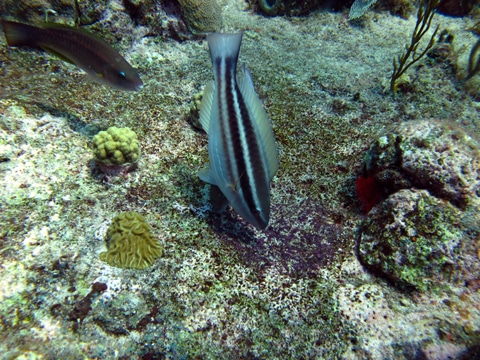
At the edge of the reef terrace several sergeant majors (Abudefduf saxatilis) had deposited their purple eggs, each patch forming a perfect circle, 15-20 cm in diameter. The fish vigorously defended these from predators, including Andy. He had placed his transect line a bit close to one territory, and the angry fish repeatedly nipped at his legs. It’s a good thing they are small! While most fish were chased away, one of the fish was unsuccessful in defending his nest; several medium-sized herbivorous parrotfish overwhelmed the fish and rapidly consumed the eggs. Mostly princess parrotfish, these species are supposed to eat algae. It must have been an occasion for celebration, as they couldn’t resist a luxury delicacy – Abudefduf caviar. Check out the video!
To follow along and see more photos, please visit us on Facebook! You can also follow the expedition on our Global Reef Expedition page, where there is more information about our research and our team members.
(Images and Videos: Andy Bruckner)