search-icon
Fish Bites in the Brimstone Shallows

Afternoon dive

For our third dive, we surveyed Brimstone Shallows, a submerged shelf edge reef about 2 miles off St. Kitts.  Extending for several miles along the leeward side of the island, the reef begins at about 50 feet and slopes downward to a terrace at a depth of 100-120 feet. Much of the high relief structure is provided by large mountainous star corals (Montastraea faveolata) and lobate star corals (M. annularis), with sand channels separating the reef structure.  Like other dives at similar depths we have done in St. Kitts, these corals at Brimstone Shallows lost much of their living tissue 10-15 years ago.  What was different is that there was much more live tissue remaining on most of these, including some small, fully live colonies.  This reef also had a high number of colonies of a species that is a close cousin, boulder star coral (Montastraea franksi). Another notable difference at this site was the abundance of fish bites on these corals, and on mustard hill coral (Porites astreoides).
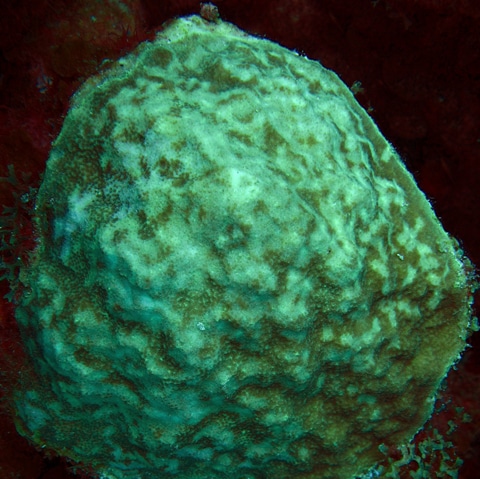
Healing mustard hill coral (Porites astreoides) from fish bites at Brimstone Shallows.

These small white spots were caused primarily by stoplight parrotfish (Sparisoma viride), which are known to be territorial and may bite the corals to mark the boundaries of their territories.  Usually, this does not kill the coral; because the bite marks are so small, they rapidly heal.  Brimstone Shallows was no exception; there were corals with newly created scars and older areas that healed, but were still a bit lighter than the surrounding tissue.
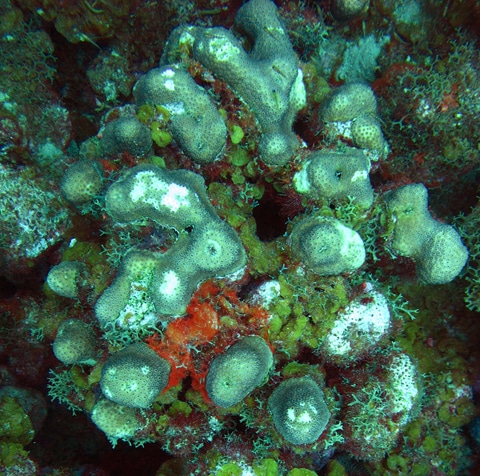
Lobate star coral (Montastraea annularis) with fish bites

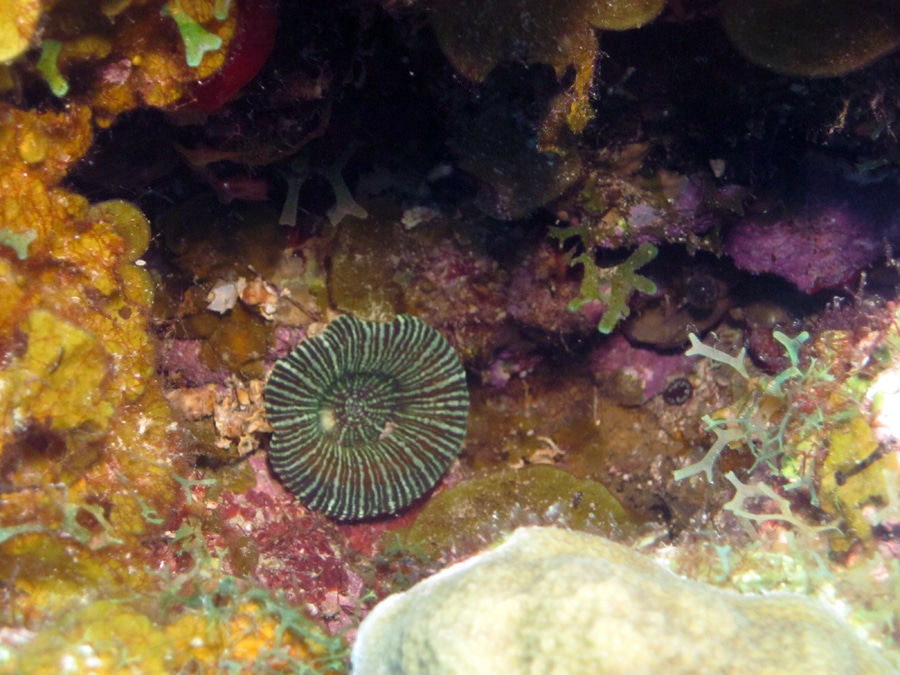
Brimstone shallows is notable for the high diversity of stony corals.  We recorded 25 species of corals, including one, a solitary coral called Scolymia, which we had not yet seen in St. Kitts.   Many of these were fairly small and very abundant, which made it difficult to complete a full coral assessment. In fact, some of our transects (each one covers a total area of 10 square meters) have 20-25 corals, while a single transect at this site had over 100 corals, each of which we identify, measure, and assess its health.

Scolymia cubensis, about 3cm in diameter

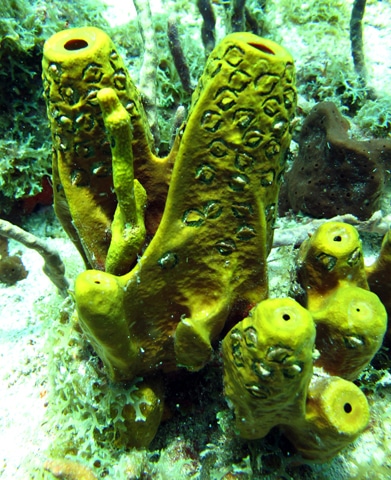
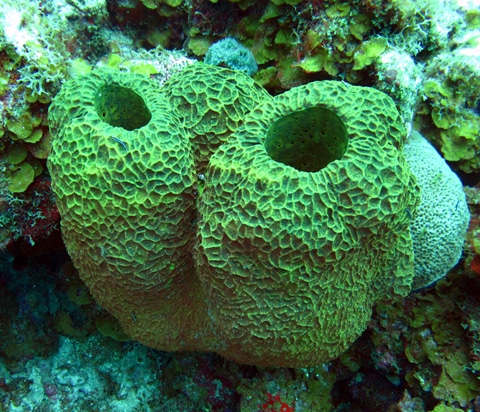
In addition to corals, large colorful sponges of all shapes and sizes covered the bottom.  Sponges are particularly important to reefs for many reasons. In addition to their biomass, diversity and key role they play in reef growth and bioerosion, they filter thousands of gallons of water each day. As they process the water, they remove small particles, bacteria and other microscopic organisms, affecting the balance of carbon and nitrogen in the water column.  They also support a highly diverse community of microorganisms and symbionts, and some house photosynthetic organisms, much like the corals. Some of the more prominent sponges we found at Brimstone Shallows include the large barrel sponges, tube sponges, and rope sponges, but they also form crusts, can overgrow corals, and penetrate and erode coral skeletons.
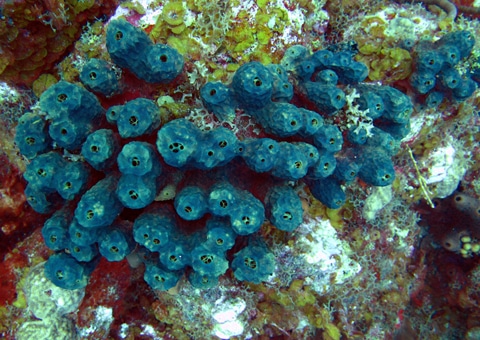
Blue tube sponge (Pseudoceratina crassa)
Netted barrel sponge (Verongula gigantea)
Yellow tube sponge (Aplysina fistularis) with fish bites

Tomorrow, we are heading south to explore reefs off Nevis.

(Images/Photos: 1-2, 4-6 Andy Bruckner, 3 James Byrne)

To follow along and see more photos, please visit us on Facebook! You can also follow the expedition on our Global Reef Expedition page, where there is more information about our research and our team members.
Related Posts

World Oceans Day: Protecting the Ecosystems That Protect Us

This World Oceans Day, the global community is being challenged to think differently about the ocean.

The 2026 World Oceans Day theme, “Reimagine: Beyond the World We Know, A New Relationship With Our Ocean,” invites us to recognize that the ocean is not something distant or separate from our lives. It regulates our climate, supports our economies, provides food for billions of people, and sustains the natural systems that make life on Earth possible.

Few places illustrate this connection more clearly than the coastal ecosystems that protect our shores and support marine life. While coral reefs, mangrove forests, and seagrass meadows are often…

Read More

After the Storm: Standing with Our J.A.M.I.N. Family in Jamaica

There are moments in this work that feel heartbreakingly familiar.

Two weeks after we completed our Jamaica Awareness of Mangroves in Nature (J.A.M.I.N.) programming, Hurricane Melissa made landfall. A powerful Category 5 hurricane, Melissa is now tied with Hurricane Allen in 1980 for the strongest winds ever recorded in an Atlantic storm. Like Hurricane Dorian, which devastated The Bahamas in 2019, Melissa will be remembered as one of the strongest hurricanes on record in the region.

For 11 years, the University of the West Indies Discovery Bay Marine Laboratory and William Knibb Memorial High School have been more than program partners. They have welcomed us into their classrooms and labs, shared meals and laughter, and committed themselves to educating their students about mangroves and coastal resilience. These colleagues and students are not distant collaborators. They are family.

And they were hit hard…

Read More
Privacy Overview

This website uses cookies so that we can provide you with the best user experience possible. Cookie information is stored in your browser and performs functions such as recognising you when you return to our website and helping our team to understand which sections of the website you find most interesting and useful.  You can view our complete Privacy Policy here.

Strictly Necessary Cookies

Most of our cookies are used to improve website security and reduce spam. These cookies should be enabled at all times. They also enable us to save your preferences for cookie settings.

3rd Party Cookies

This website uses Google Analytics to collect anonymous information such as the number of visitors to the site, and the most popular pages. Keeping this cookie enabled helps us to improve our website.