Focus for today:
Crown-of-Thorns Starfish COTS Outbreaks.
Target key stage:
Key Stage 4: National Science Curriculum, Dual Award, Sc2, 5a: the distribution and relative abundance of organisms in habitats can be explained using ideas of interdependence, adaptation, competition and predation.
Key information:
One of the most significant coral predators on the reef is the Crown-of-Thorns Starfish (COTS) (Acanthaster planci). COTS are found throughout the Indo-Pacific region, from the Red Sea, across the Indian Ocean and through to the Pacific. They are not found in Atlantic waters. These starfish look sinister – they are reddish-grey and blue in colour and are covered in 4-5 cm long spines (which give a nasty wound). They are voracious predators and are specially adapted to feed on coral tissue. They are ‘extraoral’ feeders which means that in order to feed, they force their stomach out through their mouth! Specific enzymes are then secreted by the stomach in order to break down the coral tissue. Once finished, the stomach is retracted and the starfish moves on, leaving behind it a bright white scar which is the coral skeleton. COTS seem to prefer eating branching and table-forming corals, usually of the genus Acropora.

COTS clustered together
An individual adult Crown-of-Thorns Starfish consumes coral at an average rate of 160 cm2 per day and they are estimated to consume between 5-6 m2 of coral tissue per year. Like other starfish, COTS can survive without feeding for up to 9 months, just living off energy reserves stored within their bodies.
Huge COTS outbreaks have been reported, for example, on the Great Barrier Reef. On 5th May 2006, the expedition encountered a huge infestation of COTS on the reef off the island of Abu Shuqar. Up to 20 starfish were observed feeding on an individual Acropora table at one time. The starfish were frequently observed clustered on the surface of the coral. The white area of the coral in the photographs is the exposed skeleton after the coral tissue has been eaten, and the brown area is the healthy coral which is about to be eaten. The starfish progress across the surface of the coral, consuming every last scrap of flesh.
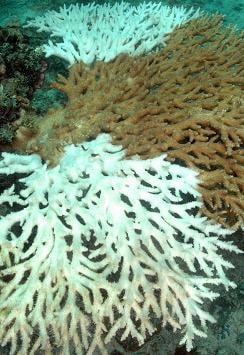
Scarred corals
So why do these huge COTS outbreaks occur? There are two schools of thought: 1) outbreaks are thought to be part of the natural cycle of COTS abundance and decline and 2) human impacts have caused COTS populations to increase. Fossil records have shown that COTS outbreaks have occurred throughout history (fossilised spines have been found showing that outbreaks on the Great Barrier Reef occurred 7,000 years ago) so this is not a new phenomenon. However, it is likely that humans are making these outbreaks worse by collecting and removing the giant triton shell (Charonia tritonis) from the reef. The triton is a natural predators of COTS and thus by removing them (for the international shell trade), the COTS population increases. It is most likely to be a combination of both factors that causes these outbreaks.
Question for students/food for thought:
Do you think there are any ways of controlling COTS outbreaks and if so, what do you suggest? Are there any ways in which reef management techniques could help? If COTS prefer to eat certain coral genera, how do you think this would affect the overall coral community?
Additional information:
On our dive in the area infested with Crown-of-Thorns Starfish, two divers recorded the number and size of individuals present with a specific area. 87 starfish were counted within a 120 m2 area. That gives a density of 0.725 starfish per m2. The starfish average a size of 24 cm in diameter from arm tip to arm tip.