
Focus for today:
Symbiosis on the reef.
Target key stage:
Key Stage 4: National Science Curriculum, Dual Award, Sc2, 5a: the distribution and relative abundance of organisms in habitats can be explained using ideas of interdependence, adaptation, competition and predation.
Key information:
The word symbiosis comes from the Greeks, meaning ‘together’ and ‘life’, so literally it means: ‘living together’. In biology it often refers to a close relationship between two or more organisms. A symbiosis can be mutualistic: when both partner benefit from it; parasitic: when one partner benefits from it at the expense of the other; or, saprophytic: when one partner benefits and the other one is not affected.

Coral Polyps
Many reef-building corals represent fascinating examples of mutualistic symbiosis, as they are in fact made up of two types of organisms: a cnidarian or “coral host” is formed of many small polyps and a myriad of tiny unicellular algae, called zooxanthellae (family symbiodinium), living within the cnidarian tissue layers. The zooxanthellae are able to photosynthesise just like plants: they use the energy of light to turn carbon dioxide and water into oxygen and carbohydrates (large sugar molecules). The coral host is able to feed on the carbohydrate and uses the oxygen for its respiration.
Much research is still underway to understand the many and complex chemical exchanges between the host and its unicellular symbions, and for the brave souls amongst you who will want to study such questions in the future, they will still be plenty of mysteries to be unravelled on the subject!
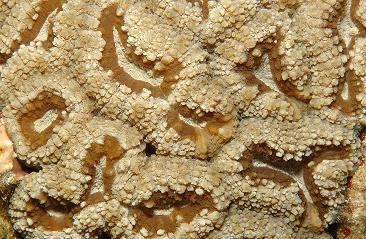
Coral polyps, coloured by the zooxanthellae
One of the most studied parts of coral biology so far is the break down of this symbiosis: a phenomenon called bleaching. When reef-building corals are placed under too much stress, such as excessive temperature and ultraviolet radiation, the zooxanthellae are expelled (or they leave; we are not yet totally sure). Without the brown-green zooxanthellae that gave it its color, the coral looks “bleached white” because its tissue is transparent and the calcareous skeleton shows through it. If the coral colony does not recover a population of symbions after bleaching, its growth will slow down and it eventually will die. Because of this, global warming has been of great concern for coral biologists as they are witnessing an increase in massive bleaching events throughout the world.
They are other examples of symbiotic relationships on the reef. You already know about the clown fish and its anemone. The fish finds protection from predators in the stinging tentacles of its host. It was thought that this relationship mainly benefited the fish, and that the anemone was not affected by it one way or another. In fact, some researchers have documented that for some species when its associated fish was removed, the anemone fell prey to predation by anemone eating fish. Diver who have been bitten on the lip by a cute “Nemo” while trying to get a close-up photograph will confirm that the little fish is quite protective of its home…
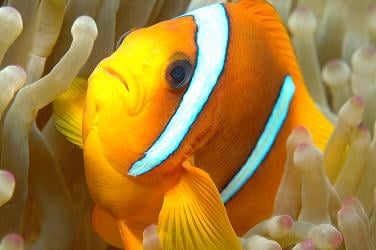
Clown fish and anemone
Finally, another mutually beneficial relationship we are seeing plenty of on this trip is the symbiosis between a gobby and its associated shrimp. The shrimp is a spectacular digger and can plow through the sand to make a home; however, it does not see well and could easily fall prey to roving predators. The gobby on the other hand sees very well, but try burrowing through the sand with those soft delicate fins! The solution to the situation is an elegant example in task-sharing: the gobby mounts guard at the entrance of the den while his shrimp goes about the construction and maintenance work. If a threat arises, the gobby flicks its tail in a warning motion and both animals disappear to the safety of their burrow…!
Question for students/food for thought:
Look for other examples of mutualistic symbiosis and explain what each partner gets from it. Hints: Do you know why termites can eat wood? Or even closer to home -if possible- do you know what lives in your own stomach?
Today the CASI data collection was completed! In total we have accrued approximately 120 giga-bytes of CASI data. Over the coming months these data will undergo processing, to form a detailed habitat map such as the one shown below.

Example habitat map