Does the idea of whales fasting sound strange to you? Read on to find out why they do…
Humpback whales are a type of baleen whale. Baleen whales do not have teeth, instead they have baleen plates, which are made from keratin, the same as our finger nails and hair. These plates act like a strainer filtering plankton and small animals out of the water. Humpback whales primarily feed on krill (small shrimp-like crustaceans) and small schooling fish.
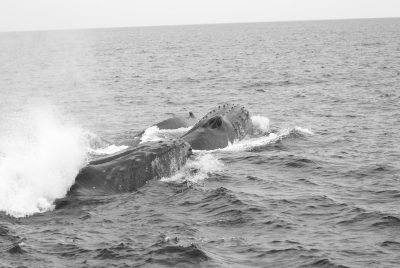
Photographed is a mating group of three whales in Vava’u.
Why are Whales Fasting?
We won’t see any humpback whales feeding in Tonga. (To find out more about why humpback whales are in Tonga read this blog: http://www.sciencewithoutborders.org/whales-whales-whales/). It may be no surprise to you that humpback whales feed primarily during the summer months when they are near the poles. The reason that this occurs in Tonga is due to the lack of nutrients that occur in subtropical and tropical latitudes. This is why the water is clear in these regions. Basically, fewer nutrients mean that there is less phytoplankton (small microscopic plants). Krill feed on phytoplankton. Due to a lack of phytoplankton, there are fewer krill. It’s easy to see that there is not much of a food source for humpback whales in the lower latitudes … hence we have whales fasting.
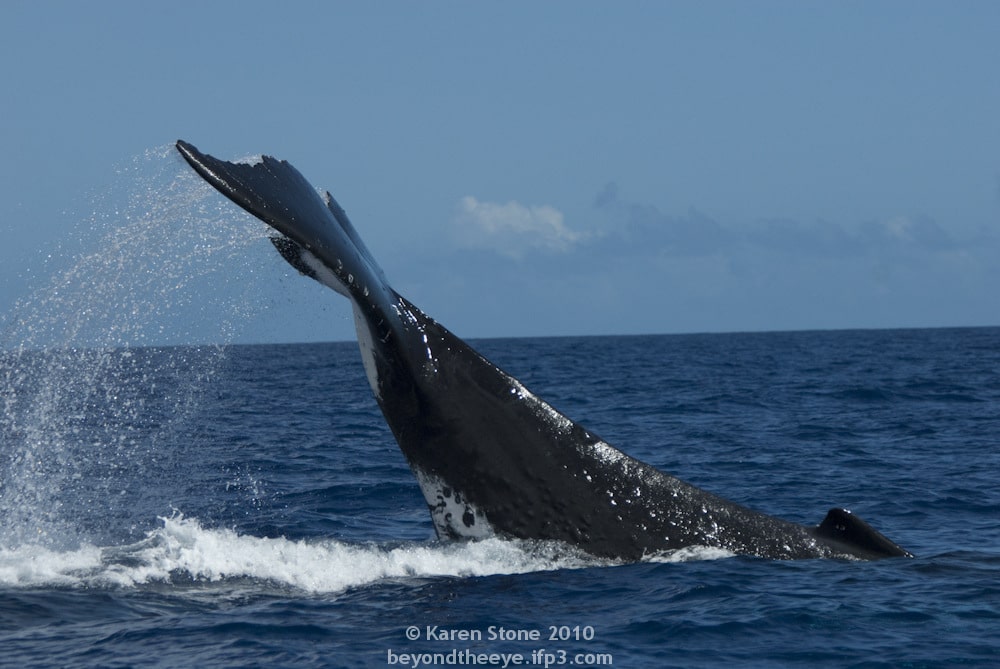
This humpback whale tail is slapping.
Whales also expel a lot of energy in order to feed. Fish do not need to control their body temperature in warmer waters, so fish in the tropics do not have as much oil as fish in the poles. The whales therefore would expend more energy to feed than the food can provide.
During the summer, it’s important for humpback whales to pack on the blubber before making the big migration to warmer water. Adults can eat between 1-2 tons of food a day. It’s a good thing too, because during their winter fast, humpback whales can lose up to third of their body weight. That means that whales fasting can last for around six months. That is some fast!
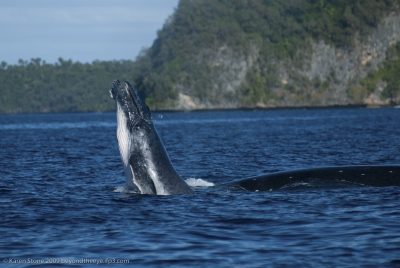
Mother and baby calf swimming in nursery ground.
For the female whales that are feeding baby calves, the whales fasting is more severe. A humpback whale calf puts on average 50kg (100lbs) of weight per day in the breeding grounds. The milk supplied by the mother is about 40% fat content and is expelled into the water close to the teat for the baby to gulp up. It really is a true wonder of nature that through whales fasting and feeding, these animals are able to control their body weight to survive such long migrations to the feeding ground.
Photos: 1-3 Karen Stone