At the southern end of Grande Terre, is Prony Bay, a large sheltered bay at the convergence of the open ocean and two larger streams that drain the surrounding mountains and hillsides. The terrain here is unusual: dark red earth scoured from nickel mining activities, surrounded by lush vegetation made up of a scrub forest, carnivorous pitcher plants, unusual orchids, the occasional palm tree Araucaria pine trees and many other species. Close to 80% of the plants found here are thought to occur only in New Caledonia, largely due to the high concentration of metals found in the soil. Because of the valuable deposits of nickel, Prony Bay is also headquarters for a large nickel mining corporation, with a processing plant located on the east side of the Bay.

Prony Bay
The calm waters of Prony Bay provide optimal conditions for diving, but the visibility was very low (< 3-4 m) due to a red carpet of fine silt that forms a cloud generated by a fin kick a bit too close to the bottom. High turbidity, low salinities and considerable run-off and sedimentation (especially after heavy rainfall) suggest that this is suboptimal for corals, as evidenced by large accumulations of dead coral that is possibly associated with freshwater die-offs.
Nevertheless, the three fringing reefs we dove all contained flourishing coral communities, which suggests they are well adapted to the harsh environment. Each of these red reefs had unique species assemblages including several species of corals that we’ve not seen yet during the GRE. The corals also formed very distinctive zonation patterns.
Some of these corals of the red reefs were small and uncommon such as the trumpet coral (Caulastrea), open brain coral (Trachyphyllia) and the endemic mushroom coral (Cantharellus noumea).
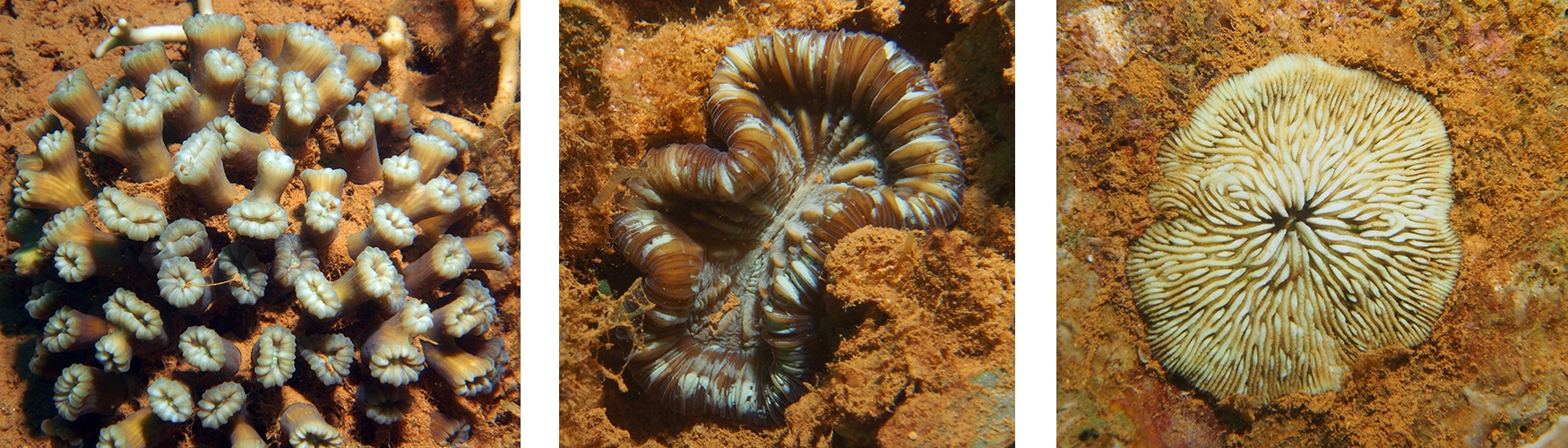
Corals of the Red Reefs: Caulastrea curvata, Trachyphyllia geoffroyi and Cantharellus jebbi.
Others formed large thickets of entangled branches, such as the bottlebrush and staghorn corals (Acropora). These types of corals are often tolerant of high levels of sedimentation, as the sediment readily falls off the coral.
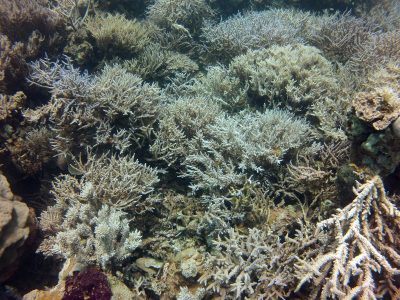
Acropora thickets
Foliaceous and plating corals were found throughout the reef, being most common in deeper areas (13-20 m). These plates are fragile and tend to grow in areas of low wave energy. Their plating morphology is also an adaptation to maximize exposure to light.
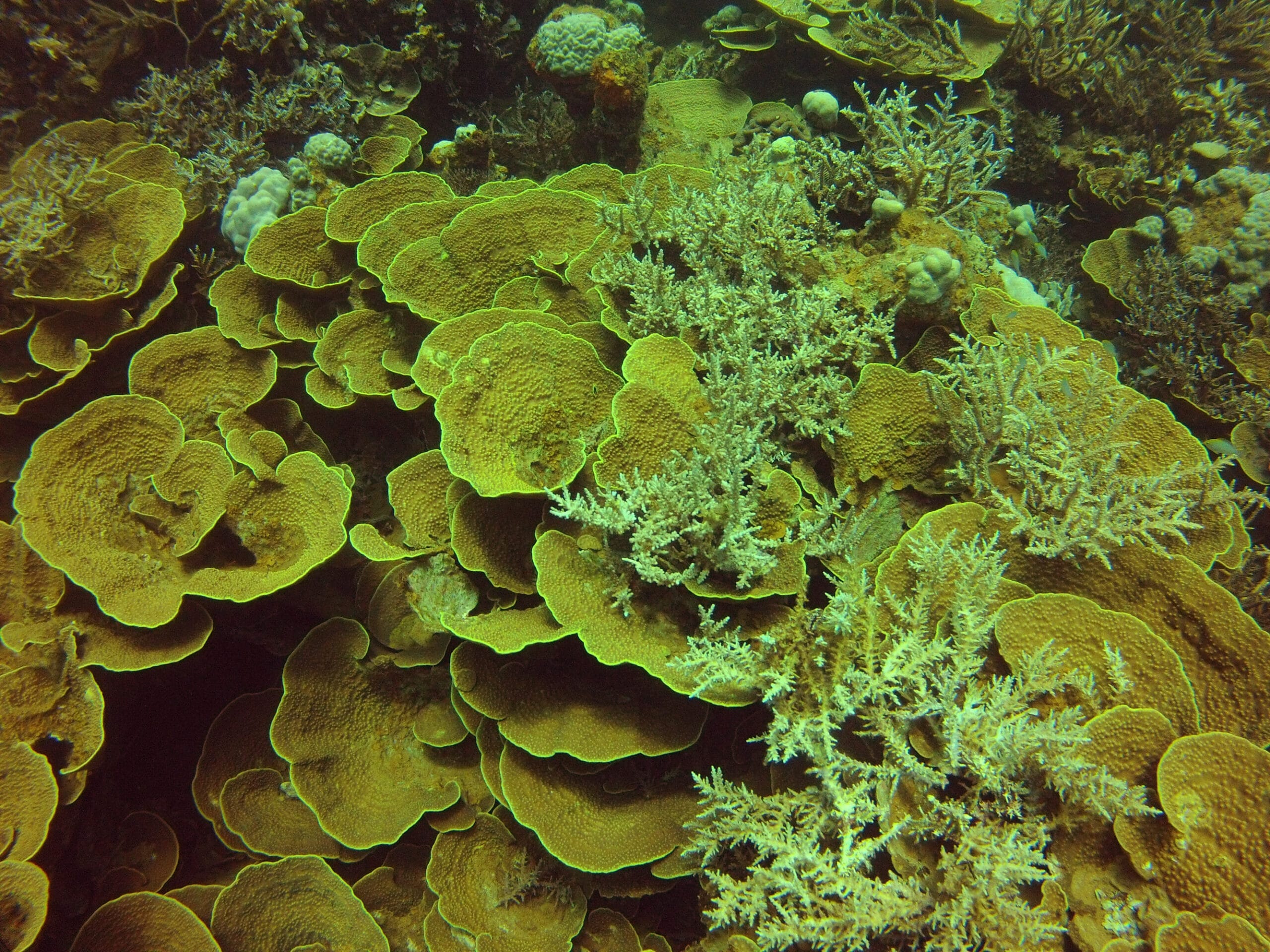
Foliaceous Turbinaria and Bottlebrush Acropora
At mid depths (8-15 m) we found the highest diversity of species and growth forms, with a mix of species that occurred in deeper water and those found in shallow water, such as elaborate branching, hemispherical mounds, tabular forms, and leaf-like plates.
Just below the water’s surface and extending to about 8 m, the community was a mix of large mounding and lobate massive corals, columnar corals and thickets of branching species.
The red reefs we visited in Prony Bay had some of the most diverse coral communities we’ve seen, and this bay is home to many other unusual habitats absent from most other locations in New Caledonia. You’ll hear more about these habitats shortly.
Photos: 1 – Ken Marks, 2-6 – Andrew Bruckner