search-icon
Ribbon Reefs

For our first three days of research, we are comparing the coral and fish community within three Ribbon Reefs.  Ribbon Reefs form a chain of 10 individual reefs beginning to the north of Cairns and stretching close to 120 km to the east of Lizard Island.  They are found from 50 -100 km offshore, along the outer edge of the Great Barrier Reef at the edge of the continental shelf.
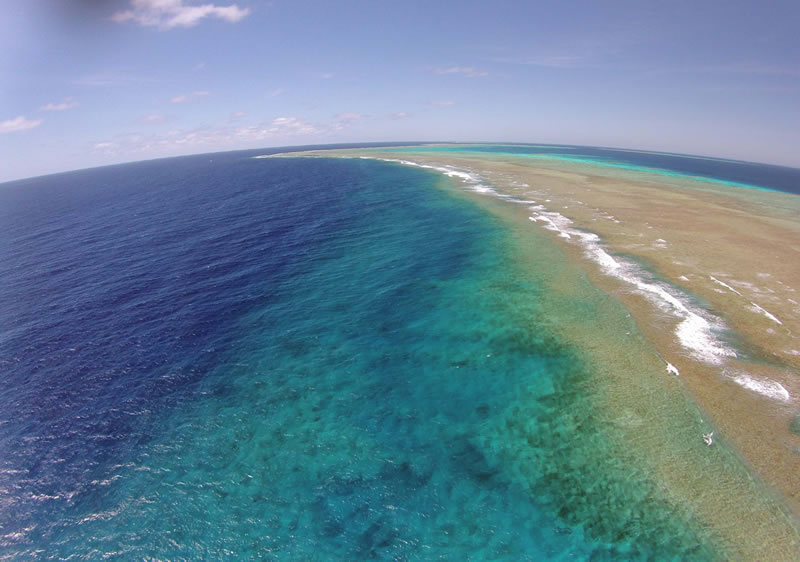
Ribbon Reef 7 of the Great Barrier Reef
Aerial view of Ribbon Reef # 7 taken using a drone.

Today’s surveys were on Ribbon Reef #7, which is located within the green (no-take) zone.  The high energy, open-ocean side of this reef had a shallow, wave-scoured reef crest, mostly bright pink with patches of turf algae and small corals, with a dense assemblage of robust, short-branched corals at its margin.
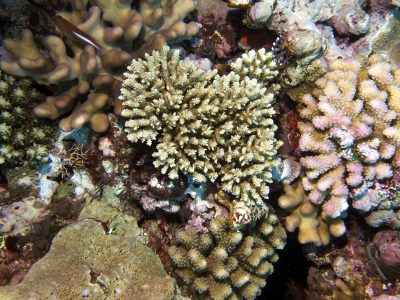
Coral Diversity of Ribbon Reef 7 of the Great Barrier Reef
A photo of the typical diversity of branching and encrusting corals found on the fore reef.

Just below this, the reef plummets, near vertically, to about 30 m depth. The benthic community here was quite diverse and variable. The shallow part of the slope had a high cover of branching, massive, columnar and plating corals in some areas, patches with unusually large soft corals, and some areas where the bottom was covered in pink crustose coralline algae and had few corals. At the base of the slope there, were extensive accumulations of rubble, evidence of past storm damage. Below 30 m the slope was more gradual and the bottom was mostly sand and scattered boulders, with few corals.
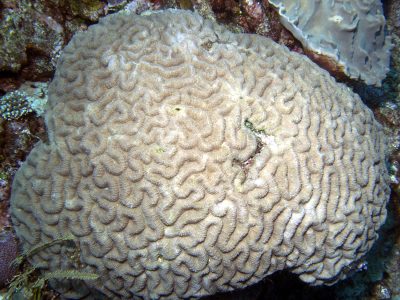
Symphyllia Coral of Ribbon Reef 7 of the Great Barrier Reef
Large Symphyllia colony found on the fore reef slope.

The leeward side was quite different, with large coral bommies extending from a sandy seafloor (15-25 m depth) to the water’s surface.  Some of the bommies were constructed of large boulder-like Porites colonies while others were carpeted in thickets of branching and bottlebrush Acroporids, soft corals, or large foliose corals.  The deeper parts of the reef supported a diverse assemblage of corals, many of which formed colonies several meters in diameter and height.
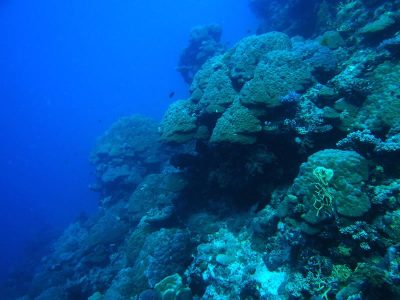
Porites Bommies on Ribbon Reef 7 of the Great Barrier Reef
A coral bommies on the leeward reef constructed of massive Porites lobata colonies.
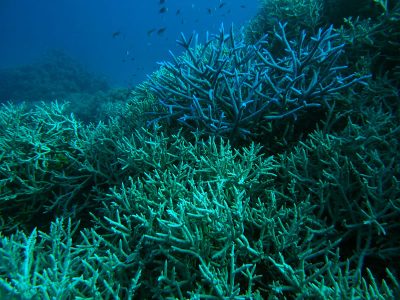
Staghorn Coral of Ribbon Reef 7 of the Great Barrier Reef

Large staghorn thickets (shown) and bottlebrush acroporids were found on some coral bommies.

Photos: 1- Will Robbins; 2,3 – Alex Dempsey; 4,5 – Andrew Bruckner
Related Posts

Introducing Our New Website: A Fresh Look for the Foundation’s Future

As we celebrate the Khaled bin Sultan Living Oceans Foundation’s 25th anniversary, we are proud to unveil our newly redesigned website—a modern home for our science, conservation work, and educational programs. This launch marks an important moment for the Foundation as we honor our long history and look toward the future of ocean conservation.

For more than two decades, the Foundation has worked tirelessly to improve the health of our living oceans. We have advanced ocean science, led one of the largest coral reef research missions in history, restored mangrove forests with local communities, created award-winning education programs, and shared the wonders of the ocean with people around the world. Our new website reflects the organization we are today—focused on conserving coral reefs, restoring mangrove forests, and improving ocean literacy—while still highlighting the legacy of work that brought us here.

The redesigned site…

Read More

Connecting People, Art, and Oceans: Championing Conservation at the 2025 IUCN Congress

The IUCN World Conservation Congress brings together thousands of leaders and decision-makers from governments, non-profit organizations, civil society, Indigenous groups, and the private sector to shape global conservation policy and action. This influential gathering serves as a platform to share knowledge, build partnerships, and advance initiatives that protect our planet’s biodiversity.

As a member of the International Union for Conservation of Nature (IUCN), the Khaled bin Sultan Living Oceans Foundation was honored to take part in the Congress, joining a global community of leaders, organizations, and changemakers committed to protecting nature and advancing sustainable futures.

Read More
Privacy Overview

This website uses cookies so that we can provide you with the best user experience possible. Cookie information is stored in your browser and performs functions such as recognising you when you return to our website and helping our team to understand which sections of the website you find most interesting and useful.  You can view our complete Privacy Policy here.

Strictly Necessary Cookies

Most of our cookies are used to improve website security and reduce spam. These cookies should be enabled at all times. They also enable us to save your preferences for cookie settings.

3rd Party Cookies

This website uses Google Analytics to collect anonymous information such as the number of visitors to the site, and the most popular pages. Keeping this cookie enabled helps us to improve our website.