search-icon
Sessile Sea Squirts

Tunicates, commonly called sea squirts include a diverse assemblage of invertebrates that are usually attached to the bottom, but also include 10 species that live in the water column.  These invertebrates share some similarities with vertebrates by having a tail, a dorsal nerve cords and notochords and pharyngeal gill cleft at some point in their life.

Most of the larger tunicates are solitary individuals, while smaller ones tend to form colonies made up of identical zooids, and some are social tunicates that tend to cluster together.  They typically have a sac-like body with two tubular openings (siphons).  They are highly efficient filter feeders, taking in the equivalent of their body size in water every second through the incurrent siphon, which is then pumped through a gill net to remove plankton and oxygen and discharged through the excurrent siphon.
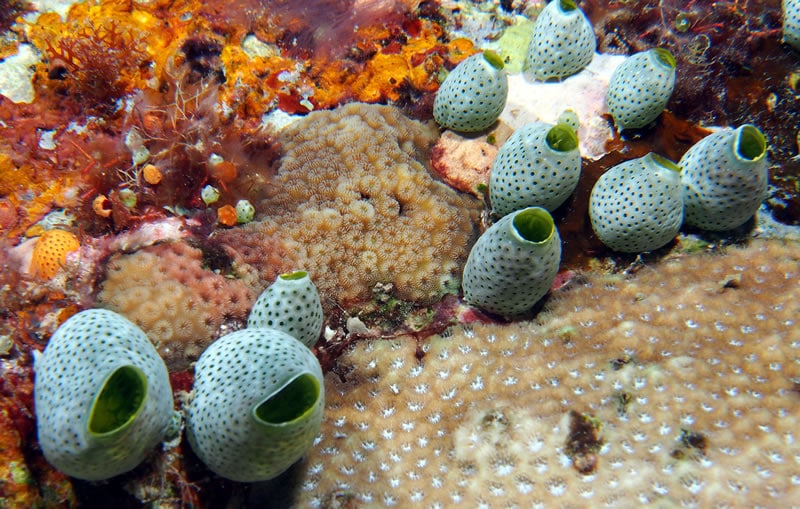
Solitary tunicate Atriolum robustum
Solitary tunicate, Atriolum robustum
(Click-thru on image for greater detail.)

Tunicates have a variety of shapes and growth forms and can be quite colorful. Their body is surrounded by a tunic which may be tough, resembling cartilage, thin and delicate, or transparent and gelatinous. The tunic is unique among invertebrates in that it contains cellulose (something found in plants), and that it can grow as the animal enlarges and does not need to be periodically shed.

On our dives, one encrusting tunicate (Lissoclinum) has been unusually common, often covering large areas of reef and growing over dead corals.  This species is greenish in color due to a symbiotic single-celled “algae” (prokaryote) called Prochloron.
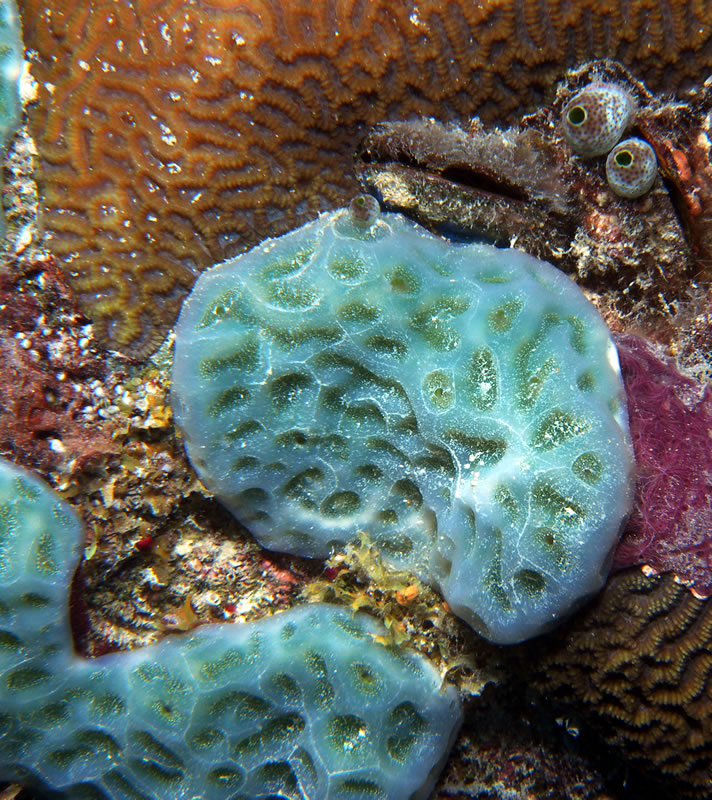
Lissoclinum patellum tunicate.
(Click-thru on image for greater detail.)

We also see a number of larger, bulbous tunicates such as Polycarpa as well as stalked tunicates (also called sea tulips) in the genus Pyura.
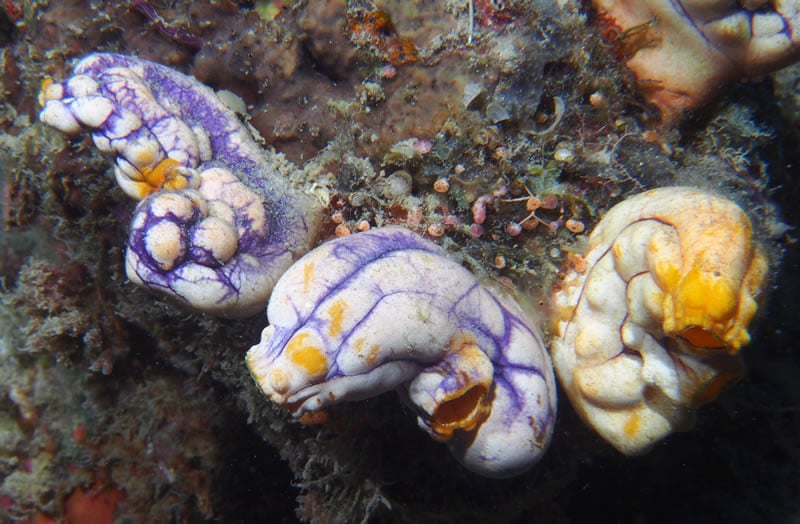
Solitary tunicate, Polycarpa aurata.
(Click-thru on image for greater detail.)
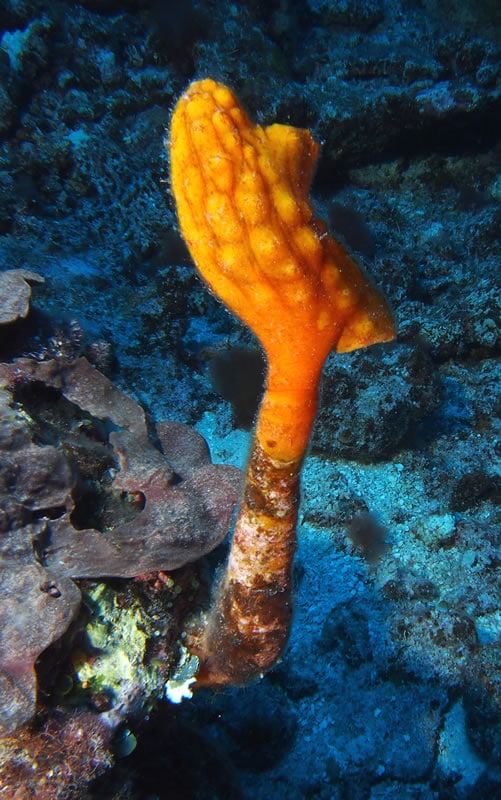
Pyura stalked sea tulips.
Pyura, stalked sea tulips.
(Click-thru on image for greater detail.)

Some of the smaller, spectacularly colored social and colonial tunicates have also been common on leeward reefs.
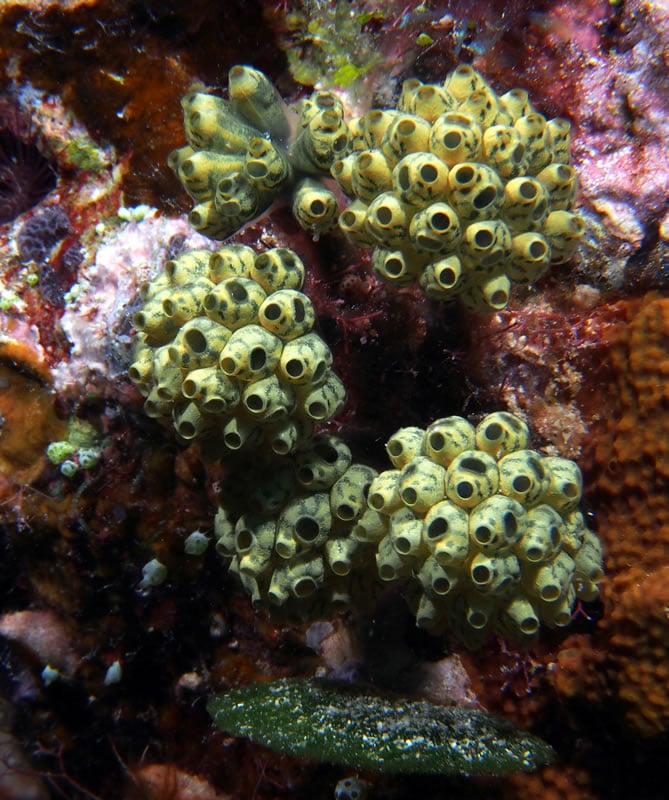
Social tunicate, Clavelina.
(Click-thru on image for greater detail.)

While tunicates are often overlooked, they are extremely important to humans.  They have few natural predators which may be due to a host of chemical compounds, several of which have been harvested for use as antiviral and cancer fighting compounds (Didemnins, Aplidine, and Trabectedin).  There is also some research into  the use of their cellulose body as a source ethanol. Some species are consumed as food, especially in Japan and Korea, where they are being cultured.

Photos by Andrew Bruckner.
Related Posts

Introducing Our New Website: A Fresh Look for the Foundation’s Future

As we celebrate the Khaled bin Sultan Living Oceans Foundation’s 25th anniversary, we are proud to unveil our newly redesigned website—a modern home for our science, conservation work, and educational programs. This launch marks an important moment for the Foundation as we honor our long history and look toward the future of ocean conservation.

For more than two decades, the Foundation has worked tirelessly to improve the health of our living oceans. We have advanced ocean science, led one of the largest coral reef research missions in history, restored mangrove forests with local communities, created award-winning education programs, and shared the wonders of the ocean with people around the world. Our new website reflects the organization we are today—focused on conserving coral reefs, restoring mangrove forests, and improving ocean literacy—while still highlighting the legacy of work that brought us here.

The redesigned site…

Read More

Connecting People, Art, and Oceans: Championing Conservation at the 2025 IUCN Congress

The IUCN World Conservation Congress brings together thousands of leaders and decision-makers from governments, non-profit organizations, civil society, Indigenous groups, and the private sector to shape global conservation policy and action. This influential gathering serves as a platform to share knowledge, build partnerships, and advance initiatives that protect our planet’s biodiversity.

As a member of the International Union for Conservation of Nature (IUCN), the Khaled bin Sultan Living Oceans Foundation was honored to take part in the Congress, joining a global community of leaders, organizations, and changemakers committed to protecting nature and advancing sustainable futures.

Read More
Privacy Overview

This website uses cookies so that we can provide you with the best user experience possible. Cookie information is stored in your browser and performs functions such as recognising you when you return to our website and helping our team to understand which sections of the website you find most interesting and useful.  You can view our complete Privacy Policy here.

Strictly Necessary Cookies

Most of our cookies are used to improve website security and reduce spam. These cookies should be enabled at all times. They also enable us to save your preferences for cookie settings.

3rd Party Cookies

This website uses Google Analytics to collect anonymous information such as the number of visitors to the site, and the most popular pages. Keeping this cookie enabled helps us to improve our website.