Our science team has embarked on our last Global Reef Expedition (GRE) mission in Oceania, and the first in the Coral Triangle. We have begun our exploration of the Solomon Islands, a Pacific Archipelago comprised of 992 mountainous islands and low-lying coral atolls located east of Papua New Guinea and northeast of Australia. With a rich cultural heritage, the 610,000 people of the Solomon Islands are of Melanesian, Polynesian and Micronesian descent. Even though English is the official language, Pijin is spoken by about half the population, along with 70 other languages.

Elementary school students from Munda community.
The bulk of the land comprises seven large volcanic islands rising up to 7,644 feet (2,330 meters) on Mount Popomanaseu on Guadacanal. They lie in two parallel chains running northwest-southeast, with a group of smaller islands to the northeast (Santa Cruz Islands) and a number of remote offshore islands, atolls and reefs. Dense rain forest covers about 90% of the mountainous islands, and these are intersected by precipitous, narrow valleys, narrow unnavigable streams and some extensive plains. Much of the 5300 km of coastline is fringed with mangrove swamps and coconut palms. Coral reefs are also widespread, covering an estimated 5,750 km2. Reef systems include narrow, steeply shelving fringing reefs, lagoonal patch reefs, atolls, barrier reef complexes and shallow platform reefs.
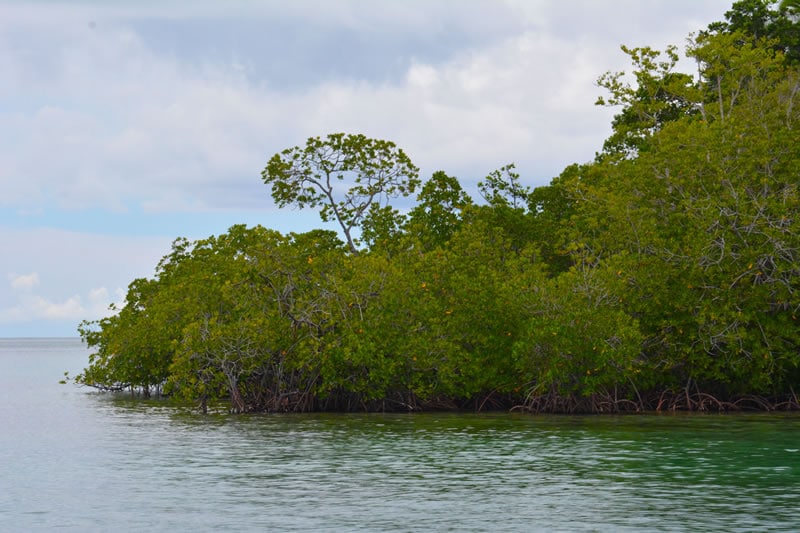
Fringing mangroves.
Our research will focus on three regions, the New Georgia Islands in the Western Province, Arnavon Islands in the Isabel Province, and Santa Cruz Islands in Temotu, the easternmost province of the Solomon Islands. During the mission we will be working with the Ministry of Fisheries and Marine resources, Catlin Seaview Survey, University of Queensland, and Oceanswatch.
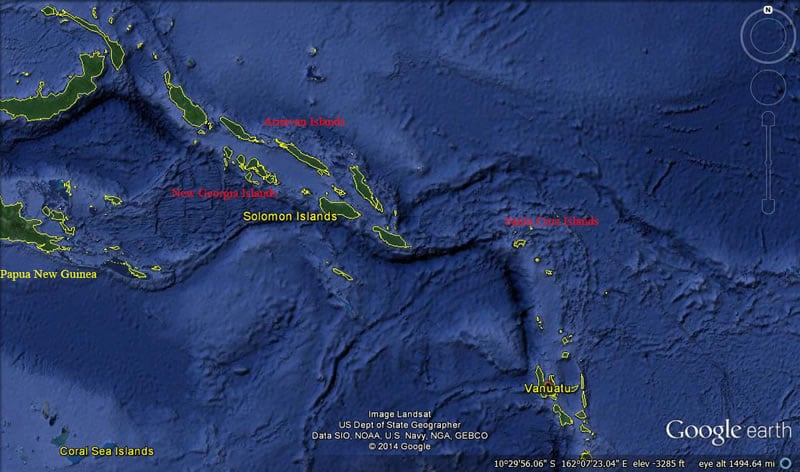
Solomon Islands Study Sites
(Click-thru on map for enlarged detail.)
Much of the New Georgia Islands are mountainous and covered in rainforest, surrounded by fringing coral reefs. Our main focus in this region is Marovo Lagoon, the largest salt water lagoon in the world.
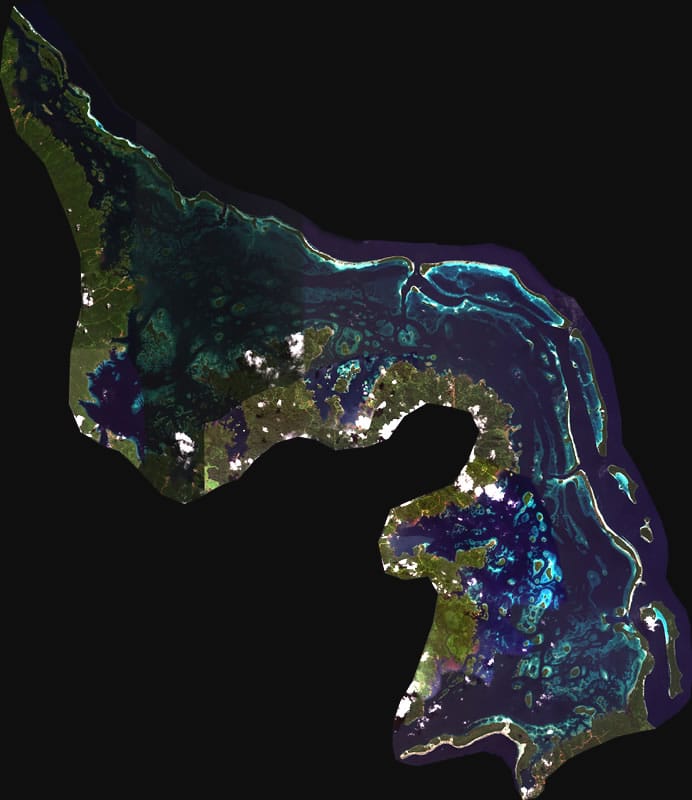
Imagery of Marovo Lagoon, the largest salt water lagoon in the world.
In Isabel Province, we will survey Arnavon Marine Conservation Area, which encompasses 157 square km between Santa Isabel and Chioseul islands in the Manning Straights. The Conservation Area is nearly 20 years old and was the first community-managed marine conservation area in the Solomon Islands.
We will conclude with two weeks in Temotu Province, where we will examine the reefs surrounding Utupua, Vanikolo, Tinakula and Reef Islands.
Photos: 1, 2 Amy Heemsoth; 3,4 Living Oceans Foundation
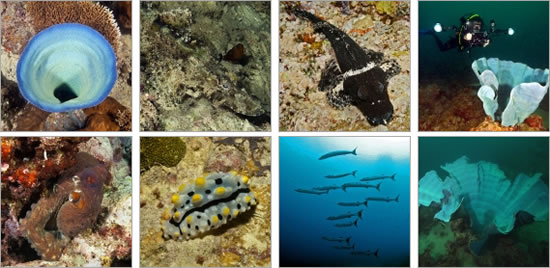
Follow the amazing sights and creatures we encounter as we update our Solomon Islands Photo Album through out the mission…