
search-icon
Palau’s Iconic Rock Islands

Expedition Log: Palau – Day 1

We’ve embarked on our next research mission of the Global reef Expedition to Palau, a Freely Associated State with strong ties to the United States.  Palau is is in the western Pacific, fairly close to southern Philippines (740 km) and southwest of Guam (1300 km), forming the westernmost archipelago in Oceania.  It is made up of 12 inhabited islands and some 700 islets which are a combination of volcanic islands, atolls, raised limestone islands and low-lying coral islands.  The main island cluster is surrounded by a barrier reef, with a double barrier system in the east, numerous fringing reefs, submerged bank reefs, patch reefs and several offshore atolls.  In many places the barrier reef forms a steep wall, dropping vertically or near vertically more than 8000 meters into the Palau trench.

One of Palau’s iconic formations are the Rock Islands, which are so special they are on UNESCO’s World Heritage List. These small islands are rugged, densely vegetated high limestone islands. These are formed from the skeletons of corals, spicules of soft corals, calcareous algae, mollusk and urchin shells, foraminiferans and other calcifying organisms.  Many of these were former reef fronts that grew extensively while submerged and then were uplifted and sculpted by erosion over hundreds of thousands of years.  They often have vertical steep cliffs of up to 30 m in height and some reach elevations of about 200 m.  One unique characteristic of these is the undercut base (a “solution notch”) that extends into the rock 1-2 m, formed over the last several thousand years by a combination of dissolution and bioerosion during a period of very stable sea level.
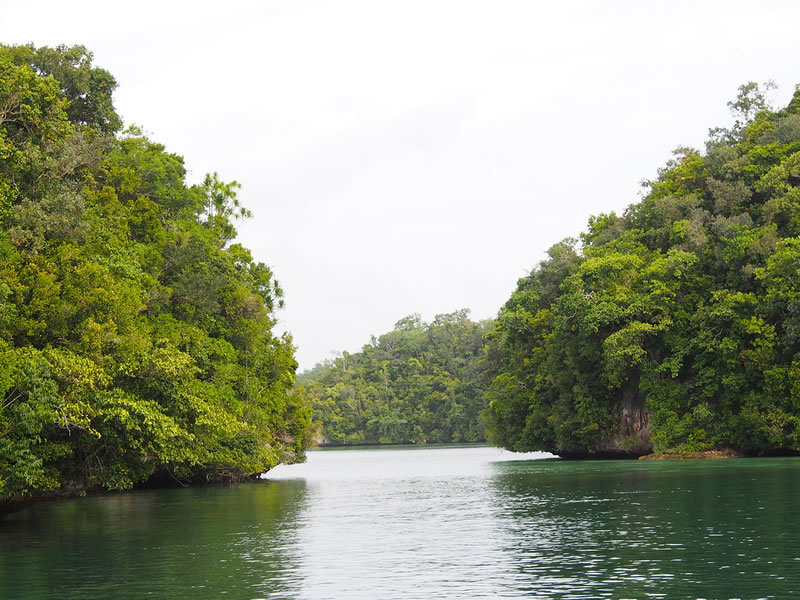
Narrow pass to dive site at Nikko Bay, Palau
Heading through the narrow pass to our dive site in Nikko Bay
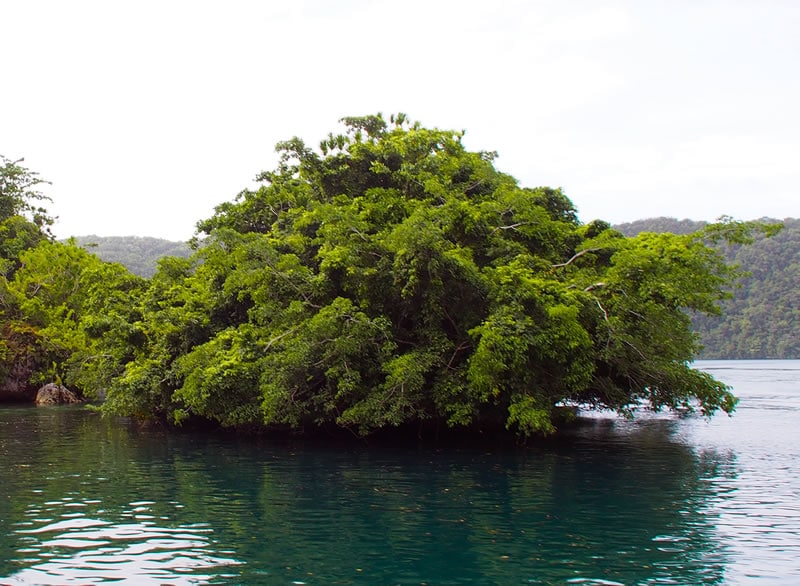
Small densely vegetated limestone islet at Nikko Bay, Palau
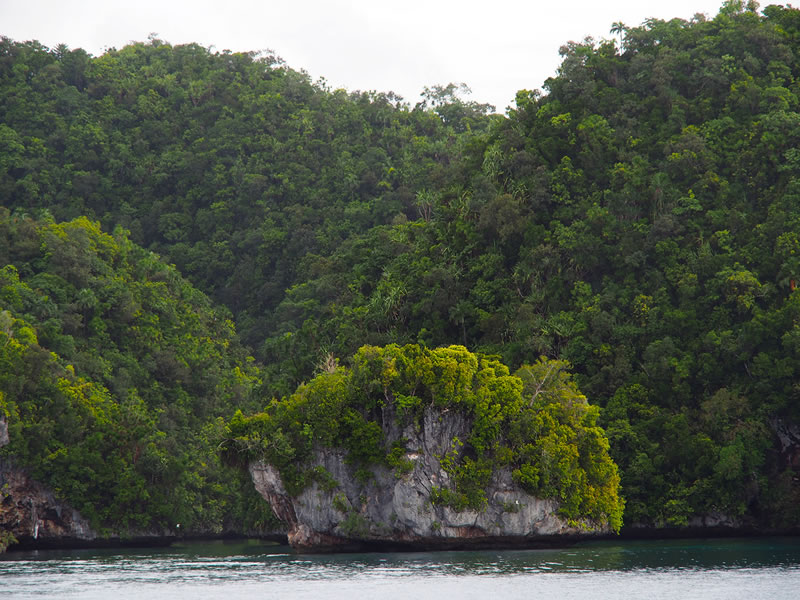
Small densely vegetated limestone islet

Inside Nikko Bay in the Airai Complex of Rock Islands, Palau
Inside Nikko Bay in the Airai Complex of Rock Islands

We start our surveys around the Airai Complex of Rock Islands located behind the sheltered barrier reef.  These are some of the most eroded of the Rock Islands and are quite sheltered, with fairly turbid water that supports a unique coral reef community.
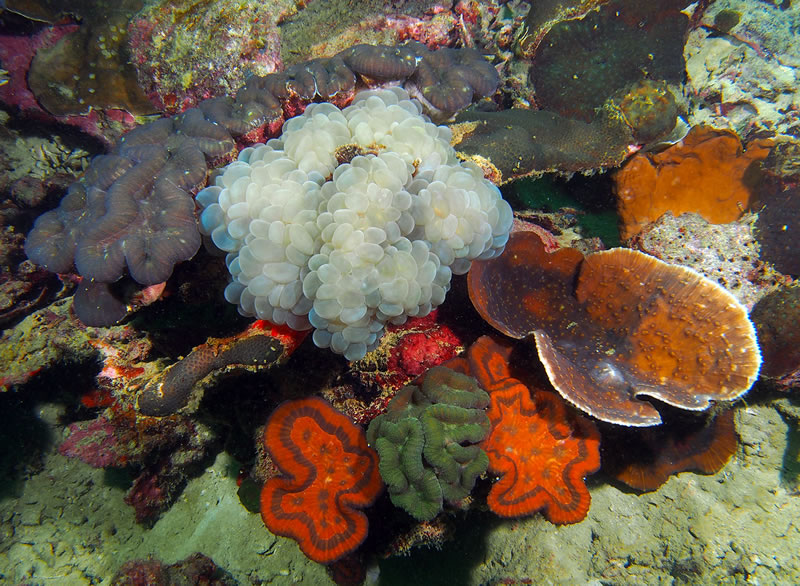
Colorful, sediment tolerant corals such as bubble coral (Plerogyra), lobe coral (Lobophyllia), chalice coral (Echinopora) and lobed brain coral (Symphyllia), Nikko Bay, Airai Complex, Rock Islands, Palau
Fringing reef within the bay had a high diversity of colorful, sediment tolerant corals such as bubble coral (Plerogyra), lobe coral (Lobophyllia), chalice coral (Echinopora) and lobed brain coral (Symphyllia)
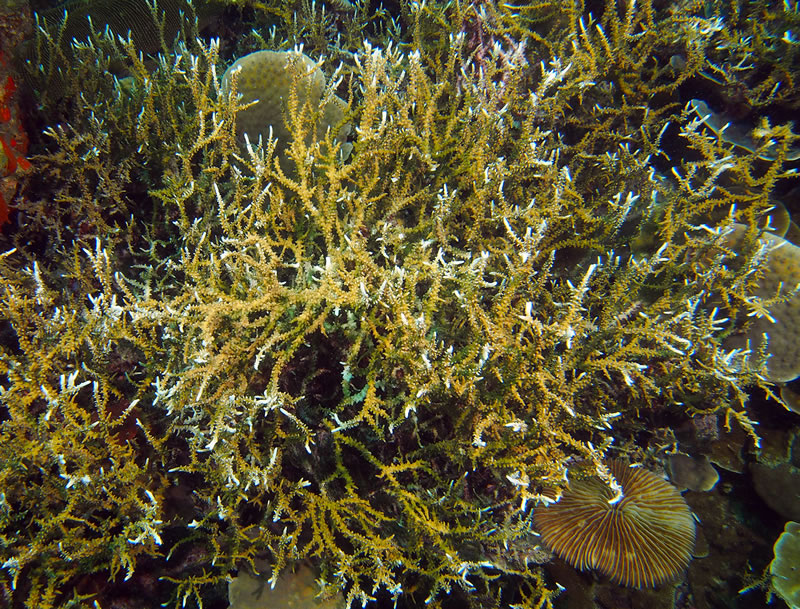
Fragile branching corals, Airai Complex, Rock Islands, Palau
The calm protected waters supported fragile branching corals such as Anacropora.
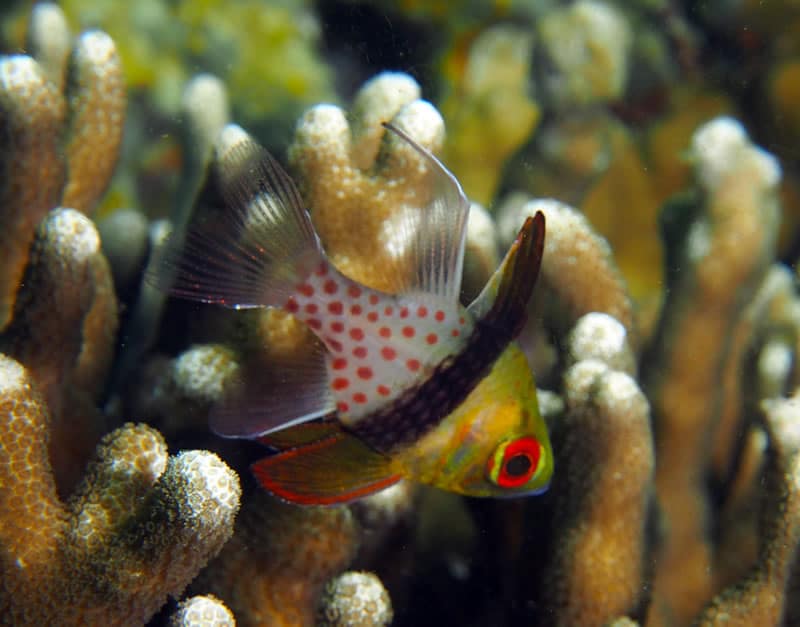
Cardinalfish, Sphaeramia nematoptera, Nikko Bay, Airai Complex, Rock Islands, Palau
While few large fish were seen many smaller reef fish such as the pajama cardinal fish (Sphaeramia nematoptera)

Related Posts

From Students to Stewards: A Full-Circle Moment for J.A.M.I.N.

There are certain faces you never forget.

Over the years, hundreds of students have stepped into mangrove forests with us through the Jamaica Awareness of Mangroves in Nature (J.A.M.I.N.) program. I may not always remember every name, but I remember the expressions — the hesitation before stepping into thick mud, the laughter when someone loses a shoe, the look of surprise when they catch that unmistakable sulfur smell rising from the mangrove soil…

Read More

World Oceans Day: Protecting the Ecosystems That Protect Us

This World Oceans Day, the global community is being challenged to think differently about the ocean.

The 2026 World Oceans Day theme, “Reimagine: Beyond the World We Know, A New Relationship With Our Ocean,” invites us to recognize that the ocean is not something distant or separate from our lives. It regulates our climate, supports our economies, provides food for billions of people, and sustains the natural systems that make life on Earth possible.

Few places illustrate this connection more clearly than the coastal ecosystems that protect our shores and support marine life. While coral reefs, mangrove forests, and seagrass meadows are often…

Read More
Privacy Overview

This website uses cookies so that we can provide you with the best user experience possible. Cookie information is stored in your browser and performs functions such as recognising you when you return to our website and helping our team to understand which sections of the website you find most interesting and useful.  You can view our complete Privacy Policy here.

Strictly Necessary Cookies

Most of our cookies are used to improve website security and reduce spam. These cookies should be enabled at all times. They also enable us to save your preferences for cookie settings.

3rd Party Cookies

This website uses Google Analytics to collect anonymous information such as the number of visitors to the site, and the most popular pages. Keeping this cookie enabled helps us to improve our website.