Expedition Log: BIOT – Day 21
Working at sea aboard the M/Y Golden Shadow, my day starts at 6:00am with a strong cup of coffee. The sun is just rising, and so is the rest of the dive team.
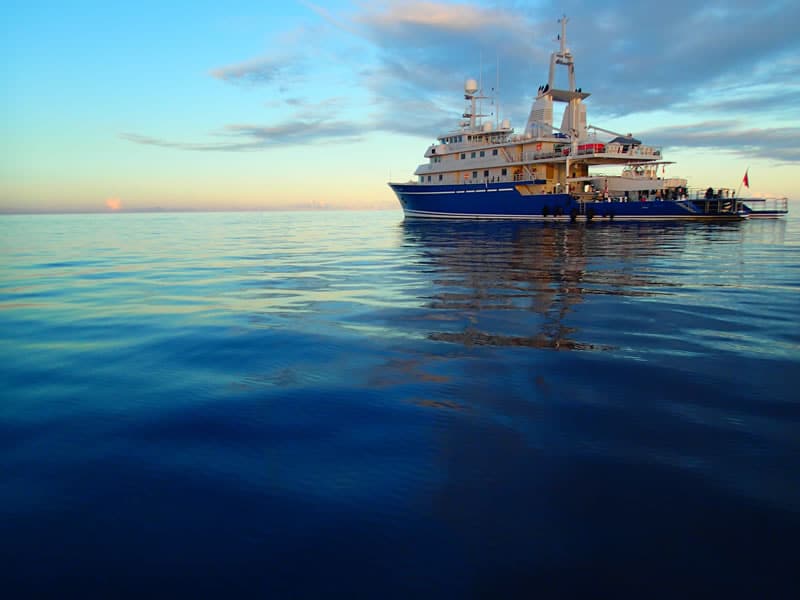
The M/Y Golden Shadow at sunrise.
I am a coral reef ecologist for Khaled bin Sultan Living Oceans Foundation and I am part of the research team surveying the British Indian Ocean Territory (BIOT). There are several things I need to do before we head out for the first dive of the day. Top of my list is to go down to the dive locker to check the air in my scuba tanks. My tanks are filled with an enriched air mix called ‘nitrox’. We use this special air mixture instead of just pure oxygen because it reduces the percentage of nitrogen that the body uptakes and means we can possibly stay underwater longer. I check the percentage of the gases in the tanks and calculate how long our maximum bottom time can be.
I check my camera equipment and dive gear to make sure it is in good working order before we head out for the first two dives of the day. We always hope for a quick, calm transit to the dive site, and today does not disappoint. The waters in BIOT are flat and calm, and it’s a beautiful 30 min ride on our dive boat, the Calcutta, to the dive site.
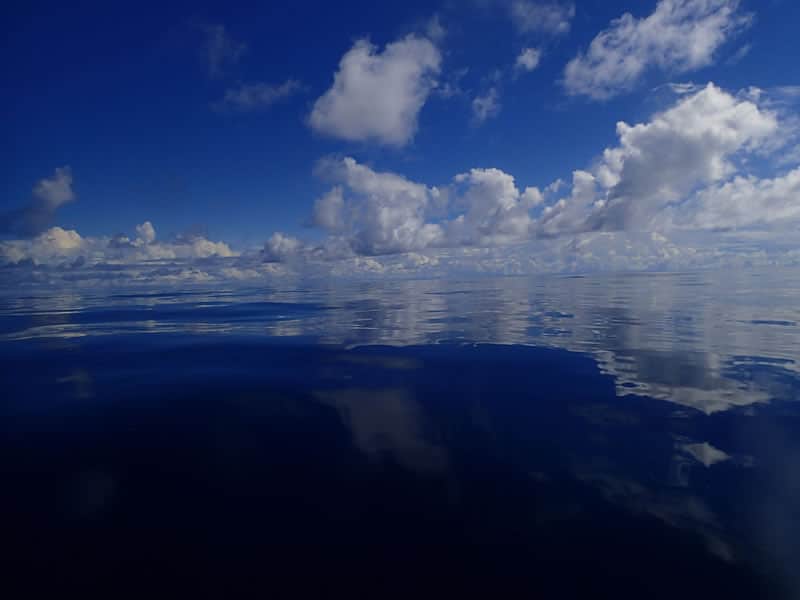
Calm seas in BIOT as we head out to our dive site.
My dive buddy is Dr. Andy Bruckner, the Chief Scientist of the Khaled bin Sultan Living Oceans Foundation. We do the deep dives. Before rolling over the side of the boat, Andy deploys a piece of equipment called a castaway CTD, which collects real time data of the salinity and temperature profiles at the dive site.
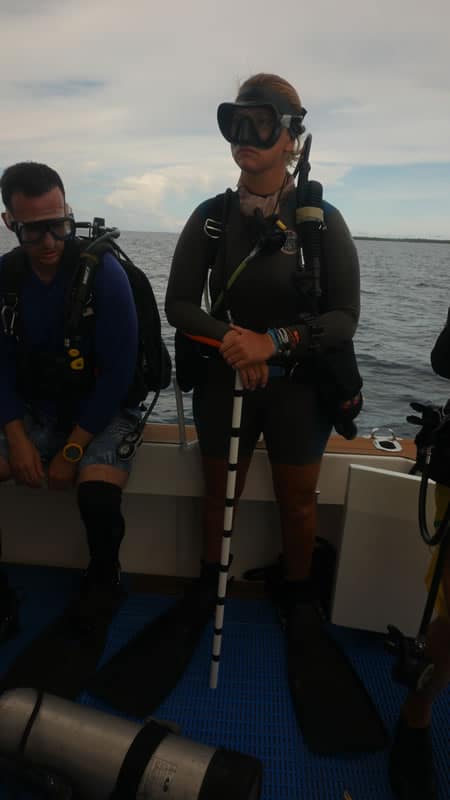
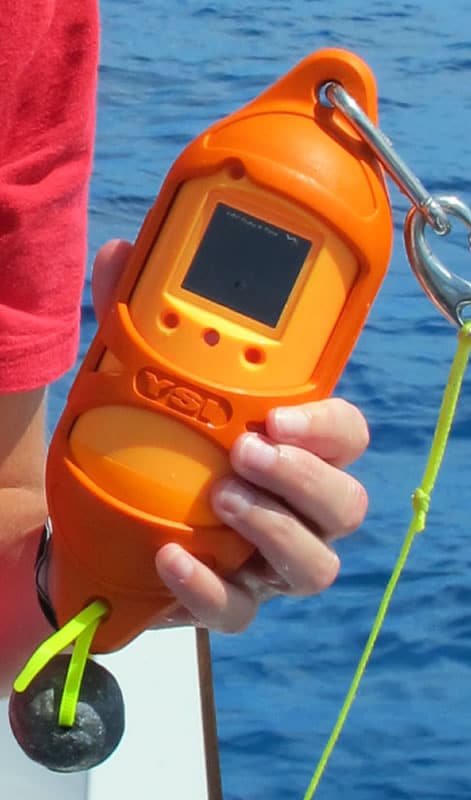
I prepare for our dive as Andy throws in a cast away CTD instrument used to collect real time data of ocean depth profiles.
Once we enter the water we look at the reef slope and see how far down the coral community extends. Today, we head down to 30m (98 feet below the sea surface) and are soon joined by several reef sharks who come to check us out.
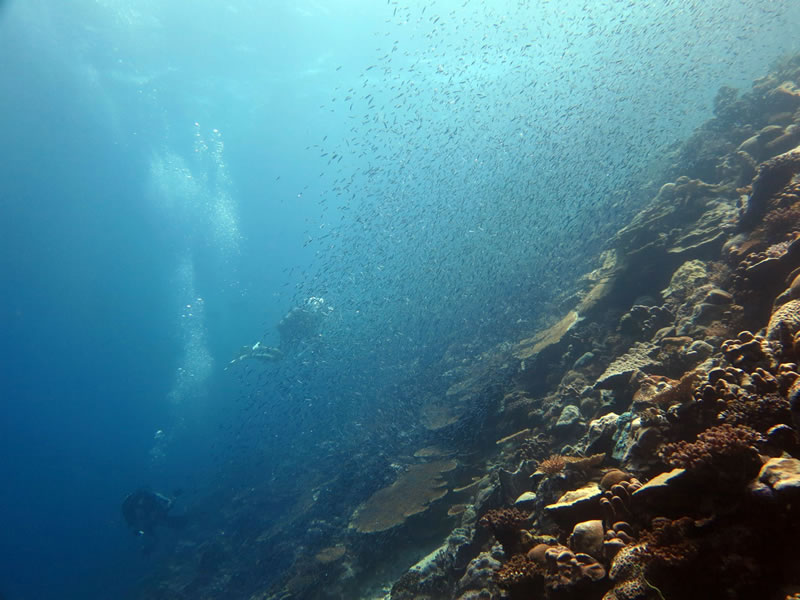
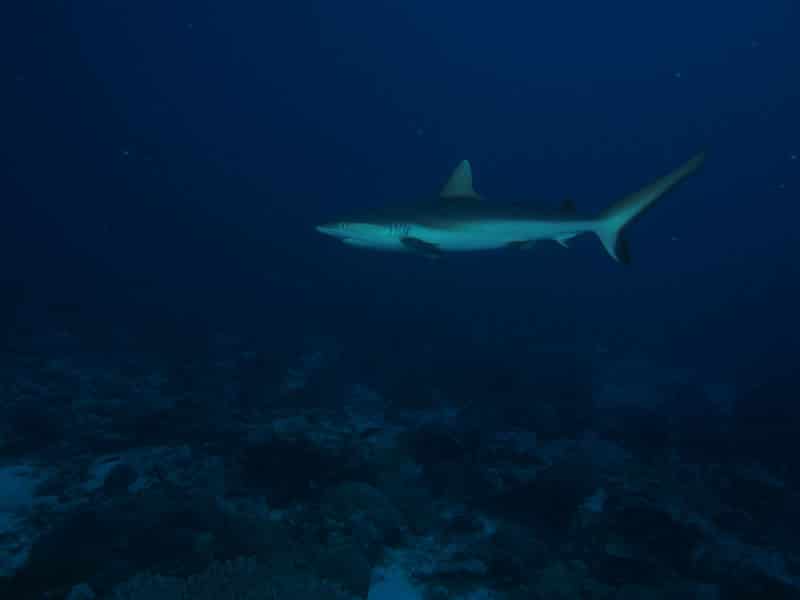
Andy and I head down to the deep reef to see how deep the coral community goes. A reef shark greets us at 30m below.
Andy and I work up the reef slope from deep to shallow depths running several photo transects of the different coral reef communities. The photo transect is a critical research tool as it allows me to collect detailed data in a proficient and productive way as I only have so much time at each depth. We typically try to conduct 2 surveys at 30m, 25m, 20m, 15m, and 10m. I start my first photo transect of the dive and quickly write down initial observations of coral health, species composition, and any other interesting findings.
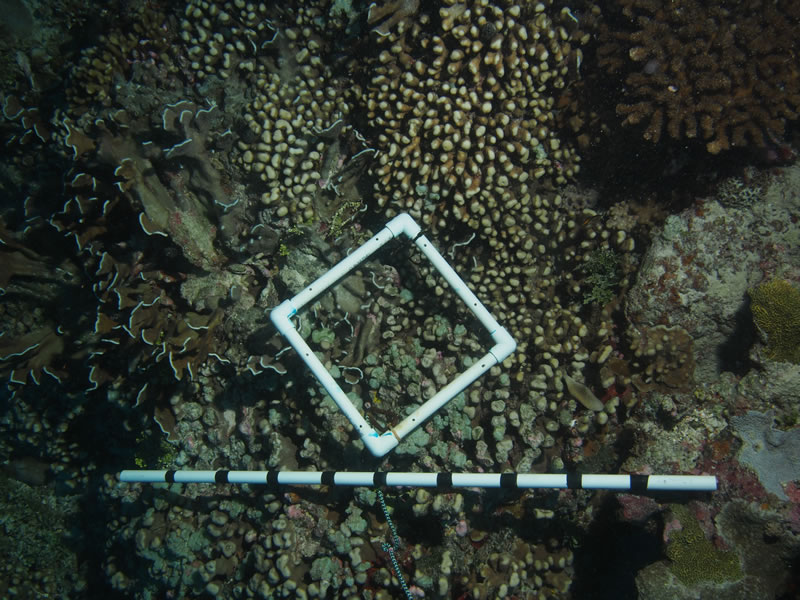
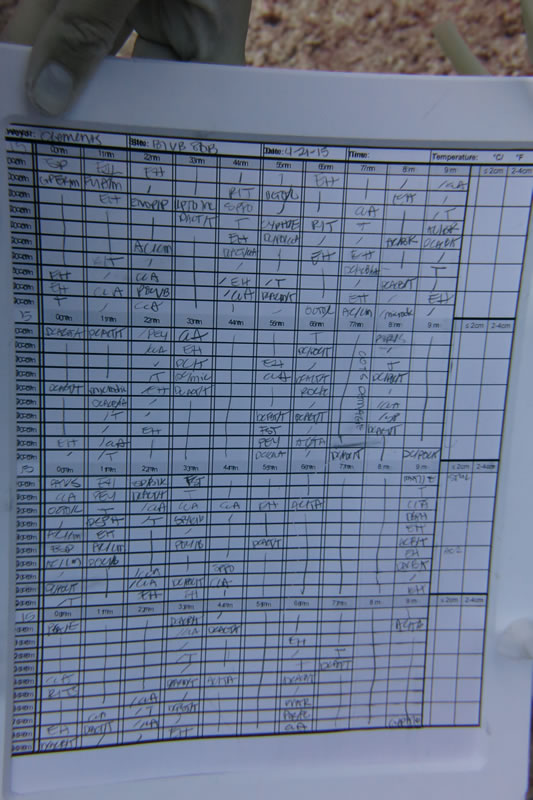
Example of a picture from a photo transect, and my notes on what I see.
After I’ve been down for 60 minutes my dive computer beeps to tell me it’s time to come up. I start to ascend to about 5 meters depth where I do a diving safety stop for 3 minutes. Often this is the time when I see some of the bigger charismatic creatures. Almost on cue, a large school of barracuda cruises past and we snap some close up pictures.
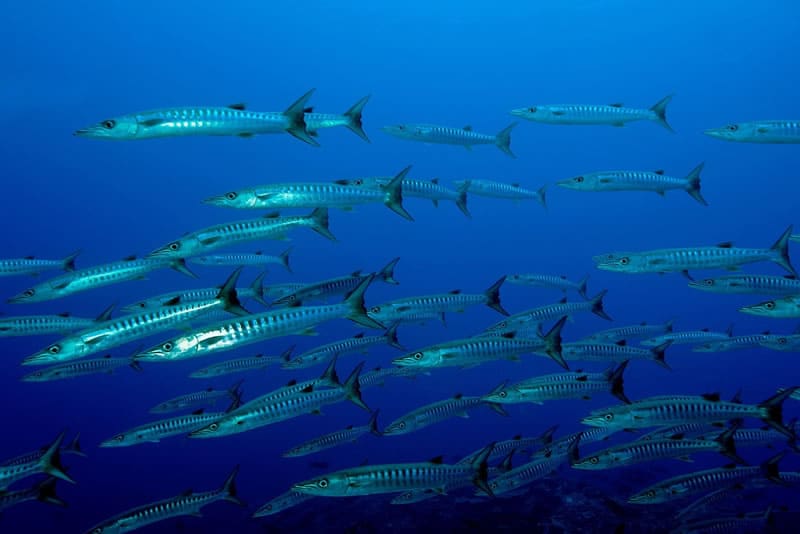
School of barracudas come up close and personal at our safety stop.
The first dive has gone well and we have two more to do before the day is over. A pod of dolphins joins us as we make our way to the next dive site. The scientists keep to a full schedule of three dives a day, every day. Once the third dive is completed, and the sun is beginning to set, we head back to the Shadow – but not to rest.
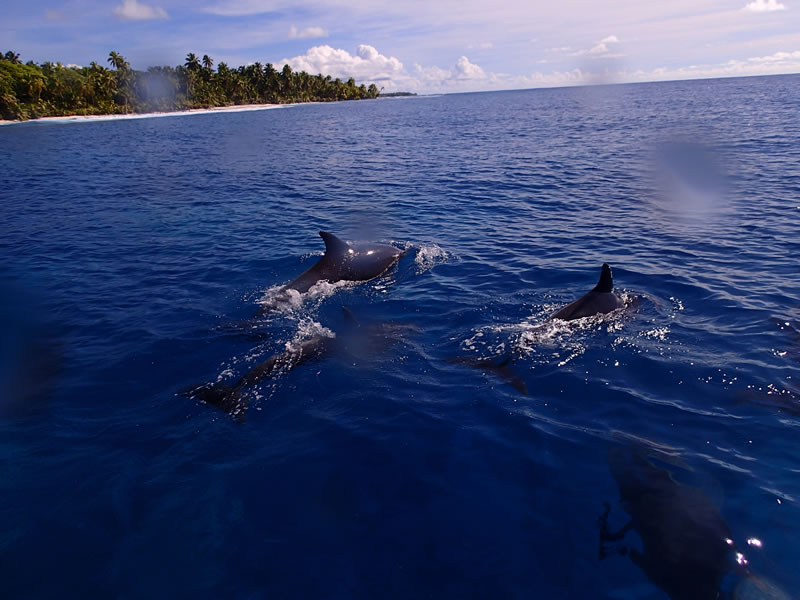
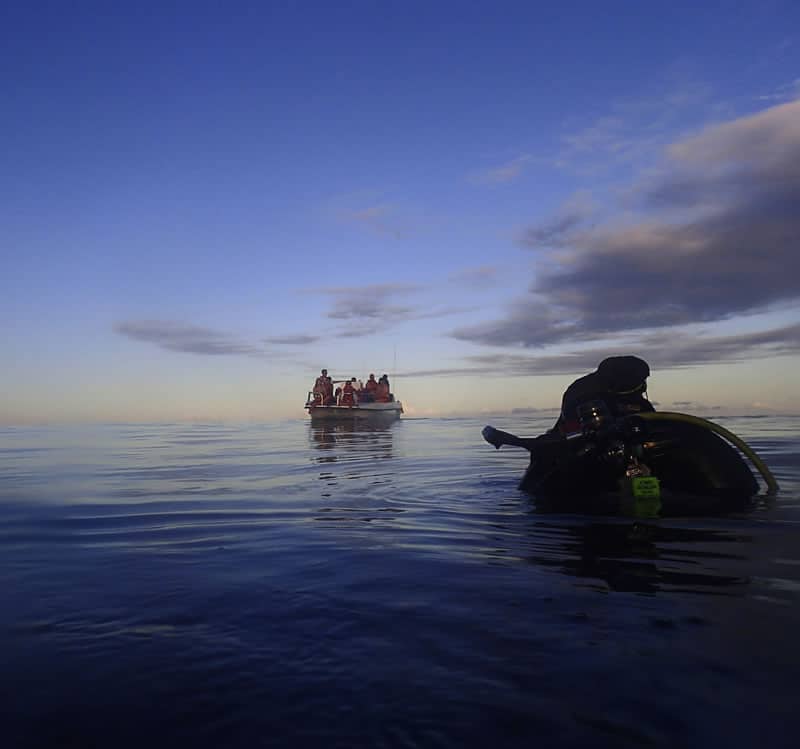
A pod of dolphins joins us as we head to our next dive site of the day. I surface from our last dive of the day, and spot the rest of the dive team waiting for me.
Back at the M/Y Golden Shadow, we haul our tanks down to be refilled ready for tomorrow’s dives, and then we spend the remainder of the evening downloading photos and entering the data we gathered from the reef.
It is tiring and arduous working in the field, but I love every minute of it. Few people have the opportunity to dive where I dove today, or to dive on the many different types of reefs I’ve surveyed during the Global Reef Expedition. Most importantly, we are collecting baseline data for some of the most remote reefs in the world. It is really rewarding to know that the work I do is making a difference for coral reef conservation.
Photos: 1 Lauren Valentino, 2,10 Steve Saul, 3-4 Liz Smith, 5-6 Andy Bruckner, 7-8 Alex Dempsey, 9 Ken Marks, 11 Anderson Mayfield