
search-icon
Above the Waterline (Al Lith)

Today we continued exploring the reefs in the northern portion of the Farasan Banks and several team members surveyed the mountainous Abu Latt (Al Lith Island) Island. The islands sandy beaches are important hawksbill nesting grounds, with twelve tracks observed in one area.
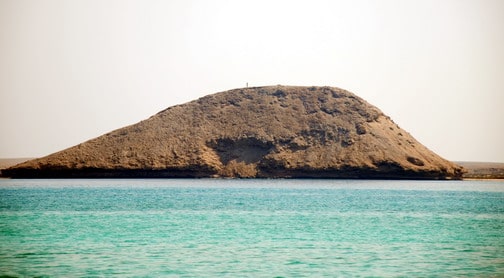
Al Lith Island
The highest point on Al Lith Island, known locally as Jabal Al Lith

The uplifted limestone terraces that make up much of the island were laden with fossil corals, mollusks and other organisms derived from a relict pliocene-pleistocene carbonate platform, which grew on ancient salt deposits.
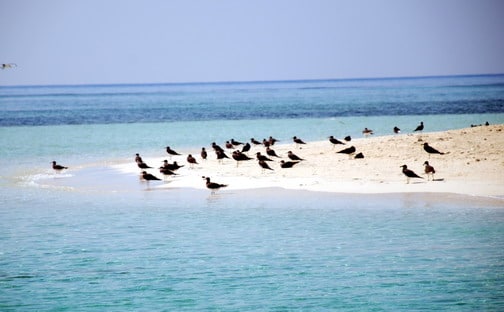
White-eyed gulls on the beach.

The island has a rich and diverse bird life on the island, including several endangered and threatened or near threatened species. Highlights included the endemic Red Sea white–eyed gull (Larus leucophthalmus, classified as Near Threatened on the IUCN Red List 2004), boobies, and osprey. One of the most interesting birds, Eleonora’s falcon (Falco eleonorae) is an endangered species found in Europe, most commonly in Greece, with small populations wintering in the Red Sea and Indian Ocean, especially around Madagascar. It breeds in late July, primarily on unpopulated islands in the Mediterranean, the young hatch in August, followed by a migration south, with the birds hunting insects (especially migratory butterflies) around islands and over the sea.
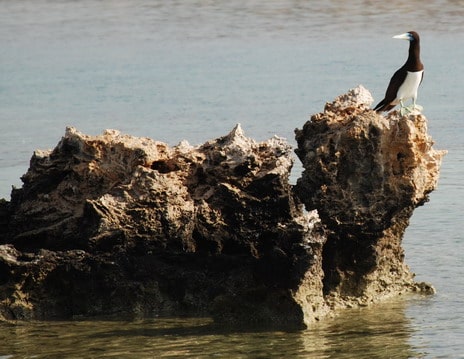
A common seabird of the Farasan Banks, a booby.

As mentioned yesterday, Al Lith is an important urban center with a population of about 150,000. The coastal town was once an important port and is now the gateway to the Farasan Banks. The town is formed around a large number of dry (intermittent and ephemeral) river beds known locally as “Wadis”. These have a long-standing history in supplying Al Lith with water for domestic use and irrigation, but this only occurs during times of heavy rain Much of the freshwater originates in the Sarawat Mountains, a long mountain chain that runs for hundreds of miles parallel to the west coast, inland from the coastal plain.

 

Related Posts

Announcing the 15th Annual Science Without Borders® Challenge: Navigate with Care

Every day, fishing boats, ferries, sailboats, kayaks, research vessels, cargo ships, whales, sea turtles, dolphins, seabirds, and countless other marine animals share the same waters. While people rely on the ocean for transportation, recreation, research, fishing, and exploration, it is also home to some of the most diverse and important ecosystems on Earth.

That simple but powerful idea is the inspiration behind the 15th Annual Science Without Borders® Challenge.

Read More

2025-2026 B.A.M. Student Voices

Throughout the Bahamas Awareness of Mangroves (B.A.M.) and Jamaica Awareness of Mangroves in Nature (J.A.M.I.N.) programs, we evaluate each phase of the mangrove education and restoration process to better understand how students are learning, growing, and connecting with their coastal environments.

Before the programs begin, students share what they already know about mangroves and how they feel about them. As the program progresses, we continue to gather feedback to see how their knowledge evolves from identifying mangrove species and understanding food webs to recognizing the role mangroves play in coastal protection and climate change mitigation.

But the surveys go beyond science content.

We also ask students…

Read More
Privacy Overview

This website uses cookies so that we can provide you with the best user experience possible. Cookie information is stored in your browser and performs functions such as recognising you when you return to our website and helping our team to understand which sections of the website you find most interesting and useful.  You can view our complete Privacy Policy here.

Strictly Necessary Cookies

Most of our cookies are used to improve website security and reduce spam. These cookies should be enabled at all times. They also enable us to save your preferences for cookie settings.

3rd Party Cookies

This website uses Google Analytics to collect anonymous information such as the number of visitors to the site, and the most popular pages. Keeping this cookie enabled helps us to improve our website.