Our fifth day of research was an epic day. Once again, we had blue skies, calm seas and clear water. One of the local experts warned us of strong winds and a change in conditions, but so far the seas have been like glass. The Golden Shadow relocated to a third anchorage, deep into the Farasan Banks. As the Golden Shadow picked up anchorage, the second officer Andy spotted a massive whale shark which gracefully and slowly swam under the vessel, just below the water’s surface Captain Nick carefully navigated around several treacherous shoals and small patch reefs that don’t quite break the surface, and fortunately the sun was at the right angle.
Heading south at about 15 knots, the Shadow approached what first looked like an unmarked reef off the port side. When it moved, turning abruptly towards the vessel, the Captain realized it was another whale shark – this one at estimated to be 5-6 m long. The whale shark narrowly missed the bow of the Shadow, as it dove to the depths. Interestingly, the whale shark is the largest living fish, yet this pelagic animal is a filter feeder that prefers zooplankton, crustaceans, fish and squid. They may be particularly fond of the Farasan Banks because of the deepwater channels that separate the shoals and patch reefs, especially in areas of upwelling.
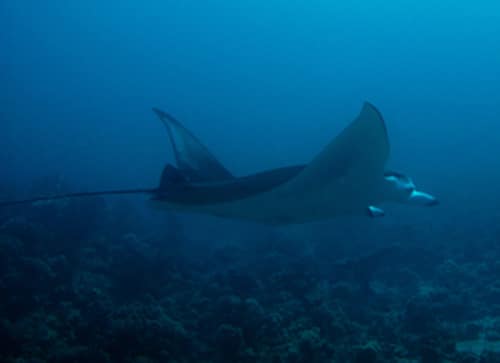
Manta Ray
We found a protected anchorage between several patch reefs, roughly ten miles due south of our second anchorage, with help of local Saudi Arabian charts delivered to us by the Saudi Arabian coast guard only yesterday. From here, we can explore many of the outer sites – wall dives that plummet from just below the surface, near vertically to 500-600 m, known for large pelagic sharks, turles and other charismatic megafuana.
While we have yet to see a whale shark under water, several of us were fortunate to see a manta ray (Manta birostris) pass over our survey area, headed for the drop off. Manta rays are cartilaginous fish in the same family as the eagle ray, but they a much larger pelagic species typically found in tropical areas. They feed mostly at night on plankton and fish larvae which are captured by their gills as they passively filter seawater. They are usually very curious of divers, and are probably pretty smart, as they have the largest brain to body ratio of the sharks and rays.
Speaking of sharks, on our third dive today we were visited by a silky shark (Carcharhinus falciformis) , who carefully checked out Ameer, our fish expert, before swimming along the wall to give all of us a good look. Silky sharks are quite common in the Red Sea, and are also found in most other tropical ocean basins, often occurring over deepwater reefs and near insular slopes. For our research team, this shark was the highlight of this dive, but to others it can be a terrifying experience – many sharks are highly territorial, ferocious and unpredictable, and they may become quite aggressive when antagonized.
Classic films, such as the 1970s movie Jaws as well as reports of shark attacks on surfers and swimmers have given these majestic creatures a bad name.
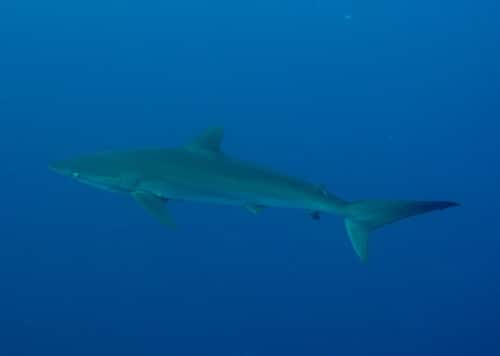
Silky Shark
Populations of most species have declined worldwide and many species are listed as threatened. Unfortunately, the silky shark (and other sharks) it is often caught in large numbers as bycatch in oceanic fisheries and it is landed for its meat and fins. Yet these species are of critical importance as top predators at the pinnacle of the marine food chain. With any luck, we will see some of the other shark species over the duration of our expedition.