Mangrove Education and Restoration Program Blog
Today, it’s absolutely beautiful weather in Abaco, Bahamas. It’s sunny outside and there is a gentle breeze wrestling the branches of the mangrove trees. Along the waterline of the mangroves, groups of students from Forest Heights Academy are setting up 5-meter x 5-meter square plots. The mangroves are so dense in some areas that students have to climb on the strong mangrove trees to create the plots. (Don’t worry, no mangroves or students were harmed during this activity.) Students place PVC pipes into the four corners of their plot and then using a GPS device, they record the geographic coordinates of each corner.
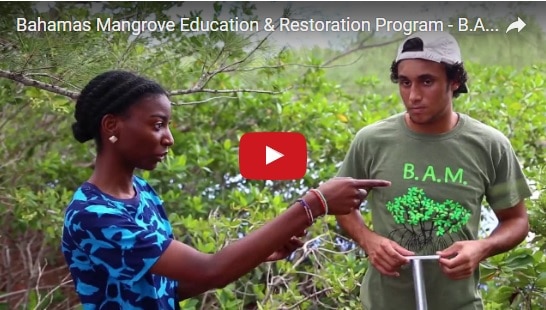
What I have just briefly described is our second year Mangrove Education and Restoration pilot program. Throughout this school year, we are implementing a second year program as part of the B.A.M. and J.A.M.I.N. programs. During the first year of the program, grade 10 Biology students learn about and restore mangroves through project-based learning. In this second year program, we will work with grade 11 Biology students who participated in the first year program to monitor and manage mangroves, again through project-based learning. Students will apply the knowledge that they learned in the previous year to understand how to manage this important ecosystem.
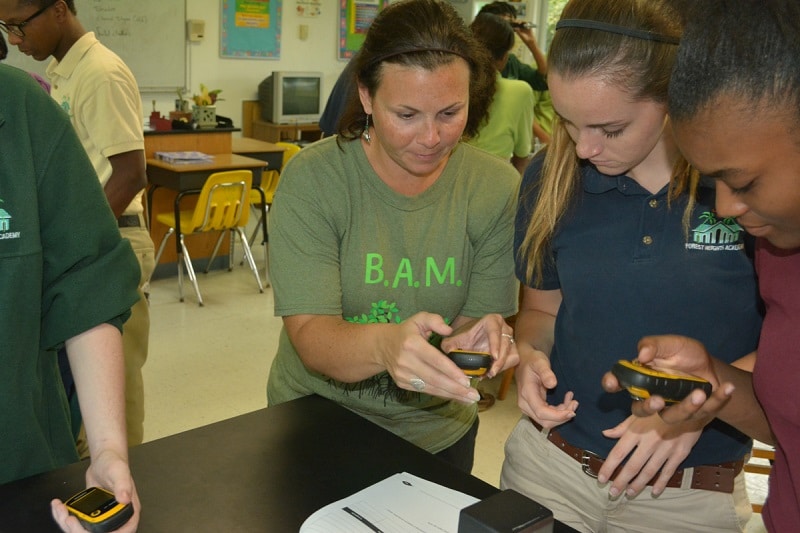
Prior to the field trip, Amy Heemsoth, Director of Education teaches students how to use a GPS device.
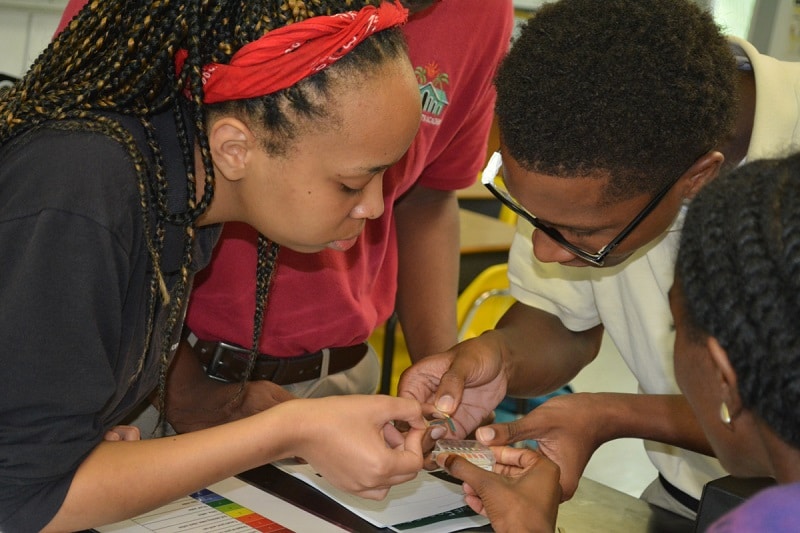
Forest Heights Academy students practice testing the pH of various liquids before going into the field.
Through a hands-on outdoor education experience, students in the year two program will learn how monitoring mangroves and restoring them is part of managing this ecosystem. Students will monitor mangroves using some of the same techniques scientists use when managing mangroves. The program will be implemented in three different installments. In the first installment, students will set-up mangrove plots and collect some initial environmental factors data from their plot, such as salinity, dissolved oxygen, soil texture, temperature, and pH. In the other two installments, students will collect data on environmental factors and information about each individual mangrove tree in their plot. At the end of the project, students will use the data that they collected to determine what is happening in their mangrove ecosystem and come up with a management plan.
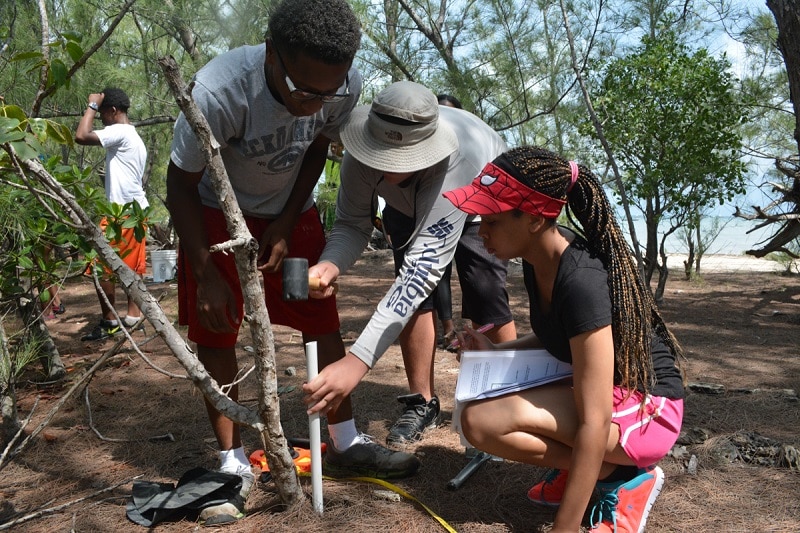
Students create the first corner of their square plot by hammering a PVC pipe into the ground.
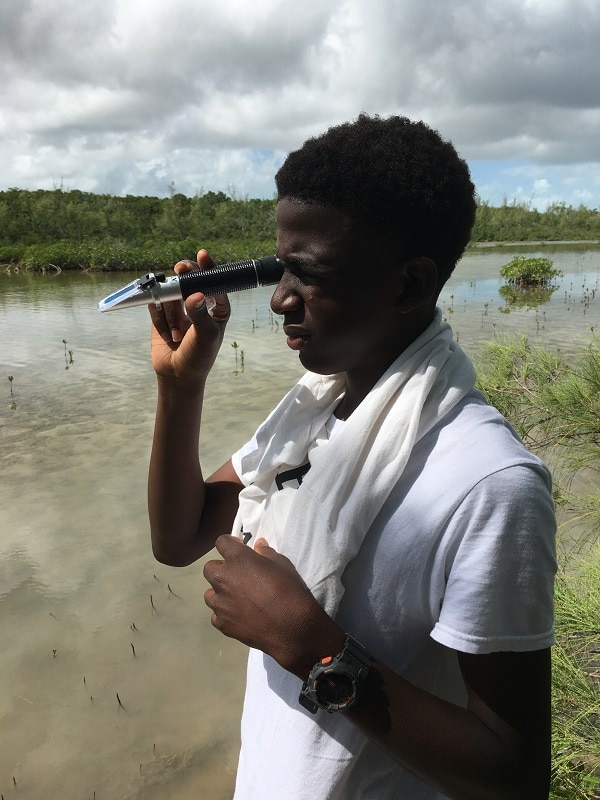
Student uses a refractometer to measure the salinity (saltiness)of the water in his mangrove plot.
Both year 1 and 2 programs allow students to participate in an immersive, yearlong experiential education, which is designed to strengthen STEAM education and increase ocean literacy. Additionally, our hope is that we will generate behavior change and inspiring youth to become environmental stewards of their mangroves.