Western Atlantic Coral Reef Health and Resilience Cards
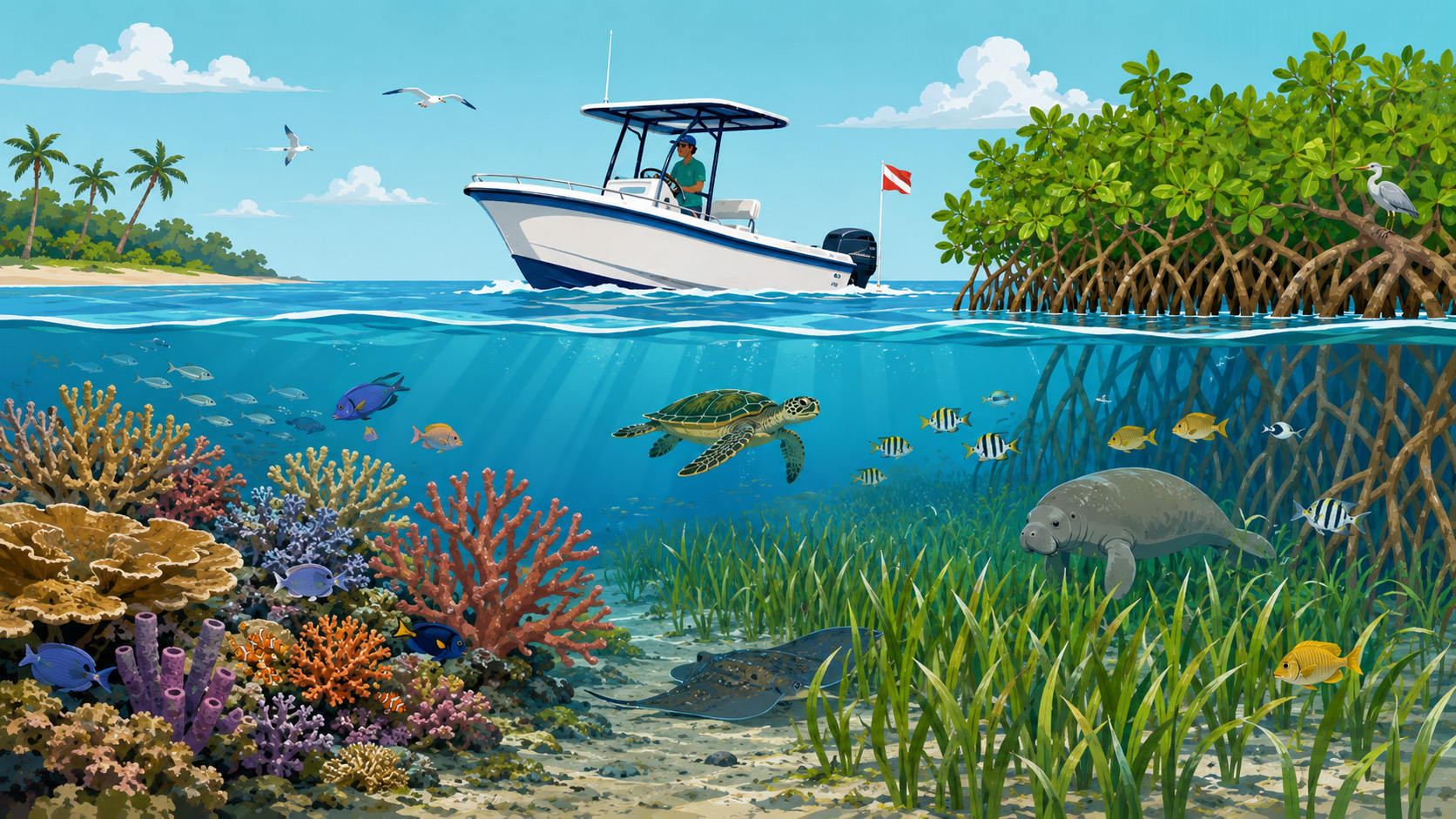
The Western Atlantic Health and Resilience Cards provide photographic examples of the dominant habitat features and biological indicators of coral reef condition, health and resilience to future perturbations. Representative examples of benthic substrates types, indicators of coral health, algal functional groups, dominant sessile invertebrates, large, motile invertebrates, and herbivorous and predatory fishes are presented, with emphasis on major functional groups regulating coral diversity, abundance and condition. This is not intended as a taxonomic ID guide.
Resilience is the ability of the reef community to maintain or restore structure and function and remain in an equivalent ‘phase’ as before an unusual disturbance. The most critical attributes of resilience for monitoring programs are compiled in this guide. A typical protocol involves an assessment of replicate belt transects in multiple reef environments to characterize 1) the diversity, abundance, size structure cover and condition of corals, 2) the abundance/cover of other associated and competing benthic organisms, including “pest” species; 3) fish diversity, abundance and size for the key functional groups (avoiding many of the small blennies, gobies, wrasses, juveniles and non‐reef species, and focusing on large herbivores, piscivores, invertebrate feeders, and detritivores); 4) abundance of motile macroinvertebrates that feed on algae and invertebrates, especially corallivores; 5) habitat quality and substrate condition (biomass and cover of five functional algal groups, turf, CCA, macroalgae, erect corallines and cyanobacteria; amount of rubble, pavement and sediment); 6) coral condition (prevalence of disease and corallivores, broken corals, levels of recruitment); and 7) evidence of human disturbance such as levels and types of fishing, runoff, and coastal development. In addition to the bioindicators shown here, physical attributes of the reef (shading, canopy layers, reef slope, presence of deep water), historic and current water temperatures, currents, wave exposure, other environmental measures, and external factors like connectivity help maintain high resilience in coral reefs…