search-icon
Announcing Finalists in the 2021 Science Without Borders® Challenge

Happy Earth Week! One of the ways we are celebrating Earth Week this year is by announcing the Science Without Borders® Challenge finalists. Each year we choose an ocean conservation theme to encourage students and teachers to learn about different important ocean topics. Our goal is for students to not only learn about the theme through art, but also create artwork that inspires others to want to learn about it too.

The theme for this year’s art contest was “The Magic of Mangroves.” Students were asked to learn about the importance of mangroves, that are not only essential to the wellbeing of the planet, but also are an essential resource for humans too. Based off responses from our student surveys, many learned a great deal about mangroves and came to appreciate them. Here is what some of our participants said: 

I am thankful that you gave us the opportunity to portray our thoughts with the medium of art and for this I learned about the importance of Ocean marine life and about the mangroves. I’m eager to visit the places where I can found mangroves naturally with my family. We will soon plan to see. I also want to be the part of any campaign regarding saving nature, mother earth and the environment.”

–Student age 11, Pakistan

Before coming in contact with Science Without Borders I wasn’t aware of the depth of (importance of) the oceans. A major part of the oceans is a mystery still. I am thankful to Science Without Borders for their work in spreading the awareness and more.”

–Student age 13, India

When I was working on my painting, the back of my mind keeps telling me that you do not have enough skills to compete. However, it did not matter to me even if my painting is not as amazing as the other participants, but it is my love for the ocean and the desire to protect the environment. It was what became my motivation to finish my work despite having a lot of school requirements to do.”

–Student age 17, Philippines

I loved participating in this challenge. I had a little bit of knowledge about mangrove fauna, but I did not realize how important the flora was. I learned so much researching for my art. I definitely recommended this challenge to any middle or high-schooler.”

–Student age 15, United States

I loved working on my artwork because I could give my artwork meaning while helping other people understand something important for everyone.

–Student age 15, Germany

Each year these young artists inspire us to want to do more for the environment. Their passion for the ocean is evident and contagious. This Earth Week, we hope that these youth will inspire you to want to do more for the environment too. Without further ado, we are pleased to announce our Science Without Borders® Challenge finalists. 

Finalists of the 2021 Science Without Borders® Challenge

Entries to the Science Without Borders® Challenge are judged in two categories based on age. Here are the finalists in each category:

Younger Students: 11-14 Years Old

First Place: "Shelter" by Dana Chung, Age 13, Connecticut, United States of America
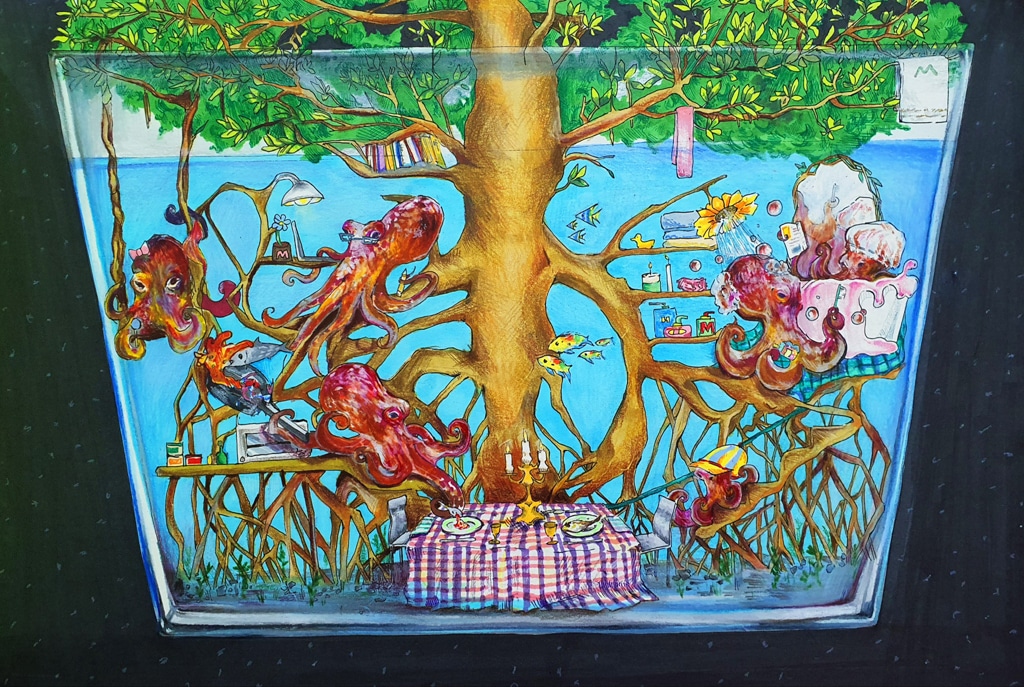
Image 1 of 13

Artist's Statement: Mangrove forests are the barrier that protects locals from severe ocean waves and flooding, and also a shelter that protects sea animals. There are many various reasons that Mangrove trees are a valuable property for not just for humans, but also for the Earth. For this art piece, I depicted a safe, protective shelter that is for all aquatic animals.
Older Students: 15-19 Years Old

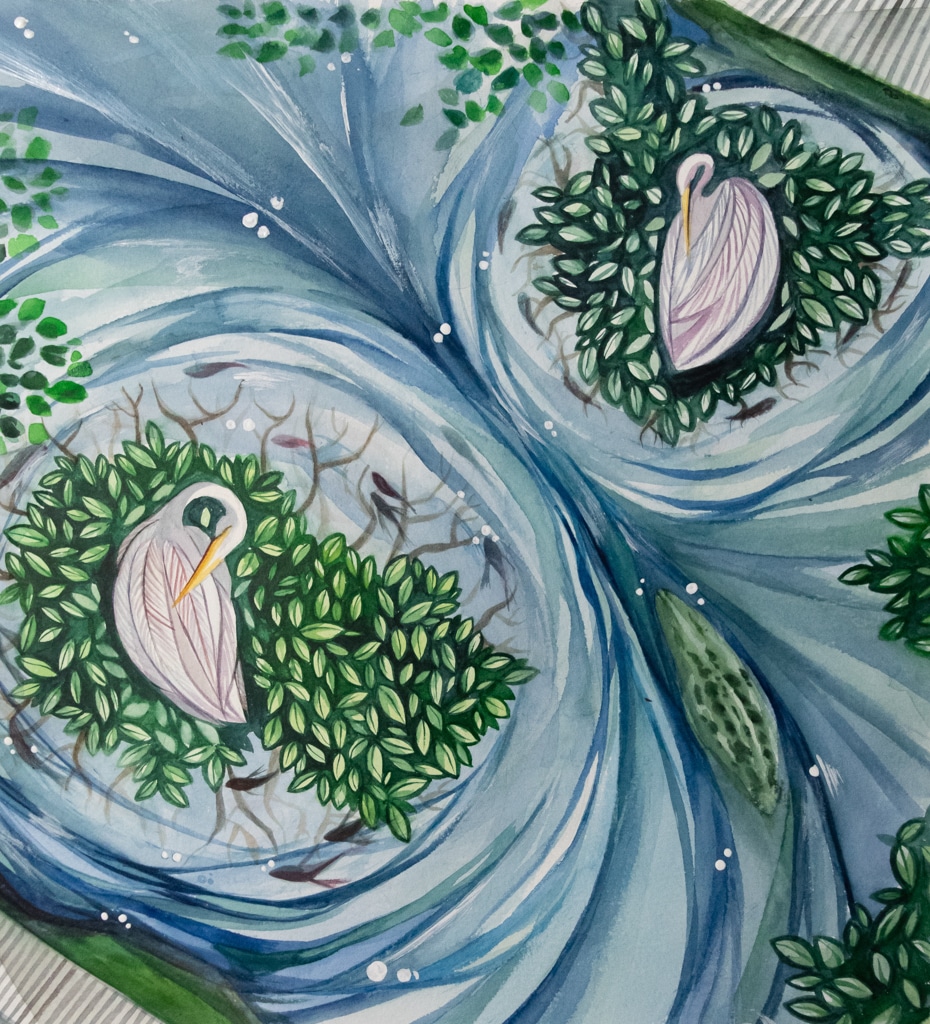
"Mangroves: Humble, Strong, Essential" by Daye Kwon, Age 18, Arkansas, United States of America

Image 5 of 14

Artist's Statement: Mangroves are humble, and Mangroves are strong. Mangroves lack the visual extravagance that other plants may possess; yet standing strong with roots reaching deep into the mud, they play a central role in crafting vibrant and flourishing ecosystems that support countless forms of life. My illustration takes the viewer on an aerial view of mangroves in their natural habitat. The rendition of the mangroves is purposely simple; it draws focus to the impact mangroves have in their ecosystems. Mangroves provide habitat for a variety of animals such as fish and the white egret and also protect human life by absorbing energy. Moreover, they improve water quality, which in turn benefits organisms and other ecosystems. The movement, energy, and vibrant colors of the water reflect this effect. Mangroves matter. There is growing need to protect them from human activity and pollutants, as protecting one mangrove protects thousands more lives.

Related Posts

World Oceans Day: Protecting the Ecosystems That Protect Us

This World Oceans Day, the global community is being challenged to think differently about the ocean.

The 2026 World Oceans Day theme, “Reimagine: Beyond the World We Know, A New Relationship With Our Ocean,” invites us to recognize that the ocean is not something distant or separate from our lives. It regulates our climate, supports our economies, provides food for billions of people, and sustains the natural systems that make life on Earth possible.

Few places illustrate this connection more clearly than the coastal ecosystems that protect our shores and support marine life. While coral reefs, mangrove forests, and seagrass meadows are often…

Read More

After the Storm: Standing with Our J.A.M.I.N. Family in Jamaica

There are moments in this work that feel heartbreakingly familiar.

Two weeks after we completed our Jamaica Awareness of Mangroves in Nature (J.A.M.I.N.) programming, Hurricane Melissa made landfall. A powerful Category 5 hurricane, Melissa is now tied with Hurricane Allen in 1980 for the strongest winds ever recorded in an Atlantic storm. Like Hurricane Dorian, which devastated The Bahamas in 2019, Melissa will be remembered as one of the strongest hurricanes on record in the region.

For 11 years, the University of the West Indies Discovery Bay Marine Laboratory and William Knibb Memorial High School have been more than program partners. They have welcomed us into their classrooms and labs, shared meals and laughter, and committed themselves to educating their students about mangroves and coastal resilience. These colleagues and students are not distant collaborators. They are family.

And they were hit hard…

Read More
Privacy Overview

This website uses cookies so that we can provide you with the best user experience possible. Cookie information is stored in your browser and performs functions such as recognising you when you return to our website and helping our team to understand which sections of the website you find most interesting and useful.  You can view our complete Privacy Policy here.

Strictly Necessary Cookies

Most of our cookies are used to improve website security and reduce spam. These cookies should be enabled at all times. They also enable us to save your preferences for cookie settings.

3rd Party Cookies

This website uses Google Analytics to collect anonymous information such as the number of visitors to the site, and the most popular pages. Keeping this cookie enabled helps us to improve our website.