search-icon
Celebrating Fish Diversity

Fish communities in the Tuamotu Archipelago have been much more diverse than in Society Islands, especially on the fore reef.  The fish are not only more abundant, but they are larger overall, meaning greater biomass, which is good for reefs and for the human populations they must sustain.
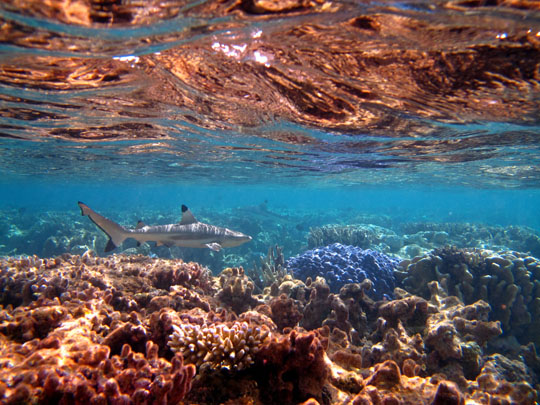
Two blacktip reef sharks patrol a reef at Fakarava

Fish Diversity at Tuamotu

Typically each dive site hosts a large diversity of fish and fish schools, including apex predators, such as sharks, groupers, and snappers.
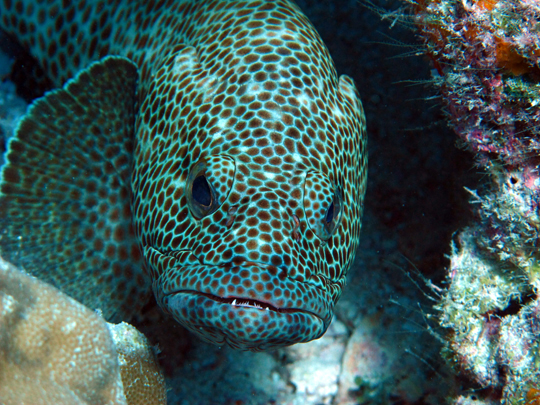
Large groupers are more abundant in the Tuamotus


There were many more fish near channels and on reefs with very high relief and high coral cover.  Reefs dominated by fleshy algae, especially the lagoonal reefs, and areas damaged by storms had many fewer fish, but in general still reflected higher fish diversity than in the Society Islands.
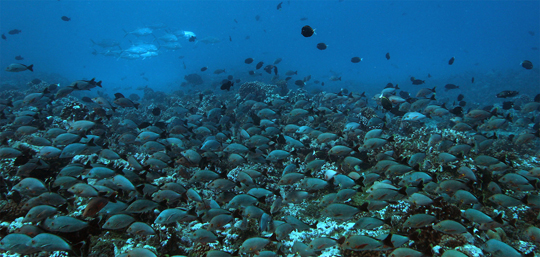
Fish Diversity: Schools of fish inhabit the reefs


Though we are not studying fishing pressure on the reefs around French Polynesia, it is apparent that there are fewer fish being caught here due to their larger size, greater abundance and higher fish diversity when compared to the Society Islands.

(Photos by: 1 – 2 Dr. Brian Beck, 3 Serge Andrefouet)

If you liked this blog, you might also like reading about Fish Spotting in Jamaica.
Related Posts

Introducing Our New Website: A Fresh Look for the Foundation’s Future

As we celebrate the Khaled bin Sultan Living Oceans Foundation’s 25th anniversary, we are proud to unveil our newly redesigned website—a modern home for our science, conservation work, and educational programs. This launch marks an important moment for the Foundation as we honor our long history and look toward the future of ocean conservation.

For more than two decades, the Foundation has worked tirelessly to improve the health of our living oceans. We have advanced ocean science, led one of the largest coral reef research missions in history, restored mangrove forests with local communities, created award-winning education programs, and shared the wonders of the ocean with people around the world. Our new website reflects the organization we are today—focused on conserving coral reefs, restoring mangrove forests, and improving ocean literacy—while still highlighting the legacy of work that brought us here.

The redesigned site…

Read More
Privacy Overview

This website uses cookies so that we can provide you with the best user experience possible. Cookie information is stored in your browser and performs functions such as recognising you when you return to our website and helping our team to understand which sections of the website you find most interesting and useful.  You can view our complete Privacy Policy here.

Strictly Necessary Cookies

Most of our cookies are used to improve website security and reduce spam. These cookies should be enabled at all times. They also enable us to save your preferences for cookie settings.

3rd Party Cookies

This website uses Google Analytics to collect anonymous information such as the number of visitors to the site, and the most popular pages. Keeping this cookie enabled helps us to improve our website.