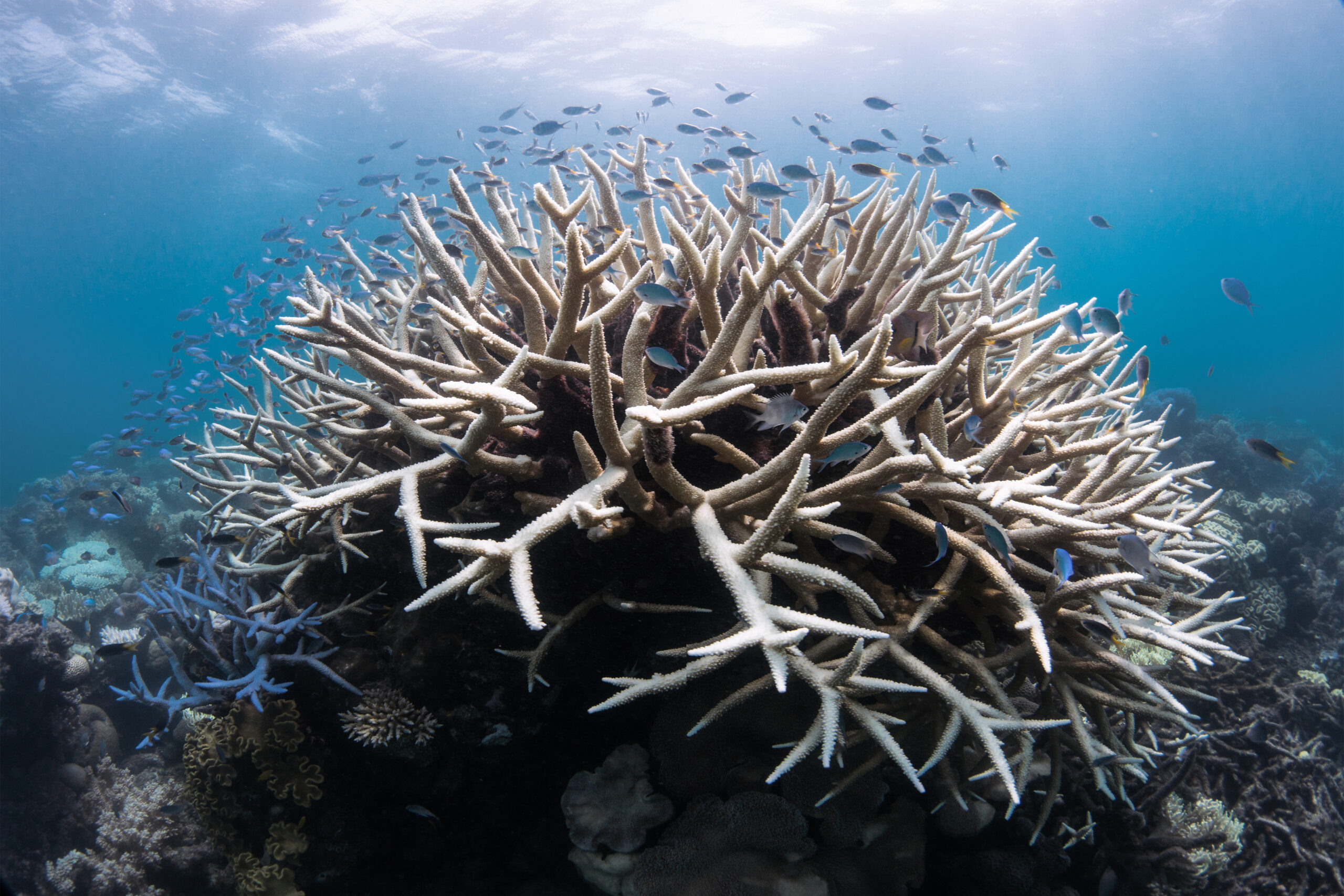
This morning we headed to Shib Ammar, a submerged patch reef at the outer edge of the Farasan Banks, some 40 miles offshore. Twenty knot winds from the northwest, and a 1.5 meter swell made for a wet and bumpy ride and prevented a dive at the exposed northwestern tip. As an alternative, we first dove on the outer, more protected southern side.
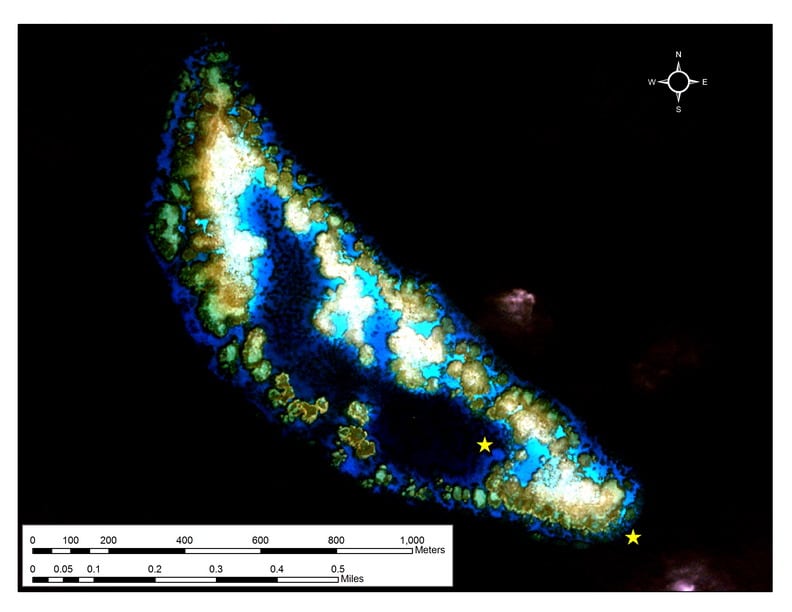
Satellite Image of Shib Amar.
The outer fore reef sloped steeply from a shallow emergent reef flat to a narrow terrace at 10-15m, dropped vertically to a second terrace at 20 m, and then plummeted into blue water to 500 m or deeper. The reef slope was intersected with sand channels and large pinnacles and mounds that reached towards the water’s surface, completely covered in living stony corals and soft corals.
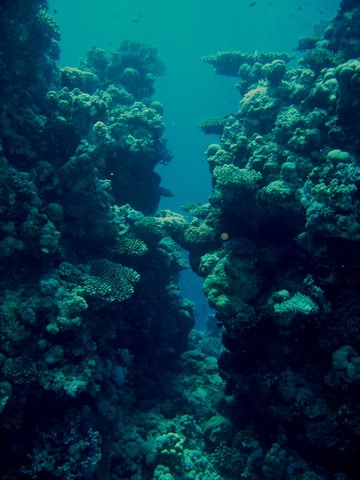
Farasan Banks reef: Pinnacles separated by a narrow groove.
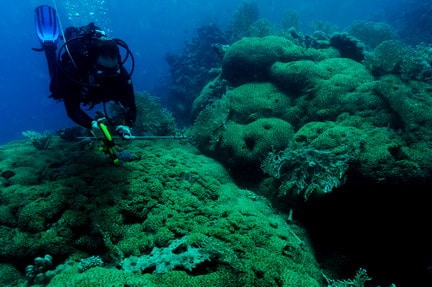
Huge table corals (Acropora), several meters across, towered above a complex, highly diverse branching, plating and massive coral assemblage.
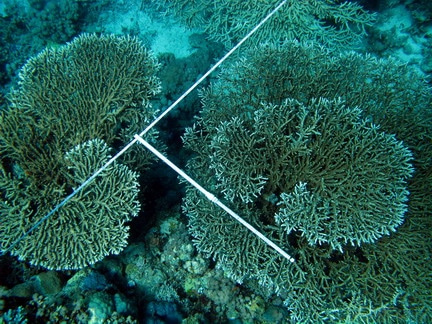
Acropora: Table corals in my transect (scale bar = 1m).
Besides an unusually high cover of living coral, the reef was teeming with colorful angelfish, butterflyfish, anthias, surgeonfish, small grouper and even a juvenile humphead wrasse and a few larger bumphead parrotfish.
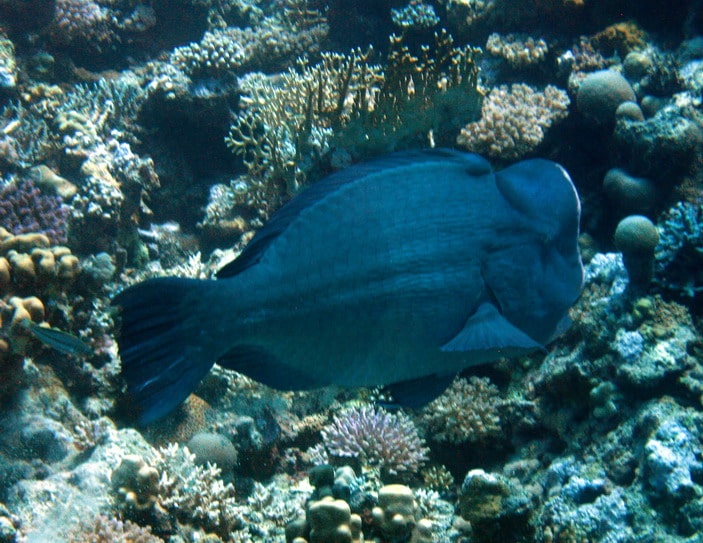
A bumphead parrotfish swims slowly across the reef, munching coral and algae.
We navigated through a narrow channel to reach the inner lagoon for our second dive, a site protected from the wind and waves. The center of the lagoon was, mostly sand, with large coral bommies. A rim of coral fringed the lagoon, dropping from the reef flat to reef terrace at 10 m depth, and a gradual slope to 15 m, followed by a second drop-off to the base of the reef at 25 m.
While most of the corals in the lagoon were small, one of the largest monospecific stands of flower coral (lobed brain coral or Lobophyllia hemprichii) I had ever seen covered much of the area.
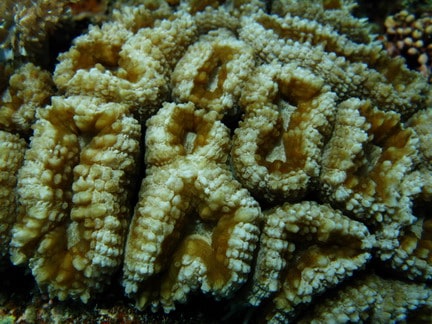
A closeup of a flower coral, Lobophyllia.
This coral formed unusually large colonies, some over 5 m meters in diameter. Each colony consisted of thousands of individual animals (polyps), each 4-5 cm in size.
These type of corals have what is referred to as a phaceloid growth form towards the colony center, with individual polyps (coral aminals) having their own walls and little or no connecting tissue between polyps. They often also have a more flabello-meandroid (brain-like, meandering) growth form at the margins. This is largely because of the way the coral grows, with individual polyps dividing “intratentacularly”. In other words, the polyp will divide into two or more polyps within the wall of the corallite, instead of on the outside of the coral wall.
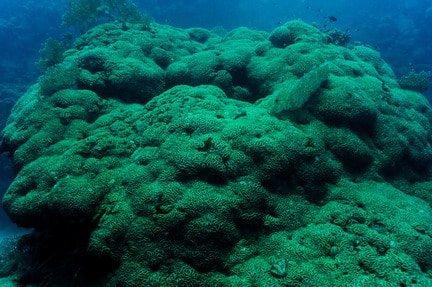
An immense colony of flower coral.
Because of this unusual growth form, these coral colonies are often broken apart by strong waves, or other physical impacts, which may help them form large monospecific (single species) stands. If you look closely at the coral, you can often see the stalk-like, corallites separating from the “mother” colony. This trait also makes this coral fairly easy to propagate in home aquaria, as you can separate the individual polyps and the rest of the coral will survive and continue growing.
Glenn Page swimming above a Lobophyllias colony.
We are looking forward to seeing some of these coral colonies at night – because of the large size of the individual animals, each polyp has extremely long tentacles which it extends at night to capture zooplankton and maybe even a small fish.