Expedition Log: Maldives – Day 15
Often misidentified as a brittle star, yet plant-like in appearance, with long, flexible and highly contorted feathery arms, crinoids are the most ancient class of spiny skinned animals in the Phylum Echinodermata. Dating back to the Paleozoic period, long before sea urchins, sand dollars, sea cucumbers and even the crown of thorns starfish, these echinoderms are the only representatives that have a mouth oriented away from the bottom and are attached to the bottom, at least as a juvenile.
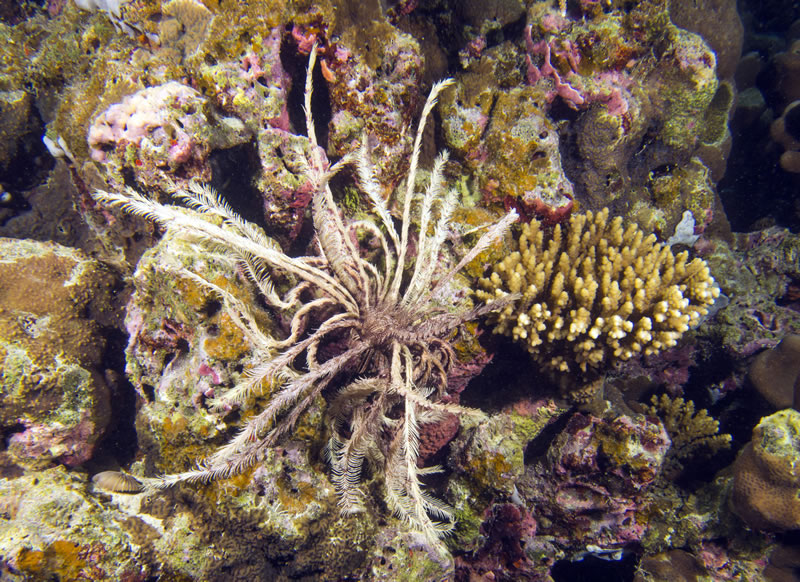
A crinoid.
As a young animal, their bodies have an attached stalk, a central crown, and 5-200 jointed arms that radiate off the periphery of the crown. The stalk persists in the sea lilies, but in the other group of crinoids, the feather stars, it breaks off, and the animals become stalk-less and lead a mobile life-style.
On many of our dives especially in areas of high currents and during the night we often see dozens of sea lilies perched on the tops of sponges, sea fans and corals. Along their colorful arms are rows of feather-like pinnules, each with a narrow channel (the ambulacral groove) lined by tube feet. The arms are intertwined, forming a basket that is extended into the water column to capture plankton. As the plankton is carried past the basket, it becomes trapped in mucus; the tube feet transfer the food to the amulacral groove, and hair-like cilia that line the groove carry the plankton to the mouth through this elaborate conveyer system.
While some reefs may contain hundreds of crinoids, it’s much less common to see one crawling along the bottom. During a recent dive I found a small crinoid slowly crawling along the reef substrate. It used its arms in a coordinated fashion to slowly lift its body and move forward, inch by inch.

Photos by Andrew Bruckner