search-icon
Fasting Whales

Does the idea of whales fasting sound strange to you? Read on to find out why they do…

Humpback whales are a type of baleen whale. Baleen whales do not have teeth, instead they have baleen plates, which are made from keratin, the same as our finger nails and hair. These plates act like a strainer filtering plankton and small animals out of the water. Humpback whales primarily feed on krill (small shrimp-like crustaceans) and small schooling fish.
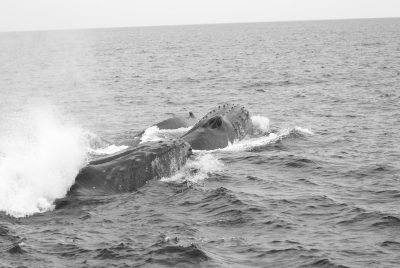
Whales fasting in Tonga.

Photographed is a mating group of three whales in Vava’u.

Why are Whales Fasting?

We won’t see any humpback whales feeding in Tonga. (To find out more about why humpback whales are in Tonga read this blog: http://www.sciencewithoutborders.org/whales-whales-whales/). It may be no surprise to you that humpback whales feed primarily during the summer months when they are near the poles. The reason that this occurs in Tonga is due to the lack of nutrients that occur in subtropical and tropical latitudes. This is why the water is clear in these regions. Basically, fewer nutrients mean that there is less phytoplankton (small microscopic plants). Krill feed on phytoplankton. Due to a lack of phytoplankton, there are fewer krill. It’s easy to see that there is not much of a food source for humpback whales in the lower latitudes … hence we have whales fasting.
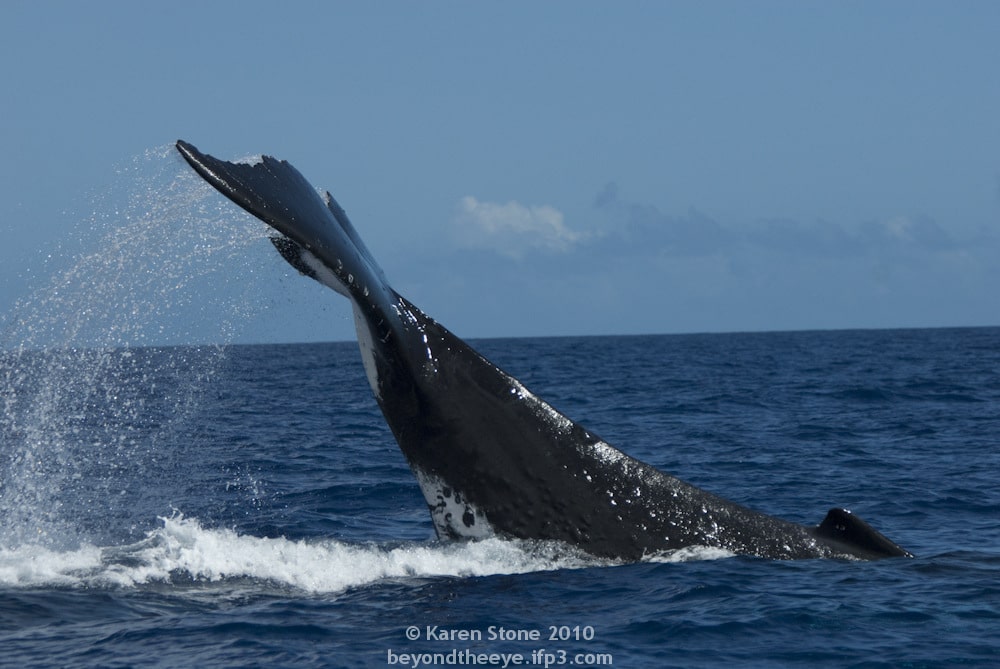
humpback whales, baleen whales

This humpback whale tail is slapping.

Whales also expel a lot of energy in order to feed. Fish do not need to control their body temperature in warmer waters, so fish in the tropics do not have as much oil as fish in the poles. The whales therefore would expend more energy to feed than the food can provide.

During the summer, it’s important for humpback whales to pack on the blubber before making the big migration to warmer water. Adults can eat between 1-2 tons of food a day. It’s a good thing too, because during their winter fast, humpback whales can lose up to third of their body weight. That means that whales fasting can last for around six months. That is some fast!
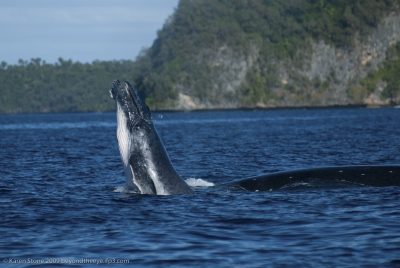
When not in a period of whales fasting, they feed on krill and plankton.

Mother and baby calf swimming in nursery ground.

For the female whales that are feeding baby calves, the whales fasting is more severe. A humpback whale calf puts on average 50kg (100lbs) of weight per day in the breeding grounds. The milk supplied by the mother is about 40% fat content and is expelled into the water close to the teat for the baby to gulp up. It really is a true wonder of nature that through whales fasting and feeding, these animals are able to control their body weight to survive such long migrations to the feeding ground.

Photos: 1-3 Karen Stone
Related Posts

Introducing Our New Website: A Fresh Look for the Foundation’s Future

As we celebrate the Khaled bin Sultan Living Oceans Foundation’s 25th anniversary, we are proud to unveil our newly redesigned website—a modern home for our science, conservation work, and educational programs. This launch marks an important moment for the Foundation as we honor our long history and look toward the future of ocean conservation.

For more than two decades, the Foundation has worked tirelessly to improve the health of our living oceans. We have advanced ocean science, led one of the largest coral reef research missions in history, restored mangrove forests with local communities, created award-winning education programs, and shared the wonders of the ocean with people around the world. Our new website reflects the organization we are today—focused on conserving coral reefs, restoring mangrove forests, and improving ocean literacy—while still highlighting the legacy of work that brought us here.

The redesigned site…

Read More

Connecting People, Art, and Oceans: Championing Conservation at the 2025 IUCN Congress

The IUCN World Conservation Congress brings together thousands of leaders and decision-makers from governments, non-profit organizations, civil society, Indigenous groups, and the private sector to shape global conservation policy and action. This influential gathering serves as a platform to share knowledge, build partnerships, and advance initiatives that protect our planet’s biodiversity.

As a member of the International Union for Conservation of Nature (IUCN), the Khaled bin Sultan Living Oceans Foundation was honored to take part in the Congress, joining a global community of leaders, organizations, and changemakers committed to protecting nature and advancing sustainable futures.

Read More
Privacy Overview

This website uses cookies so that we can provide you with the best user experience possible. Cookie information is stored in your browser and performs functions such as recognising you when you return to our website and helping our team to understand which sections of the website you find most interesting and useful.  You can view our complete Privacy Policy here.

Strictly Necessary Cookies

Most of our cookies are used to improve website security and reduce spam. These cookies should be enabled at all times. They also enable us to save your preferences for cookie settings.

3rd Party Cookies

This website uses Google Analytics to collect anonymous information such as the number of visitors to the site, and the most popular pages. Keeping this cookie enabled helps us to improve our website.