While scientific expeditions are generally driven by precise objectives implying rigorous data collection and protocols, they also occur in the wild, in an uncontrolled environment. Generally, we wish for surprise encounters with charismatic mega-fauna that could generate a bit of adrenalin: hammerhead sharks, whales, and manta rays heading towards us in the deep blue. However, surprises are…surprises, you never know what you’re gonna get. While diving in New Caledonia for the Global Reef Expedition, we encountered a quite unexpected fauna on the bottom of an otherwise empty sandy lagoon.
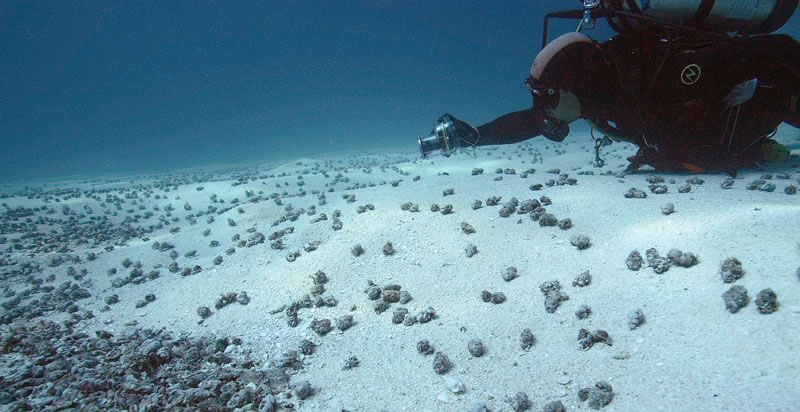
Diving to search for sea cucumbers, Antoine Gilbert and I set out to explore the lagoon of Surprise Atoll. As we headed to the shallower areas of the lagoon, we bumped into unusually high numbers of small hermit crabs. Tens of thousands of hermit crabs roamed the seafloor – far and away the largest cast of crabs we had ever seen. The end of the aggregation could not be seen.
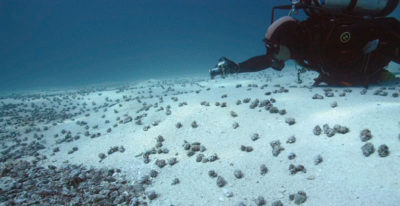
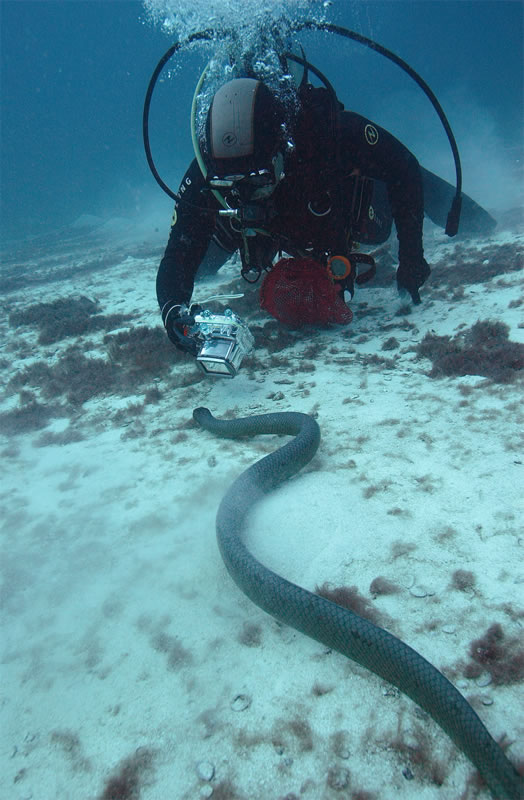
The reasons of the giant hermit crab aggregation were not obvious. Feeding? Not really. No food source could be seen. Reproduction? Possible. Shell exchange market? Could be. The fact that we witnessed this aggregation only for 25 minutes meant we could not assess if this was the beginning, the end, or the middle of this behavior, triggered by some stimulus we could not see. No other fauna was seen, except sea snakes that cruised above the hermit crabs, but ignored them. It was an amazing sight, the 6ft long undulating snakes swimming over the scurrying crustaceans in their shells.
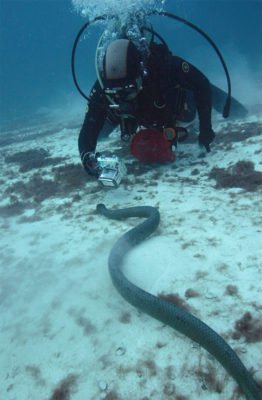
Antoine visiting with a sea snake amidst the hermit crabs.
We picked up a number of live specimens for Nathaniel Evans, an invertebrate specialist who embarked on the Global Reef Expedition to describe the biodiversity of small invertebrates: crustaceans, echinoderms, mollusks, etc. Returning from the trip, we realized that the event we witnessed was unheard of in the literature. Scientific divers in Noumea had recollection of similar events, although less impressive. We all thought that this observation could make an interesting “Reef Site” story, which are one-page papers that the journal Coral Reefs publishes on remarkable and unusual observations on coral reef ecology and natural history. We waited for Nathaniel Evans and his colleagues at the Florida Museum of National History to genetically identify the species involved (it turned out to be Dardanus scutellatus (H. Milne Edwards, 1848)). Once we knew the species of hermit crab we saw aggregating on the sea floor, it was easy for us to write an article.
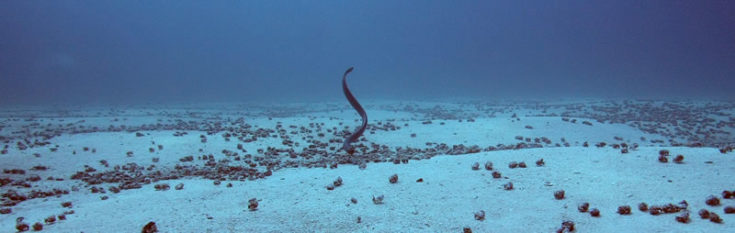
This short observation on Surprise Atoll is just a testimony of little we know about the behavior of marine species. This subtidal aggregation exceeds those reported for intertidal hermit crab species and emphasizes our incomplete knowledge of clustering behavior in hermit crabs. It also more generally illustrates how little we know about the social behavior of most other marine species, from the small ones, like these hermit crabs, to the largest most charismatic species such as the green turtles that abound in the waters of the Entrecasteaux Reefs and make these reefs so special.
Surprise Atoll is part of the UNESCO World Heritage Area “Lagoons of New Caledonia” since 2008 because of its natural value. It is uninhabited, and is also protected by the government of New Caledonia. Few have the chance to visit these lagoons and reefs. The occurrence of the rare events we witnesses reinforces the conservation value of this area. Who knows what else happens in these remote lagoons?
To learn more about this large cast of hermit crabs, our full Reef Site article, “A massive subtidal aggregation of hermit crabs in Surprise Atoll lagoon, New Caledonia,” can be found in the latest issue of Coral Reefs, the Journal of the International Society for Reef Studies.
Photos by Serge Andrefouet.