I’m back in Jamaica and I’m ready to implement the J.A.M.I.N. project. Last year, we initiated the pilot program in two high schools in Jamaica and it was a huge success.
My colleague, Camilo Trench from the University of the West Indies Discovery Bay Marine Lab, is tied up in Kingston helping get a solar energy program implemented, so I’m flying solo today.
I pack up the rental car with all of my educational materials (projector, computer, worksheets) and set off for Falmouth where I will introduce mangroves to 10th grade biology students at Holland and William Knibb high schools.
During the pilot, we implemented the program in a science club at Holland High School and a 12th and 13th grade combined biology class at William Knibb High School. After running the pilot program, we determined that the best course to carry out the program is in grade 10 biology because it fits best into the Jamaican curriculum and it allows for us to build a year two program with the same students.
This will be my fourth visit to these schools and I’m used to navigating to them. Before I pull out on the main road, I think to myself, “Drive on the left side of the road.” In Jamaica, they drive on the left side of the road, which for me is one of the most challenging parts of this trip.
I pull out into the left lane and I’m on my way. I weave through mountainous terrain trying not to get distracted by the beautiful turquoise ocean view to my right and the limestone rock formations on my left. I often think about how this island was geologically formed and my mind wanders a bit.
On my drive, I see herds of goats on the side of the road eating grass. It’s a common occurrence as the schools are in a rural area of Jamaica.
About 30 minutes later, I exit the main road. The schools are only about 5 more minutes away. Luckily, they are on the same road and less than half a mile away from each other. These are the only two high schools in Falmouth.
I arrive at Holland High School and Mr. Gregory Peart, one of the science teachers, meets me in the lot to help me carry my supplies. We walk up the stairs to the second floor of the building where the library is located.
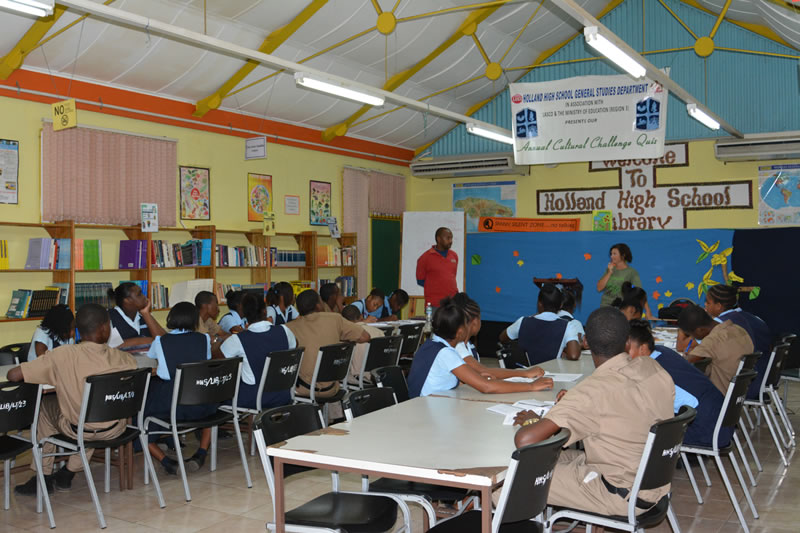
2nd Floor Library turned classroom for JAMIN Class at Holland High School.
I start setting up the projector and computer and I spread out the mangrove leaves and propagules. I pile the students’ mangrove journals on the table and lay out my pre-surveys. I’m excited to meet the students and teach them about mangroves.
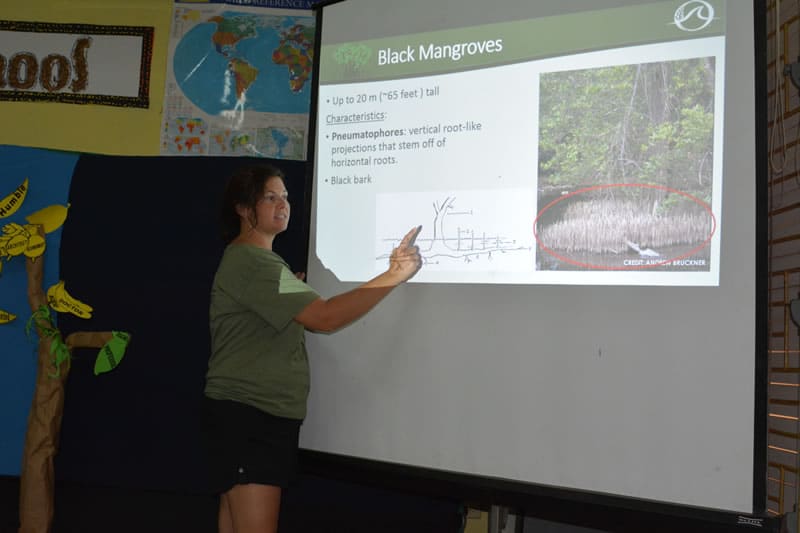
Living Oceans Foundation Education Director Amy Heemsoth teaching students about local species of mangroves.
The bell rings and the students come in excited and uncertain of what awaits them. I instruct them to sit down at the table.
Then I say, “Good morning grade 10 biology!”
In unison, they respond with, “Good morning miss!”
I smile and begin to introduce the program. Year two of the J.A.M.I.N. project has begun.
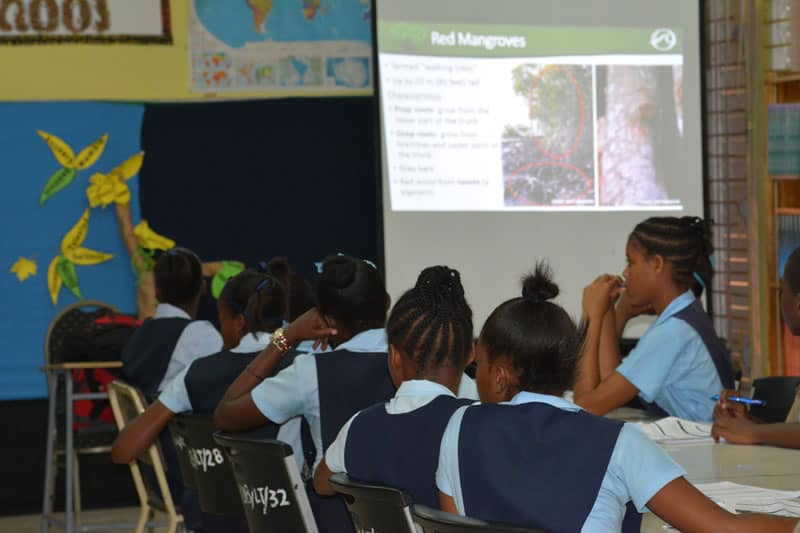
Holland high school students listen intently as they learn about their local mangrove ecosystems.
Photos by Amy Heemsoth