Expedition Log: Palau – Day 9
After surveying the reefs located off Angaur, an oceanic Island about 10 km south of Peliliu, we headed ashore to explore the island. Tucked away in a lush tropical rainforest at the northwestern end of Anguar are a series of small, shallow lakes. Unlike Palau’s more famous jellyfish lake, these are very young on a geological time scale (60 years), much less salty, slightly acidic (we measured a pH of only 6.2 compared to pH 8.2 for the ocean), and they are also man-made.
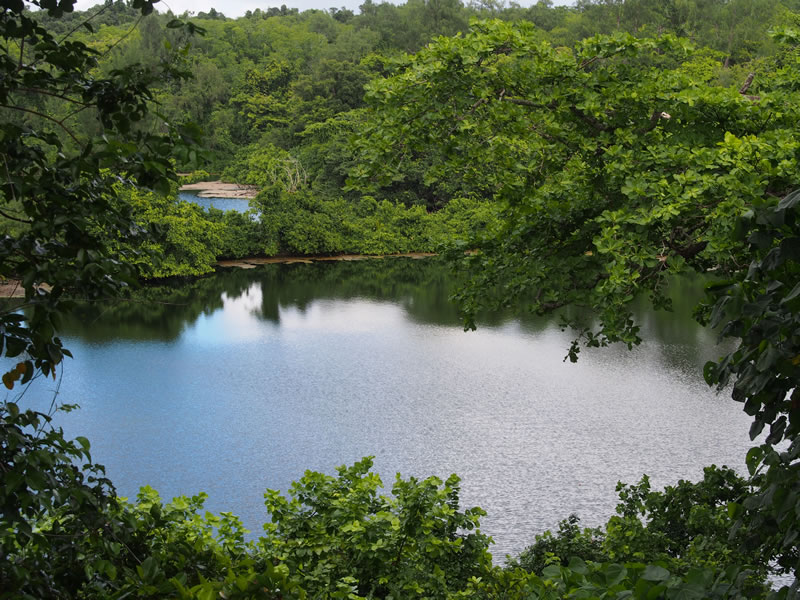
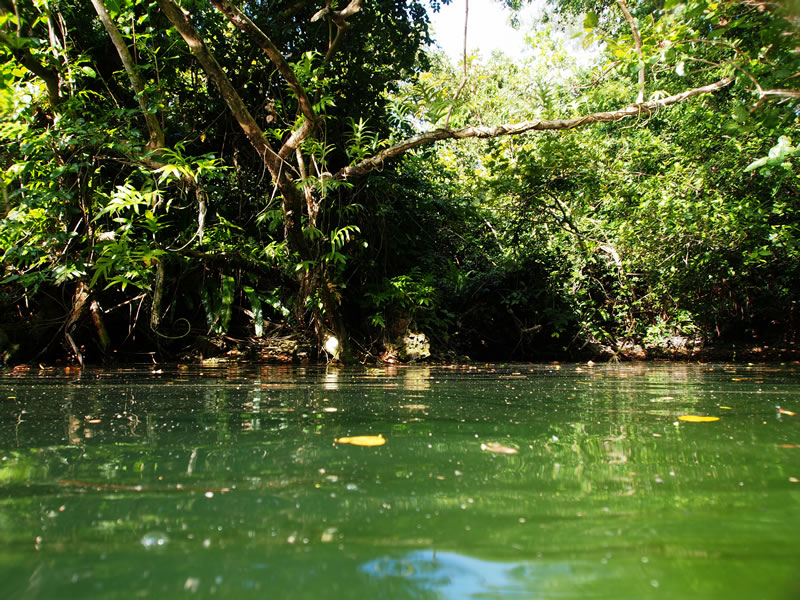
The marine lakes of Angaur.
Angaur’s lakes are remnants of old phosphate pits that were abandoned in the 1950s as the mines became infilled with rainwater and seawater percolated through the limestone. The phosphate ore mined from these pits came from a type of rock that is rich in calcium phosphate. It was formed from ancient uplifted coral reefs (which are calcium carbonate) that were exposed to an acidic environment. The source of the acidity is from the combination of bird droppings, humus from decaying leaves and other plant material, and rain water. When bird guano is exposed to rain and acidified by humus, it goes into solution and filters through the reef rock, dissolving away the calcium carbonate and leaving behind a deposit of phosphate. In Angaur, phosphate ore was first mined by the Germans and then the Japanese from the start of the 20th century until around 1955, being exported for use as fertilizer. Beginning in WWI, pumps were used to lower the water table in these pits to about 2 m below sea level. Once the pumping stopped, the excavation holes began to fill with groundwater.
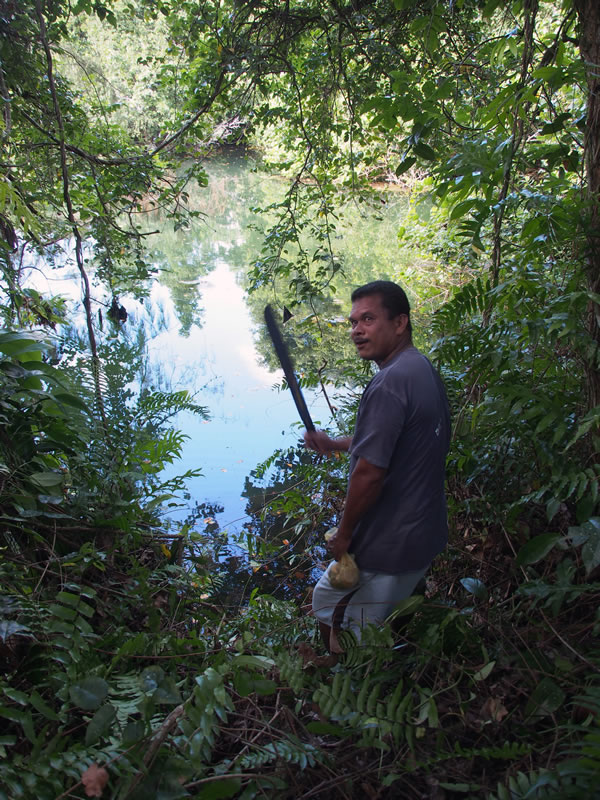
Locals won’t swim here – there are rumors of crocodiles, and some believe the lakes are inhabited by a “sea monster. As explained to me, the women often hunt for coconut crab at night. The crabs once were quite common around these lakes. One year, dozens of these crabs from the forest surrounding the lake were found dead, all missing their abdomens, presumably due to the feeding of a hungry monster.
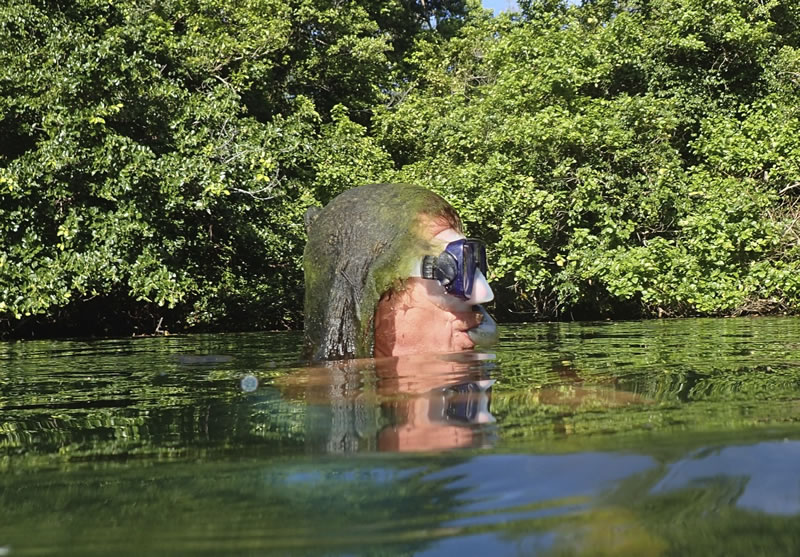
Dense growth of trees and other vegetation lines the lake (left)
A “sea monster” emerges from the depths (right).
We were asked to see what kind of marine life inhabits the lake, so into the murky water our team plunged. Ferns, bushes, mangrove trees and many other plants grow right up to the water’s edge, their roots hanging down into the water. At first look, there doesn’t seem to be much life in the lake. A dense mat of spongy green algae, more like angel-hair pasta, covers all of the roots and obscures much of the shoreline. Thousands of mosquito larvae hover around the algae.
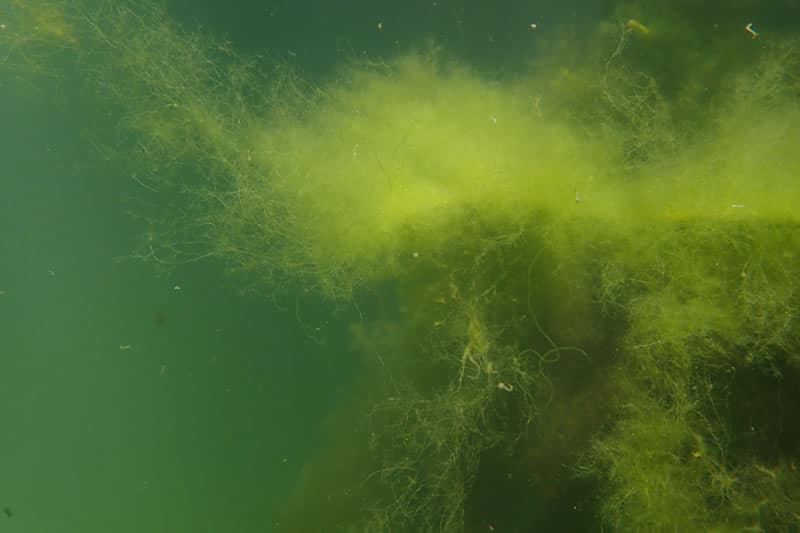
Dense algae covers the roots of shoreline vegetation.
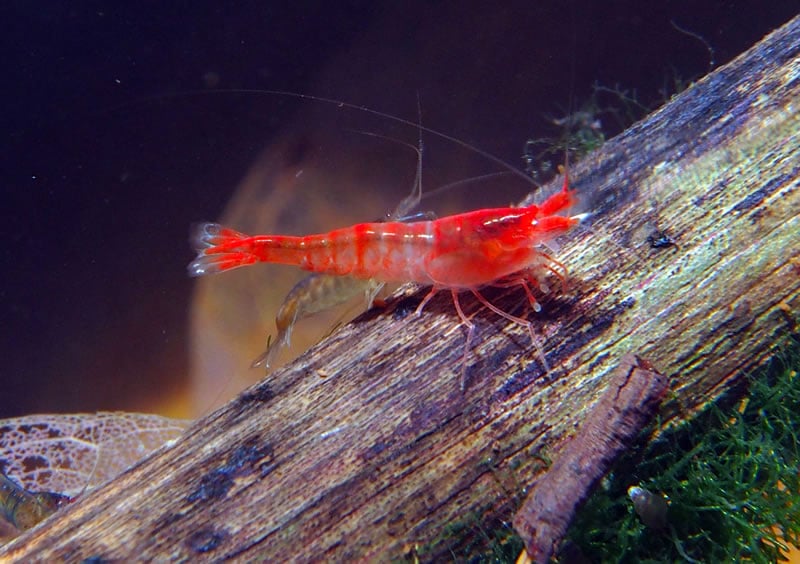
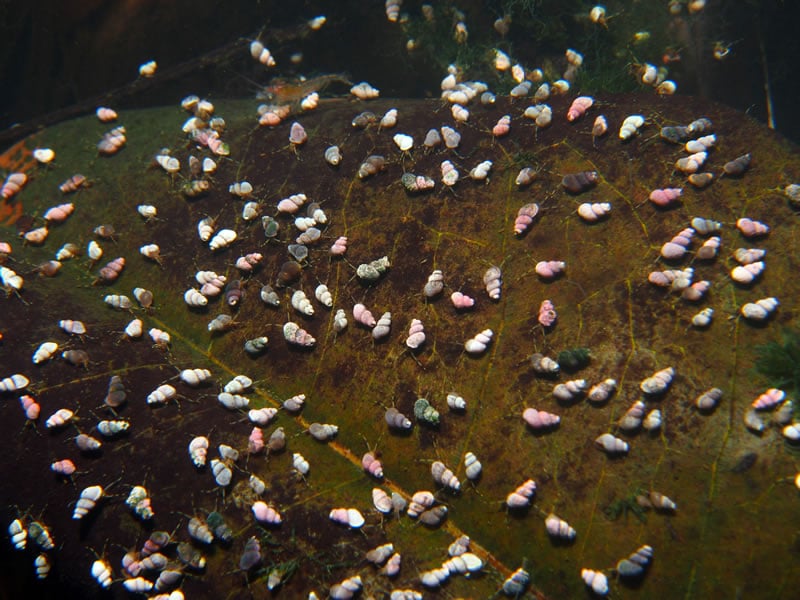
To get a better look, I dive down to inspect the bottom. Among the leaf litter were thousands of shrimp, most only about 1 cm long, but I found a few larger prawns as well. Fish darted among the roots, most just as small as the shrimp, and thousands of tiny gastropods crawled over the roots, algae and leaves. I didn’t find any jellyfish, sea anemones, sponges or other marine critters that inhabit other lakes in Palau, but these critters have had more than 4,000-5,000 years to colonize and evolve into their present state. Maybe in a few thousand years these will be the next tourist destination, but for now few people will enjoy swimming here.
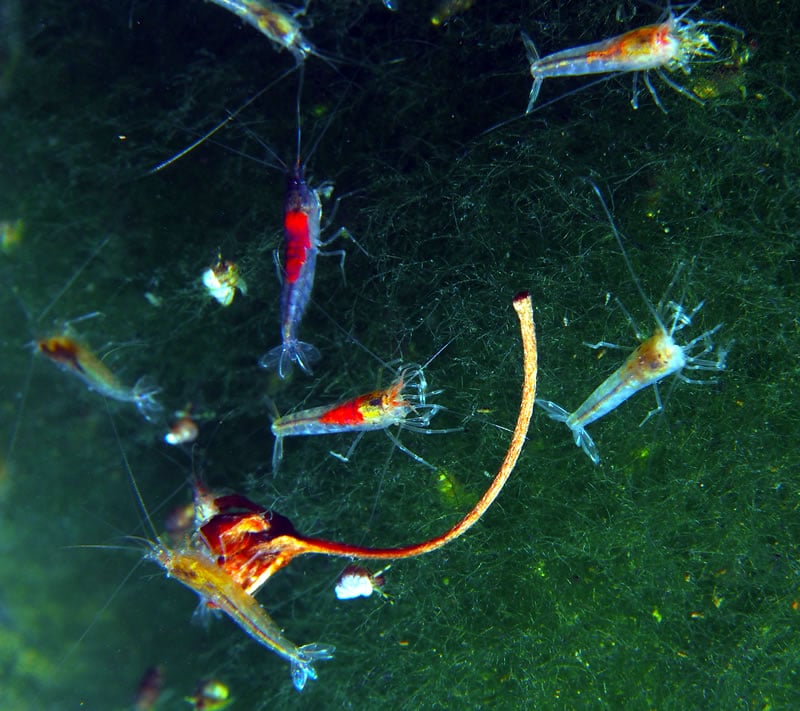
Tiny shrimp dart among the algae (left).
A few larger shrimp are found in the lake (middle).
The largest mollusk, less than ½ cm is a gastropod with a spiral shell (right).
(Click-thru on images for greater detail.)
All photos by Andrew Bruckner, except the picture of the “sea monster” by Joao Monteiro.