The 2026 Science Without Borders® Challenge invited young artists from around the world to explore the hidden world of the ocean with the theme, “Microscopic Marine Life.” This year’s challenge encouraged students to create artwork inspired by the tiny marine organisms that sustain ocean ecosystems and make life on Earth possible.
We were thrilled by the incredible response to this year’s competition, which received nearly 900 entries from 65 countries. Through painting, drawing, and mixed media, students transformed invisible ocean life into vibrant visual stories that highlighted the essential role microorganisms play in marine food webs, nutrient cycling, oxygen production, and climate regulation. From phytoplankton drifting beneath sunlit waves to deep-sea microbes thriving around hydrothermal vents, students showcased both artistic creativity and scientific understanding in remarkable ways.
Although microscopic marine organisms are too small to be seen with the naked eye, their impact on the planet is enormous. These tiny organisms form the foundation of ocean ecosystems, help regulate Earth’s climate, recycle nutrients, and produce much of the oxygen we breathe. Through their artwork, students revealed the beauty, complexity, and importance of marine life that often goes unnoticed.
The winning artworks showcase a wide range of creative interpretations of microscopic marine life and the ecosystems they support. We are proud to present the winners and finalists of the 2026 Science Without Borders® Challenge, whose inspiring artwork reminds us that even the smallest organisms can have a tremendous impact on our ocean and our world.
Winners & Finalists Ages 11-14:
FIRST PLACE: "The Giant and the Invisible: A Story of Ocean Recycling" by Olivia Shin, Age 14, Canada
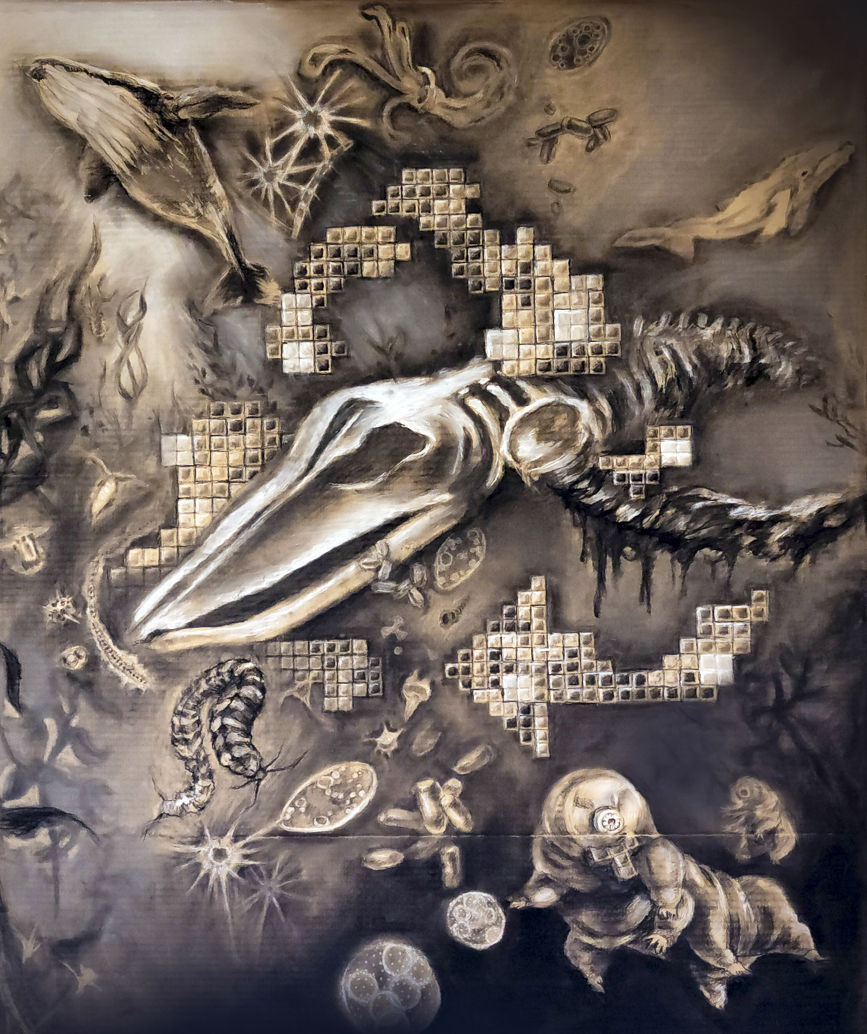
ARTIST’S STATEMENT: This drawing captures the carcass of a blue whale being decomposed by microscopic marine organisms: a key chapter in the story of ocean recycling. Blue whales are the largest creatures in the ocean. Yet when they die and sink to the ocean floor, they meet the invisible. Billions of these microscopic marine organisms clump together to form thick white and yellow mats that cover the whale bones and the surrounding sediment, visualized here as the Universal Recycling Symbol circling around the carcass. Recycled paper is used in this drawing to emphasize their role as the ocean's true recyclers. As these organisms break down the fats stored within the whale’s bones, they release hydrogen sulfide, an energy source for chemosynthetic bacteria. A single whale fall in the abyss sustains a deep-sea ecosystem over decades through recycling, thanks to these microscopic marine organisms.
Winners & Finalists Ages 15-19:
"The Unsung Heroes of Our Oceans" by Chloe Jang, Age 15, United States of America
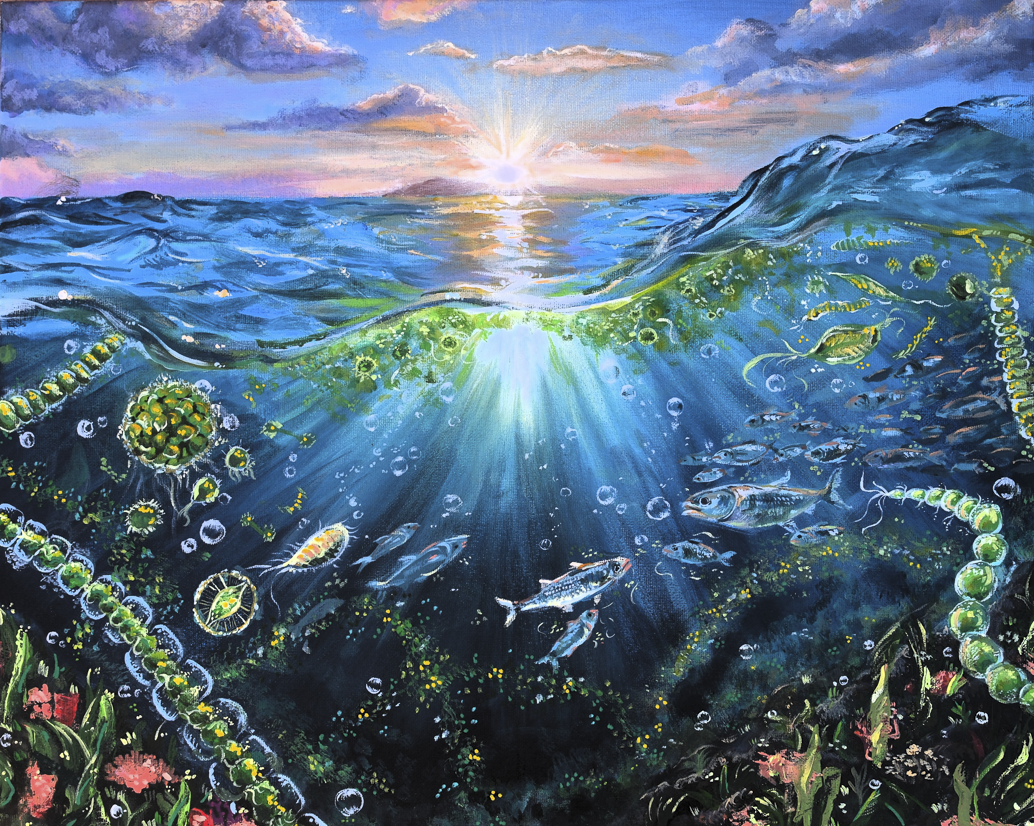
ARTIST’S STATEMENT: When I was around five years old, I asked my older brother where our oxygen comes from. His answer was the same as many others’: trees. While many point to vast forests, most of Earth’s oxygen actually comes from far smaller organisms - microscopic phytoplankton that drift through the ocean, supporting life both in and out of the water. My artwork highlights the importance of phytoplankton in the ecosystem, from their role as the foundation of the marine food web to their impact on mitigating climate change. In my piece, an ocean scene unfolds beneath a distant sunset, casting a warm glow over a vibrant underwater ecosystem filled with abundant phytoplankton. By bringing visibility to what is often overlooked, this artwork encourages awareness, reminding others that recognizing the unseen is the first step toward protecting it.