The 2026 Science Without Borders® Challenge invited young artists from around the world to explore the hidden world of the ocean with the theme, “Microscopic Marine Life.” This year’s challenge encouraged students to create artwork inspired by the tiny marine organisms that sustain ocean ecosystems and make life on Earth possible.
We were thrilled by the incredible response to this year’s competition, which received nearly 900 entries from 65 countries. Through painting, drawing, and mixed media, students transformed invisible ocean life into vibrant visual stories that highlighted the essential role microorganisms play in marine food webs, nutrient cycling, oxygen production, and climate regulation. From phytoplankton drifting beneath sunlit waves to deep-sea microbes thriving around hydrothermal vents, students showcased both artistic creativity and scientific understanding in remarkable ways.
Although microscopic marine organisms are too small to be seen with the naked eye, their impact on the planet is enormous. These tiny organisms form the foundation of ocean ecosystems, help regulate Earth’s climate, recycle nutrients, and produce much of the oxygen we breathe. Through their artwork, students revealed the beauty, complexity, and importance of marine life that often goes unnoticed.
The winning artworks showcase a wide range of creative interpretations of microscopic marine life and the ecosystems they support. We are proud to present the winners and finalists of the 2026 Science Without Borders® Challenge, whose inspiring artwork reminds us that even the smallest organisms can have a tremendous impact on our ocean and our world.
Winners & Finalists Ages 11-14:
"The Foundations of Life" by Jake Kim, Age 13, United States of America
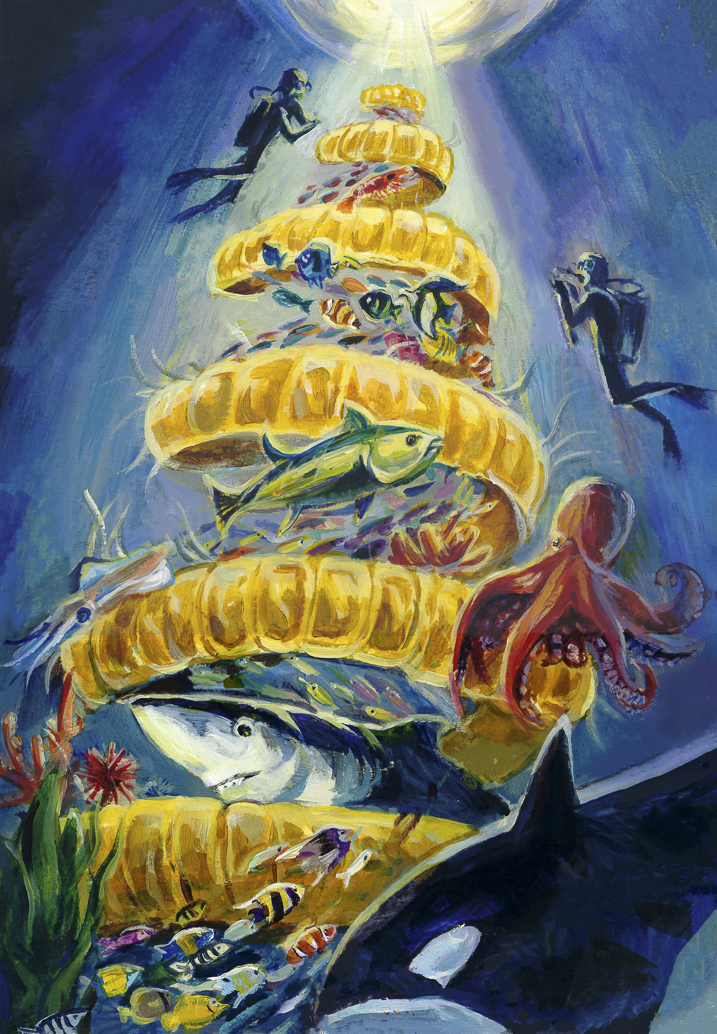
ARTIST’S STATEMENT: This piece depicts how microscopic marine organisms protect all life on Earth like a fortress. The central organism, a phytoplankton, is enlarged to emphasize its vital importance to the environment and the wildlife that depend on it. At the top are smaller life forms, such as schools of fish. As the spiral moves deeper, the marine creatures increase in size—squids, octopuses, sharks, and even humans—illustrating how all life depends on these tiny organisms. Phytoplankton form the foundation of life. They produce the air we breathe, sustain marine food webs, and support the continuous cycle of life. This work is a prime example of how something so small can have the greatest impact on our world.
Winners & Finalists Ages 15-19:
FIRST PLACE: "Ocean’s Hidden Jewel Box" by Jiye Lee, Age 17, United States of America
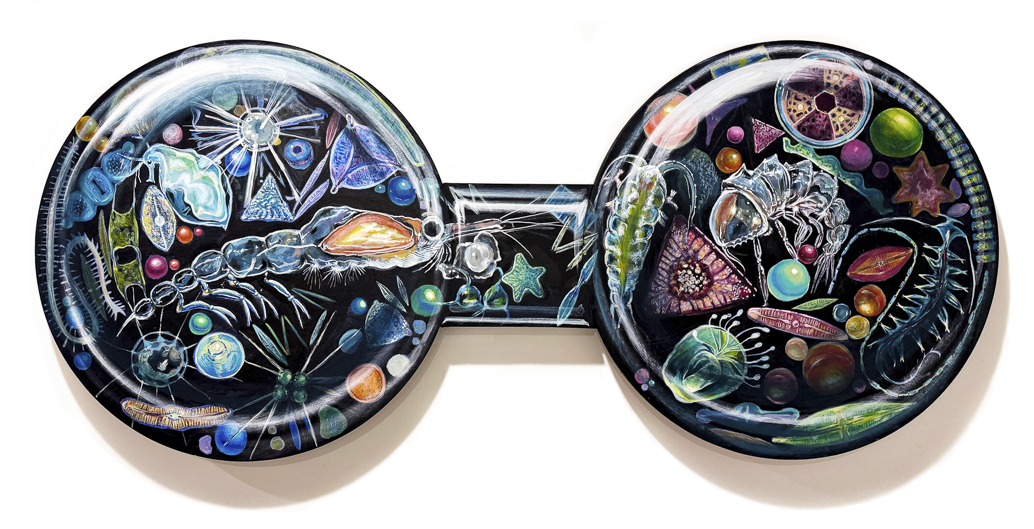
ARTIST’S STATEMENT: Magnified, marine life looks like gemstones. In addition to their beauty, these jewels are valuable for their roles, which include producing over half of Earth’s oxygen, regulating carbon cycles, and sinking as “marine snow” that feeds deep-ocean creatures from bacteria to whales. To reinforce their importance, my canvas formation mimics an oxygen molecule—two circular panels connected by a rectangular insert—mirroring the gas that these organisms help generate. While diatoms and crystal-like Acantharia exist at a scale we cannot directly see, they are the spine of our Earth’s environmental balance. My piece celebrates these inconspicuous beings by illustrating their jewel-like forms in reflective detail, reminding us that these life forms do more than just dazzle; the health of our planet depends on organisms we never see, sustaining all life from the bottom up.