Jamaican high school student, Javar Barnes, chronicles his JAMIN experience learning about Jamaican mangroves through participating in the Foundation’s Jamaica Awareness of Mangroves in Nature (J.A.M.I.N.) program.
Mangrove Education and Restoration Program Blog
My experience with the J.A.M.I.N. (Jamaica Awareness of Mangroves in Nature) Project has been great, and very informative. This project has given me knowledge about mangroves and the animals that live there.
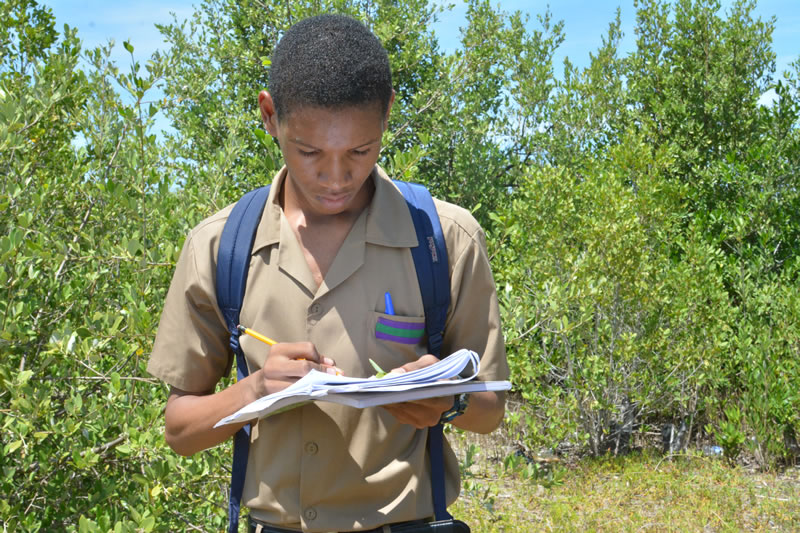
Tenth grade biology student, Javar Barnes, sketching a white mangrove leaf in his mangrove journal during a mangrove field trip.
It has been a great privilege and delight to see and interact with the animals from the mangrove forest. Some of the organisms brought in by the J.A.M.I.N. team included fire worms, sea cucumbers, sea slugs, sea stars, sea urchins and the sea sponge. It was interesting to hear facts about these animals and their habitats.
I was intrigued by the number of animals that live in the mangrove ecosystem. My favourite organism is the sea cucumber because of its ability to discharge its intestines whenever it feels threatened. The presence of these intestines, which can be very sticky, tends to deter predators. It is able to regenerate its intestines over a period of time. These creatures are decomposers belonging to the Phylum Echinodermata. They have soft bodies, and are ocean dwellers, living on or near the sea floor. Sea cucumbers feed on algae, other microscopic organisms like zooplankton and phytoplankton and waste materials. They feed through tube-like structures surrounding their mouths. One important contribution to the ecosystem is that they move along the ocean floor sucking up sand and debris; they are equipped with tube feet that allow them to effectively carry out this role.
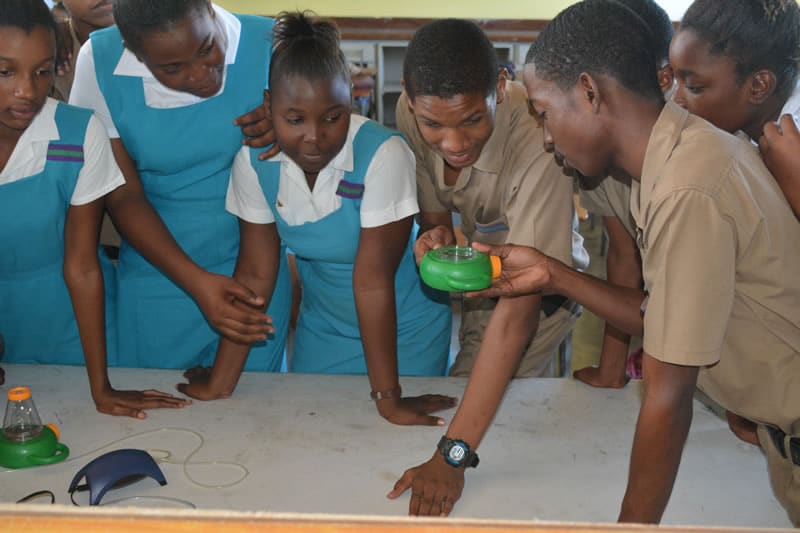
William Knibb High School students looking at a sea slug in the microviewer.
The knowledge that I gained from this project has helped me to better appreciate the contribution of each organism and the role they play in keeping a balance in the ecosystem. Mangroves are nurseries for most of these organisms and preservation is indeed necessary to continue the life cycle.
I would like to extend my appreciation to Ms. Amy, Ms. Shauna and Mr. Trench for the time and effort they have put into the introduction of the J.A.M.I.N. Project. Thank you all.
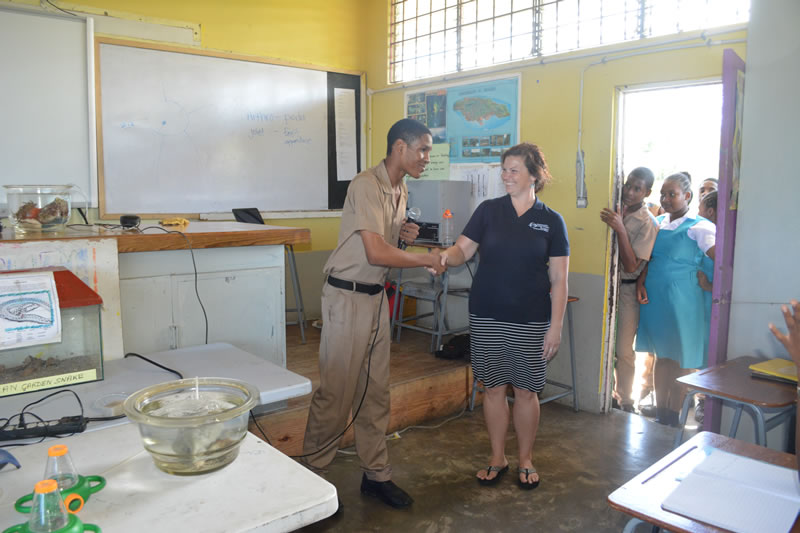
Javar Barnes thanking us on behalf of William Knibb High School and the tenth grade biology class for our ongoing commitment to teaching the students about mangroves.