
search-icon
Cook Islands Field Report

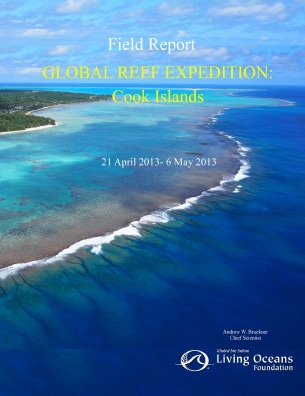
Cook Islands Field ReportFrom 20 October, 2013 – 5 May, 2013, the Khaled bin Sultan Living Oceans Foundation conducted a research mission to the Cook Islands as part of the Global Reef Expedition. The research focused on coral reefs surrounding the islands of Rarotonga, Aitutaki and Palmerston. The project was conducted in partnership with the , with involvement of scientists from Nova Southeastern University, University of the Philippines, NOAA/University of Miami, Atlantic and Gulf Rapid Reef Assessment Program (AGRRA), the National Museum of Marine Biology and Aquarium (Taiwan), and University of Tasmania. Additional support was provided to the Cook Islands Marine Park Steering Committee to assist in discussions of the zoning and management of the new Marine Park. The objectives of the mission were to:

1) Identify and characterize shallow marine habitats and develop habitat and bathymetric maps;
2) Evaluate the composition, structure and health of coral reefs using a standardized assessment protocol;
3) Assess the diversity, abundance and population structure of fishes, corals and other invertebrates, and algae,
including commercially valuable species;
4) Document the impacts of broad scale disturbances and patterns of recovery with emphasis on storm damage
and crown of thorns predation impacts;
4) Evaluate the effects of environmental stressors on coral health and subcellular changes through biomarker
expression; and
5) Measure ocean chemistry (pH) and effects on coral growth.

Groundtruthing: A total of 406 sq. km of WorldView 2 satellite imagery was acquired. To characterize shallow marine habitats, 166 videos (drop cameras) and 1,055,627 depth soundings were taken across the three islands, covering a distance of 260 km. Georeferenced WorldView-2 imagery was used to plan bathymetric tracks to sample habitat locations of interest to drop video cameras. The bathymetric information will be used to calibrate a model which will assign a depth value to each pixel in the imagery data. Similarly, information from the camera drops will be used to assign a habitat type to the imagery data. Together, detailed maps of bathymetry and habitat type will be produced for the three locations visited.

Coral Reef Assessments: Surveys were conducted across the fore reefs surrounding three islands and in lagoonal areas, when possible. A total of 186 fish transects, 196 benthic surveys, 84 coral assessments and 204 phototransects were completed in 30 locations from 5-30 m depth. The population dynamics and health of over 5,800 corals, 4 cm diameter and larger were examined…

Related Posts

Introducing Our New Website: A Fresh Look for the Foundation’s Future

As we celebrate the Khaled bin Sultan Living Oceans Foundation’s 25th anniversary, we are proud to unveil our newly redesigned website—a modern home for our science, conservation work, and educational programs. This launch marks an important moment for the Foundation as we honor our long history and look toward the future of ocean conservation.

For more than two decades, the Foundation has worked tirelessly to improve the health of our living oceans. We have advanced ocean science, led one of the largest coral reef research missions in history, restored mangrove forests with local communities, created award-winning education programs, and shared the wonders of the ocean with people around the world. Our new website reflects the organization we are today—focused on conserving coral reefs, restoring mangrove forests, and improving ocean literacy—while still highlighting the legacy of work that brought us here.

The redesigned site…

Read More

Connecting People, Art, and Oceans: Championing Conservation at the 2025 IUCN Congress

The IUCN World Conservation Congress brings together thousands of leaders and decision-makers from governments, non-profit organizations, civil society, Indigenous groups, and the private sector to shape global conservation policy and action. This influential gathering serves as a platform to share knowledge, build partnerships, and advance initiatives that protect our planet’s biodiversity.

As a member of the International Union for Conservation of Nature (IUCN), the Khaled bin Sultan Living Oceans Foundation was honored to take part in the Congress, joining a global community of leaders, organizations, and changemakers committed to protecting nature and advancing sustainable futures.

Read More
Privacy Overview

This website uses cookies so that we can provide you with the best user experience possible. Cookie information is stored in your browser and performs functions such as recognising you when you return to our website and helping our team to understand which sections of the website you find most interesting and useful.  You can view our complete Privacy Policy here.

Strictly Necessary Cookies

Most of our cookies are used to improve website security and reduce spam. These cookies should be enabled at all times. They also enable us to save your preferences for cookie settings.

3rd Party Cookies

This website uses Google Analytics to collect anonymous information such as the number of visitors to the site, and the most popular pages. Keeping this cookie enabled helps us to improve our website.