
Featured in ASI SCUBA Dive Center Spotlight
March 1, 2023
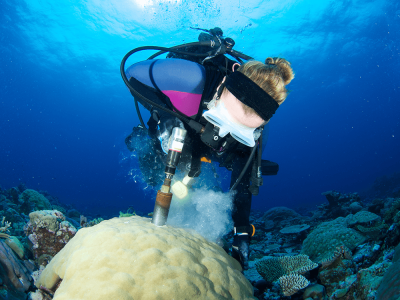
Renée Carlton, a Marine Ecologist at the Khaled bin Sultan Living Oceans Foundation, was featured by Cal Poly Pomona in their SCUBA spotlight in honor of Women’s History Month.
Q: How long have you been SCUBA diving, and what inspired you to pursue it?
A: I’ve been SCUBA diving since I was in high school, so almost 19 years. (Yikes, I feel old!) For my senior year, we had to do a “senior project” that included either learning a new skill or doing something that would help with a future career. Since I knew I wanted to be a marine biologist, I was able to do SCUBA as part of my project, which is when I got my advanced diver certification. My love for the ocean started in second grade, so it was a natural step to take to pursue my career. I grew up in California and always spent time at the beach or in the ocean, and I was always fascinated with what was underwater, so I was inspired to try it out. I loved it, and I haven’t looked back since!
Q: In honor of Women’s History Month, tell us about women in the STEM and diving community that inspire you in your career.
A: It would be a disservice not to mention Her Deepness, Dr. Sylvia Earle, as someone who has inspired my career. She is such an incredible scientist and conservationist that has paved the way for women in this field. So many STEM fields are still male-dominated, so to have such a strong, independent, and fierce woman who is not afraid to advocate for what she believes in as a leader in this field has helped inspire me to follow my dreams.
But I think the people that had the most impact were all the women friends, colleagues, and advisors that helped me throughout my career and life. I have been able to surround myself with so many strong women scientists who have always lifted me up, encouraged me, and shared their experiences with me. They have all, in some way, helped pave the path my life and career have taken.
 Q: How do you apply SCUBA diving to your career and life?
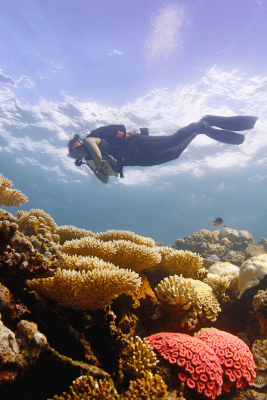
A: After high school, I attended San Diego State University, where I was able to use SCUBA and volunteer in numerous labs to help with fieldwork. This really helped solidify my love for being in or on the water, and I knew I wanted to stick with it. After I graduated with my bachelor’s degree in biology with an emphasis in marine biology, I conducted climate change research in Alaska that was more land-based. But because I missed the ocean and SCUBA diving, I decided to pursue marine science again. I ended up attending the University of Miami, where I earned my master’s degree studying the impacts of ocean acidification on coral reefs. This required a lot of fieldwork, where I was diving and snorkeling on reefs in the northern Florida Keys. After graduation, I worked for a NOAA lab for a few years, where I was provided with the opportunity to travel around the world and study coral reefs, collect coral core samples, and visit some of the most remote and pristine reefs in the world. Some of the work and travel was done in partnership with the Khaled bin Sultan Living Oceans Foundation, which was leading the Global Reef Expedition. After a few years, I was hired to work for the Living Oceans Foundation, where I help to do just this and have helped conserve coral reefs worldwide.