
search-icon
The 2022 Hunga-Tonga Mega-tsunami: Near-Field Simulation of a Once-in-a-Century Event

Published in Science Advances

Abstract

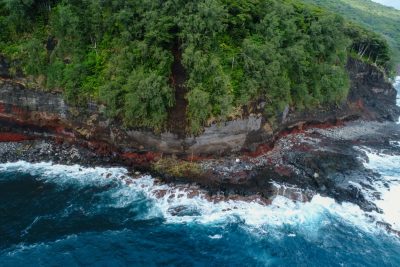
Drone shot showing the damage to the coastline Tofua, the island in Tonga which received the largest tsunami wave. Image courtesy of co-author, Dr. Shane Cronin (University of Auckland).

The 2022 Hunga Tonga-Hunga Ha’apai eruption generated a once-in-a-century magnitude tsunami.

The Hunga Tonga-Hunga Ha’apai (HTHH) volcanic eruption in January 2022 generated a catastrophic tsunami and contends for the largest natural explosion in more than a century. We present a tsunami simulation of the Tongan Archipelago calibrated by field observations, drone, and satellite data. The main island, Tongatapu, suffered waves up to 17m and Tofua Island up to 45m, comfortably placing HTHH in the ‘megatsunami’ league. Our simulation emphasizes how the complex shallow bathymetry of the area acted as a low-velocity wave trap, capturing tsunami for more than one hour. Despite its size and long duration, this tsunami claimed few lives. Simulation suggests that HTHH’s location relative to urban centers saved Tonga from a worse outcome. Whereas 2022 seems to have been a lucky escape, other oceanic volcanoes possess the capacity to spawn future tsunami at HTHH scale. Our simulation amplifies the state of understanding of volcanic-explosion tsunami and provides a framework for assessment of the future hazard in Tonga and beyond.


Model of Tonga Tsunami

Animation of the tsunami propagation across the Tonga archipelago. Credit: Steven N. Ward – Institute of Geophysics and Planetary Physics, University of California Santa Cruz, U.S.A.
Related Posts

2025-2026 B.A.M. Student Voices

Throughout the Bahamas Awareness of Mangroves (B.A.M.) and Jamaica Awareness of Mangroves in Nature (J.A.M.I.N.) programs, we evaluate each phase of the mangrove education and restoration process to better understand how students are learning, growing, and connecting with their coastal environments.

Before the programs begin, students share what they already know about mangroves and how they feel about them. As the program progresses, we continue to gather feedback to see how their knowledge evolves from identifying mangrove species and understanding food webs to recognizing the role mangroves play in coastal protection and climate change mitigation.

But the surveys go beyond science content.

We also ask students…

Read More

Ten Years of B.A.M.: Rooted in Partnership, Growing in Purpose

Ten years ago, the Bahamas Awareness of Mangroves (B.A.M.) program began with a simple but meaningful commitment: to connect Bahamian students with the mangrove ecosystems that shape and protect their island home.

Since 2015, B.A.M. has been implemented in partnership with Friends of the Environment, whose dedication to environmental stewardship in Abaco has made this program possible year after year. Together, we have worked alongside Patrick J. Bethel High School and Forest Heights Academy to bring hands-on mangrove science into classrooms and out into the field.

What makes ten years remarkable is not just longevity — it is consistency…

Read More