search-icon
Unprecedented coral bleaching induced mortality in Porites spp. at Rangiroa Atoll, French Polynesia

Unprecedented coral bleaching induced mortality in Porites spp. at Rangiroa Atoll, French Polynesia. Marine Biology 139(1): 183-189

In April–May 1998, mass coral bleaching was observed in the lagoon of Rangiroa Atoll, Tuamotu Archipelago, French Polynesia. Six months later, the extent of bleaching-induced coral mortality was assessed at three sites. Corals in the fast-growing genus Pocillopora had experienced >99% mortality. Many large colonies of the slow-growing genus Porites (mean horizontal cross-sectional area 5.8 m2) had also died – a phenomenon not previously observed in French Polynesia and virtually unprecedented world-wide. At one site, 25% of colonies, or 44% of the pre-bleaching cover of living Porites, experienced whole-colony mortality. At the two other sites, recently deadPorites accounted for 41% and 82% of the pre-bleaching live cover. Mortality in Porites was negatively correlated with depth between 1.5 and 5 m. Using a 50-year dataset of mean monthly sea surface temperature (SST), derived from ship- and satellite-borne instruments, we show that bleaching occurred during a period of exceptionally high summer SST. 1998 was the first year in which mean monthly SSTs exceeded the 1961–1990 upper 95% confidence limit (29.4°C) for a period of three consecutive months. We suggest that the sustained 3-month anomaly in local summer SST was a major cause of coral mortality, but do not discount the synergistic effect of solar radiation. Recovery of the size-frequency distribution of Porites colonies to pre-bleaching levels may take at least 100 years.
 

Related Posts

OceanImageBank_TheOceanAgency_Bleaching_16-scaled-1

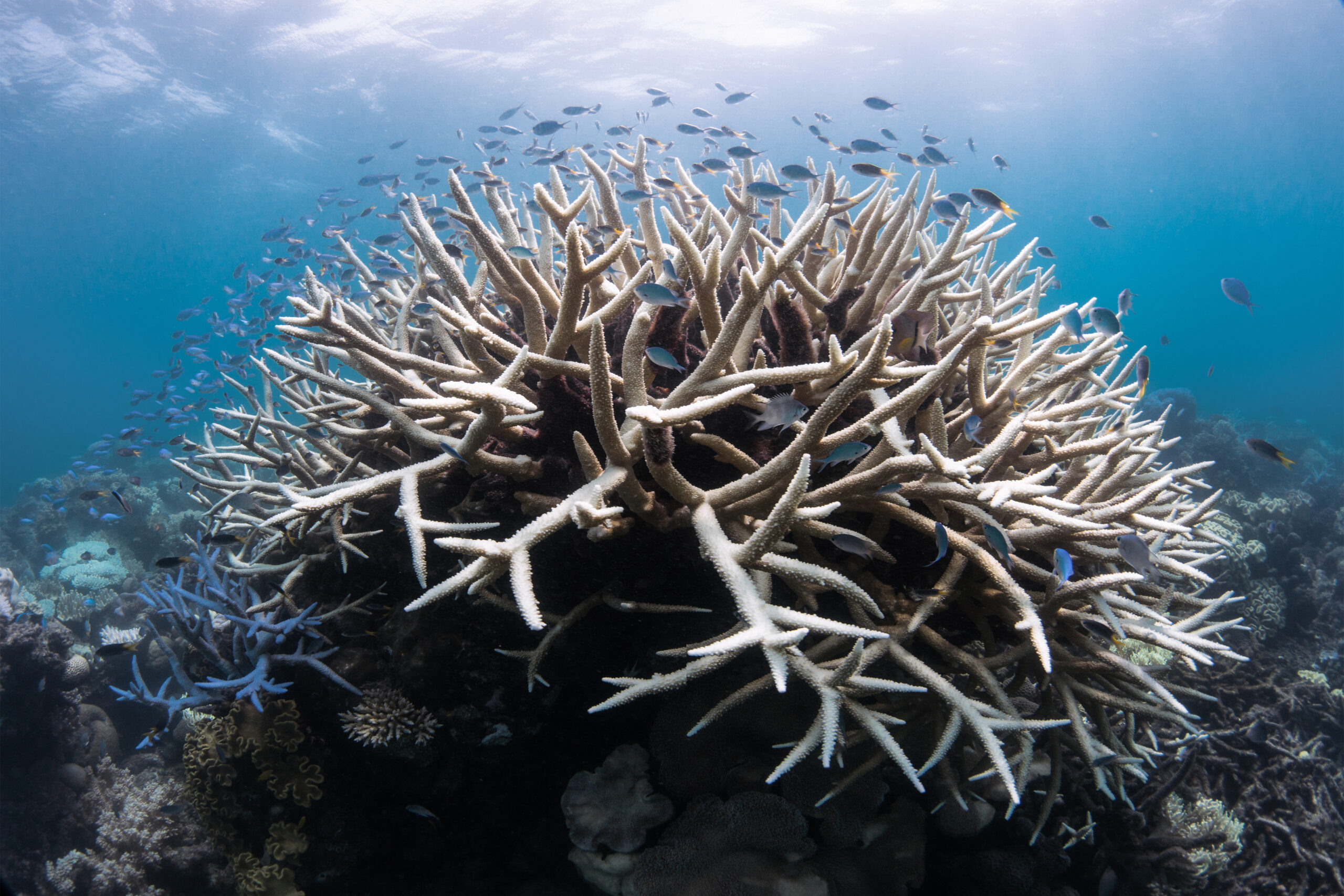
Coral Bleaching Awareness Month: Giving Coral Reefs a Chance to Recover

For hundreds of millions of years, coral reefs have supported life in our oceans. Although they cover less than 1% of the ocean floor, they provide habitat for at least 25% of all marine species. They also support people around the world by sustaining fisheries and tourism, providing food and livelihoods, and helping protect coastlines from waves and storms.

But coral reefs are under increasing pressure. Pollution, overfishing, coastal development, physical damage, and increasingly warm ocean temperatures can all affect reef health. One of the most visible signs that a coral reef is under stress is coral bleaching.

This September, in recognition of Coral Bleaching Awareness Month, we’re taking a closer look at what happens when corals bleach, why bleaching matters, and what scientists around the world are doing to better understand, protect, and restore coral reefs.

Read More

Everything You Need to Know About the 2027 Science Without Borders® Challenge

Are you ready to combine your creativity with ocean science?

The 15th Annual Science Without Borders® Challenge is now open! Whether you’re participating for the first time or returning for another year, this guide will help you get started.

This year’s theme, Navigate With Care, invites students to explore how responsible navigation helps protect both people and life in the ocean. Through your artwork, you can compete for scholarships and international recognition while inspiring others to protect both people and life in the ocean.

Read More
Privacy Overview

This website uses cookies so that we can provide you with the best user experience possible. Cookie information is stored in your browser and performs functions such as recognising you when you return to our website and helping our team to understand which sections of the website you find most interesting and useful.  You can view our complete Privacy Policy here.

Strictly Necessary Cookies

Most of our cookies are used to improve website security and reduce spam. These cookies should be enabled at all times. They also enable us to save your preferences for cookie settings.

3rd Party Cookies

This website uses Google Analytics to collect anonymous information such as the number of visitors to the site, and the most popular pages. Keeping this cookie enabled helps us to improve our website.