search-icon
The Fire Salps

Several of us have encountered a free-floating colonial tunicate during our dives on leeward reefs.  Known as Pyrosomes (from the Greek, pyro = fire and soma = body), these unusual tunicates consist of cylindrical- or conical-shaped colonies made up of hundreds to thousands of zooids. While some are only a few cm in length, the ones we’ve seen have been over a meter in length. Their name comes from their bioluminescence, a pale blue-green light that is emitted in waves as each individual zooid detects light and emits light in response.
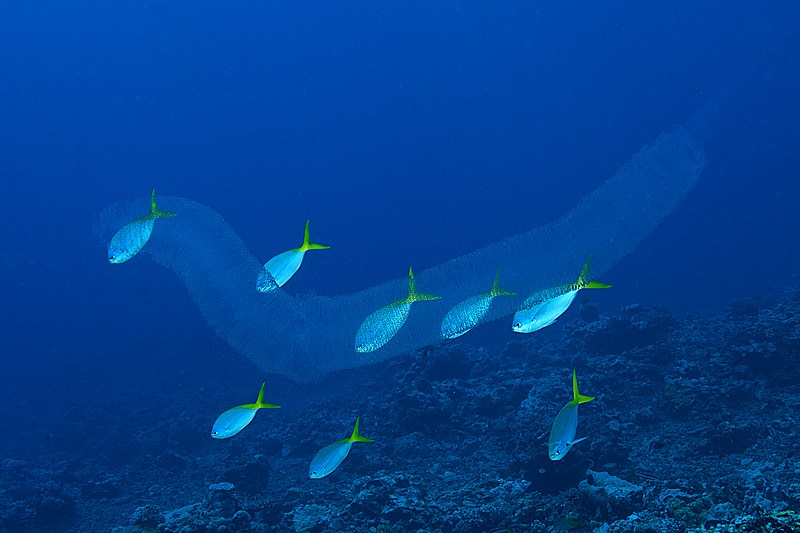
Pyrosomes
A pyrosome.

Like other tunicates, the individual zooids (each a few mm in size) are embedded in a gelatinous tunic, and are all joined together.  Each zooid has two siphons, one opens to the inside and the other to the outside of the tube.

Large scale movements of these animals are largely controlled by currents, tides, and waves. Pyrosomes can also move through the water column slowly by the process of jet propulsion created by the coordinated beating of cilia in their branchial baskets.  This process also aids in feeding.


Photo by Ken Marks.
Related Posts

2025-2026 B.A.M. Student Voices

Throughout the Bahamas Awareness of Mangroves (B.A.M.) and Jamaica Awareness of Mangroves in Nature (J.A.M.I.N.) programs, we evaluate each phase of the mangrove education and restoration process to better understand how students are learning, growing, and connecting with their coastal environments.

Before the programs begin, students share what they already know about mangroves and how they feel about them. As the program progresses, we continue to gather feedback to see how their knowledge evolves from identifying mangrove species and understanding food webs to recognizing the role mangroves play in coastal protection and climate change mitigation.

But the surveys go beyond science content.

We also ask students…

Read More

Ten Years of B.A.M.: Rooted in Partnership, Growing in Purpose

Ten years ago, the Bahamas Awareness of Mangroves (B.A.M.) program began with a simple but meaningful commitment: to connect Bahamian students with the mangrove ecosystems that shape and protect their island home.

Since 2015, B.A.M. has been implemented in partnership with Friends of the Environment, whose dedication to environmental stewardship in Abaco has made this program possible year after year. Together, we have worked alongside Patrick J. Bethel High School and Forest Heights Academy to bring hands-on mangrove science into classrooms and out into the field.

What makes ten years remarkable is not just longevity — it is consistency…

Read More