French Polynesia is a long way from my hometown of St. Albert in Alberta, Canada. For many of my students, coral reefs are an abstract concept. Fortunately, in my short time with the science team, I have acquired many amazing examples I can bring back to the classroom that can add context to the subjects I teach my students. I’ve seen firsthand how reef diversity can be measured by using various types of transects and quadrats. I’ve observed how relationships between fish size and abundance can help the team assess reef health. Photographs and videos document the issues affecting the corals. Each dive brings their research to life, and helps me to understand the complexity involved in their data collection.
Underwater Cameras Capture Fish Reality TV for Coral Reef Herbivores
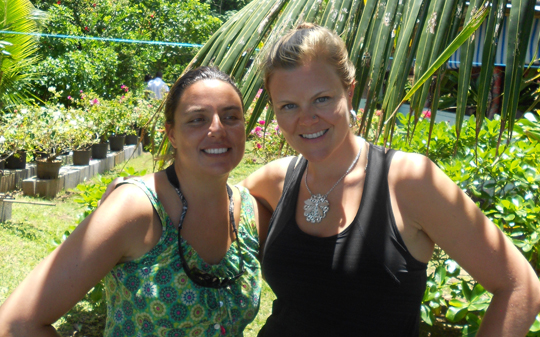
I’ve had the opportunity to spend a good amount of time with Dr. Sonia Bejarano, a Khaled bin Sultan Living Oceans Foundation post-doctoral fellow from the Marine Spatial Ecology Laboratory at the University of Queensland in Brisbane, Australia. I was curious about her research from the moment I saw her pull up ten tiny underwater cameras from the reef. Dr. Bejarano is researching the grazing behavior of herbivore fish on the algae of the reef. Too much algae may make it difficult for coral to grow while too little algae may limit the food supply for these herbivores. How is a balance maintained? What effect do herbivores have on the reef? Do they keep the algae in check? Can their grazing be used as an indicator for reef resiliency? These complex questions keep Dr. Bejarano invested in her work.
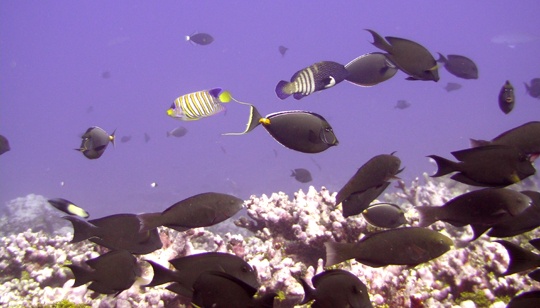
Today, I helped Dr. Bejarano set up and collect her underwater cameras on the south end of Raiatea at a depth of 33 feet. She installs a total of ten cameras, each one filming a one-meter quadrat. Setting up the underwater cameras is very labor intensive and takes about 45 minutes. Each camera must be weighted, turned on, and focused towards the quadrat to capture the area of study. It made me think of reality TV, but for fish!
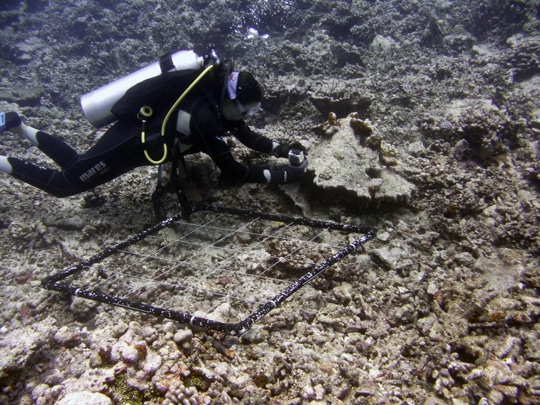
I found diving with so much extra equipment to be awkward and difficult, and I was impressed with the speed and accuracy Dr. Bejarano sets up and collects her underwater cameras. She films the fish to observe their behavior when divers are not present. Fish will often hide or act differently when approached by a diver. As a result, she usually doesn’t use the first 15 minutes of her footage. She analyzes what the cameras record for an hour after that point, hoping the video will yield some answers to her questions.
Dr. Bejarano’s calm temperament and sophisticated flare make her a very enjoyable dive partner. I am grateful to learn about her work and intrigued by the complexity of her research. Just when my mind seems to come up with a possible hypothesis on herbivore-algae relationships, I’m dragged back to the beginning to see another side of the puzzle. I suppose until it is fully understood, Dr. Bejarano will continue to tune in to see what goes on when the underwater cameras roll, one hour of footage at a time.
(Photos by: 1 and 3 Candice Jwaszko, 2 Dr. Sonia Bejarano)
To follow along and see more photos, please visit us on Facebook! You can also follow the expedition on our Global Reef Expedition page, where there is more information about our research and team members.