Focus for today:
Sex-changing fish: The future of Nemo?
Target key stage:
Key Stage 4: National Science Curriculum, Dual Award, Sc2, 5a: the distribution and relative abundance of organisms in habitats can be explained using ideas of interdependence, adaptation, competition and predation.
Key information:
Fish come in an incredible array of shapes and colors; in fact many species possess various morphs that look very different from one another. The disparity (difference) between males and females can be so striking that for some early fish ichthyologists (fish biologists) even misclassified the two sexes as different species.
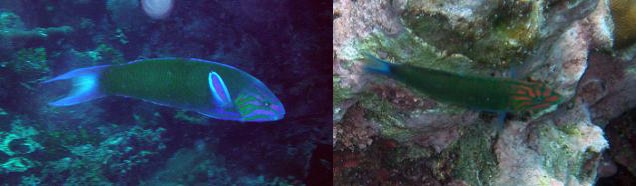
Male Wrasse Female Wrasse
Sex-changing Fish: If this was not surprising enough, some fish can also change their sex, and they actually change their look as they turn from male to female or vice versa… Yes, you read well: some fish are able to change gender… For instance, various species in the Labridae family (the wrasses) are protogynous sequential hermaphrodites: this means they start as females, but then, they can become male. In particular, researchers have extensively studied a common Caribbean fish: Thalassoma bifasciatum, the blue head wrasse. For this species, the females and some males called “intermediate type” (IP) are a drab yellow with brownish bands; but some large males sport a bright blue head and a green body separated by an oreo like pattern, they are called terminal phase males (TP). Usually, a TP defends a small territory where he courts and spawns with a harem of several females.
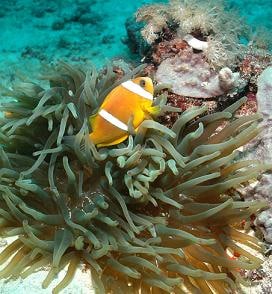
Nemo!
However, if all the males are removed from a patch reef, the largest female takes over the area: within minutes she starts behaving like a male, she courts and defend the territory; then, within a few days she turns into a true blue headed TP male. This permits the sex-changing fish to greatly increase the size of its progeny (offspring) since he can now fertilise the eggs of all the females in its territories. Furthermore, one could also argue that it allows the population of the small patch reef to keep on reproducing.
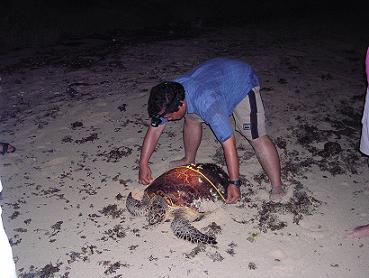
Measuring the Hawksbill
Can some species change from male to females instead? Yes, and this is precisely what many fishes of the genus Amphiprion (the famous anemone fishes like Nemo) do. These are called protoandrous sequential hermaphrodites because they start their life as males. They form monogamous pairs (lifelong partnerships) and live in one anemone that protects them from predators. When two young Amphiprion find an anemone to settle in, the largest one of the couple turns into a female; this permits any two settling fish to become a pair instead of having to wait for another fish of the opposite sex. Sometimes the resident couple allows a few smaller males to dwell in their anemone, but these little fish do not reproduce.
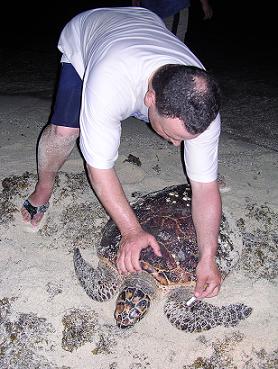
Tagging
However, if the dominant female dies, her mate is now the largest fish in the “house”; consequently he turns into a female and one of the small previously non-reproductive male becomes her partner. So, based on this biological fact, if a sequel to “finding Nemo” was made, what do you think it should to be entitled? “Meeting Nema” perhaps…
Question for students/food for thought:
Try to go to a fantastic website called “fish base” to find pictures and facts about Thalassoma bifasciatum (click on the first picture shown on the fishbase website to see more). Then go ahead and look for any fish species you are interested in, you can enter a scientific name (made of two parts: genus and species) or any common name.
Have fun!
Additional information:
As the Farasan islands are rarely visited by scientists, this expedition provides an opportunity to make some unique observations. Last night a team went ashore to look for signs of turtles laying eggs on the beaches of the Kerah Island.
The team were lucky, and infact tagged a Hawksbill turtle – this turtle was the first to be measured in the Farasans Protected Area! Each tag is individually numbered (tag no: 14002) so that if the same turtle is observed again, the date and location, and its size, can be recorded and added to the existing data for that particular turtle.
As such, turtle growth rates and migrations can be monitored; in some cases migrations can extend entire oceans….
Last nights Curve Carapace (shell) Length (CCL) was 74.5 cms, and its width was 67 cms. This turtle is somewhat larger than expected, as Red Sea Hawksbill turtle CCL mean measurements are 71.93 cms (Sudan), 69.4 cms (Yemen) and 71.5 cms (Arabian Gulf).