Focus for today:
Reef Creatures.
Target key stage:
Key Stage 4: National Science Curriculum, Dual Award, Sc2, 4a: variation arises from genetic causes, environmental causes and a combination of both.
Key information:
The sea not only occupies approximately two thirds of the surface of our planet, but it is also home to a large proportion of the species that inhabit it, and diversity at higher taxonomic levels is much greater than on land or in freshwater. There are about 82 eukaryote phyla (organisms with a cell structure) currently recognised, and out of these about 60 have marine representatives, while only 40 are found in either freshwater or on land. The reason for this high number of phyla inhabiting the sea is that most of them originated in the sea in the first place, and subsequently colonised land or freshwater. About 23 eukaryote phyla, 18 of which are animals, are confined to the marine environment.

Christmas Tree Worm
Most of these reef creatures are obscure phyla with few representative species, but the exceptions are the Echinodermata (sea urchins, starfish, sea cucumbers, brittle stars and crinoids) which contains around 6,000 recorded species, and the forameniferans with around 4000 recorded species (with many more in the fossil record). Other phyla like the Cnidaria (that includes the corals and anemones), sponges and brown and red algae are almost exclusiely marine, with only a small number of freshwater representatives. Most of the reef creatures we have focused on to date are pretty conspicuous, namely the corals and the fish. But reefs are the home to hundreds of species with representatives from most of the phyla that inhabit the sea.
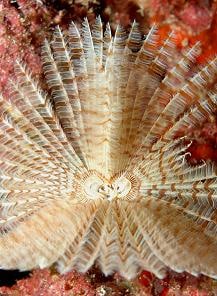
Tube worm
It is therefore not surprising that reefs are commonly referred to as the “rainforests of the sea” due to their staggering diversity of reef creatures and beauty. Divers that stop to really look at a reef close up soon realise that there is a lot more to it than just coral and fish! The reef framework is home to sea urchins, crinoids, sea cucumbers, tube worms, feather stars, sponges, algae, crustaceans and molluscs to name a few.
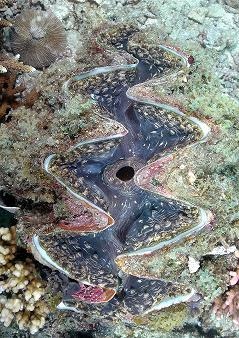
Giant clam
Many of these reef inhabitants are never seen on the reef surface as they live deep inside the coral structure. For example, recent mollusc studies have discovered countless species of tiny molluscs living within single coral heads. Taxonomist simply cannot keep up with the number of small species being discovered, there are too many and their identification requires very specialised knowledge.
This expedition does not carry a taxonomic component (unless new corals or fish are discovered), but you can be sure that in the last few weeks we have unwittingly witnessed more than one new species. We have however enjoyed the vast array of life we have witnessed, both large and small.
Question for students/food for thought:
Some of the most beautiful reef creatures we have seen are the echinoderms which include sea urchins and starfish. Can you suggest why such different looking animals as these are included in the same phylum, and why have they not colonised land.
The CASI surveys are drawing to a close – have a look at the image of the area flown (the coloured lines indicate the flight lines). Data collected from the CASI surveys will enable detailed habitat maps to be integrated into a Geographical Information System for the Farasan Islands, which in turn will help the Kingdom of Saudi Arabia to implement more effective management of the protected area.
Over dinner tonight we learnt that the ground truthing team has observed seagrass (Thalassodendron sp.) – strangely the observation was in the waters adjacent to an island with no name! This is the first observation of seagrass by the research team on this expedition, although our Saudi Arabian colleagues have observed it during their search for Dugong (it is the Dugongs preferred habitat). There is speculation that the seagrass might be more abundant in the southern Farasan islands. Our work over the coming days will reveal more…..

CASI flight lines (overlaid on Farasans map)