Focus for today:
Phases of daily life for coral reef fishes.
Target key stage:
Key Stage 4: National Science Curriculum, Dual Award, Sc2, 5a: the distribution and relative abundance of organisms in habitats can be explained using ideas of interdependence, adaptation, competition and predation.
Key Information:
A dive on a coral reef during the day presents a scene of a kaleidoscope of activity by coral reef fishes of many different species, sizes, colors and behaviors, all seeming to be moving everywhere at the same time. There is a pattern and order to this activity but it is not readily apparent because it is usually seen for less than an hour (the time-limit for most dives) and during mid-portion of the day. Coral reef fishes regularly change their behavior and activities in response to cyclic (repeating) changes in environmental conditions on the reef. In marine science these are referred to as the temporal (with time) changes in environmental parameters that alter (or drive) the phases of daily life on the reef. There are many of these environmental parameters and they change frequently. The most prominent are the water currents, which normally change direction every six hours in response to the high and low tidal cycles, and daylight and darkness. There are also changes that are monthly, timed with the phases of the moon’s cycle.
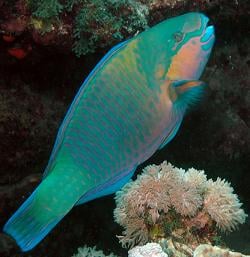
Parrotfish
The Farasan Islands are located at about 16-17° north latitude and the difference in the depth of water between high and low tide is less than 50cm. The currents caused by this minimal tidal cycle can affect the daily phases of life on a coral reef, but the changes are usually obscure. However, it only takes one dive on a coral reef at sunset (or sunrise) to realize that the most dramatic changes in daily life on a coral reef are caused by daylight and darkness. During the day the coral reef fishes are in constant motion. The parrot fish are busy moving around the reef biting off selected chunks of coral, which is passed through their digestive systems to be deposited back on the reef as the primary source of coral sand. The wrasses and butterflyfishes are everywhere, singly, in pairs, or in small schools, searching the both coral and sand for unwary small invertebrates (including coral polyps). The water just above the reef is filled with small fairy basslets and damselfishes busy eating plankton and then dashing back to the protection of the reef. Higher above the reef large schools of fusiliers suddenly appear and then vanish, constantly patrolling for snacks of plankton and larval fishes.
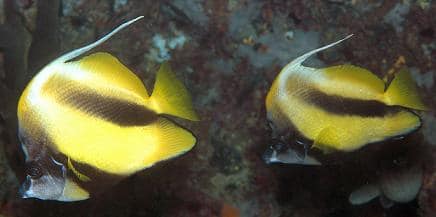
Beautiful butterfly fishes
At sunset, all of this activity slows down and the fish descend to the coral reef, often muting their colors and changing color patterns. Even the constantly moving pelagic (open water) fusiliers begin to mill around on the reef in tight groups. The fish are seeking crevices and other hiding places in the coral reef to spend the night and avoid becoming food for the nighttime (nocturnal) predators, like the sharks, moray eels, and squirrelfish. Many of the wrasses will bury themselves in the sand or coral rubble for the night. The parrotfish even secrete a mucous cocoon that is thought to prevent them from being smelled by predators. The night phase of life on a coral reef changes to patrolling predators, joined by sea urchins and mollusks venturing out from their protective holes to graze on the reef substrate under cover of darkness.
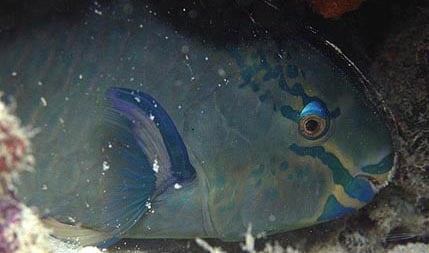
Parrotfish in its night cocoon
Questions for students/food for thought:
The differences in water depth between high and low tides in temperate rocky reefs at higher latitudes can be as much as 5-6m. Why is this so much more than on tropical coral reefs? Why does this movement of water with the ebb and flood tides occur four times each day? How many ways do you think tidal currents can affect the daily phases of life of life of coral reef fishes?
Additional information:
Our fish survey dive protocols require the dives to take place between 9am and 3pm so that we are always surveying the fish during the same phase of daily activity. If we did not do this we would not have census information that would be comparable between days. One day our last survey was delayed and we did not get into the water until 4:30pm. The fish were already descending onto the reef and it was too late to get comparable census data. We did use the information to develop a list of the species in the area.