Focus for today:
The Farasan Islands Protected Area.
Target Key Stage:
Key Stage 4: National Science Curriculum, Dual Award, Sc2, 5a: the distribution and relative abundance of organisms in habitats can be explained using ideas of interdependence, adaptation, competition and predation.
Key information:
The Farasan Islands Protected Area.
The Farasan Islands Protected Area lies in the south east of the Red Sea, 42km offshore of the coastal city of Jizan, within the coordinates 17º 20’ and 16º 20’ E and 42º 28’ and 41º 24’ N. The protected area consists of 84 Islands; the largest 3 islands are named Farasan al-Kabear, Sajeed and Gumah. The islands are composed of old reef pushed upwards by several phases of tectonic movements. The islands are uninhabited except the three large islands, consisting of a population of 20,000.
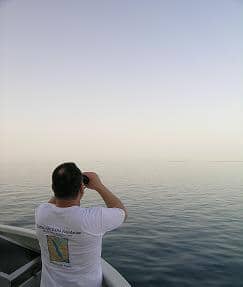
Dr. Al Mansi on early morning dolphin watch at Farasan Islands Protected Area
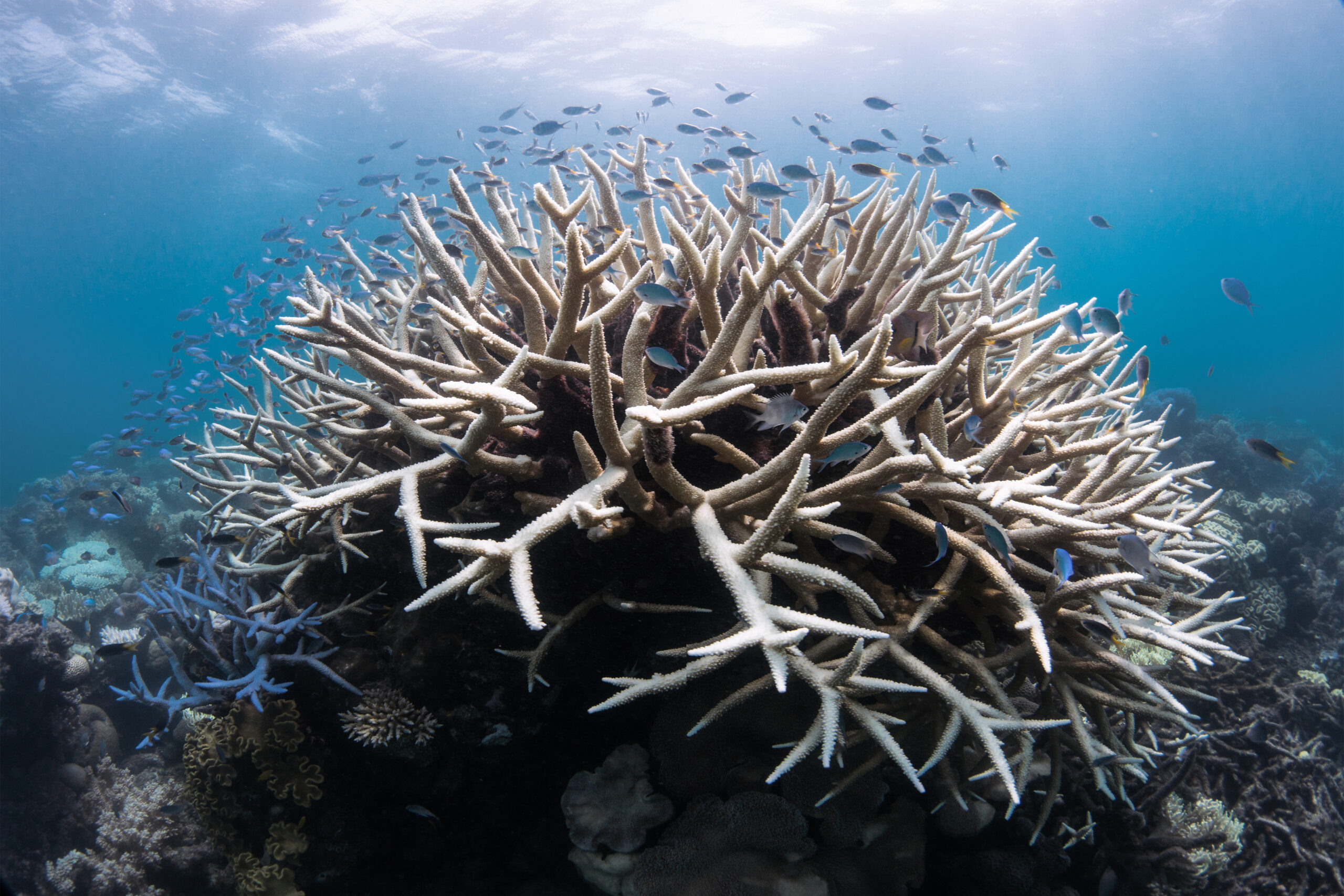
Farasan Islands are rich in marine recourses. They possess a diverse range of habitats, including coral, seagrasses beds, algal reefs, mangrove stands, and intertidal flats. Hawksbill Eretmochelys imbricata and green turtle Chelonia mydas, which are both endangered on a wide scale, are nesting on the Farasan Islands. Also Dugongs, five species of dolphin, and two species of whale are found there; the islands also support numerous species of fishes, including those that are important to artisanal (local) fisheries. In addition to the marine life, the islands sustain large populations of nesting and migratory seabirds.
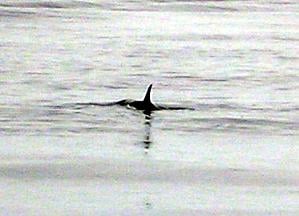
First sighting!
Today the mammals/turtles team on the Golden Shadow observed four schools of common dolphin, Delphinus delphis. Each school of Dolphins ranged from two to twelve animals. They were seen jumping from the water (known as bow riding) whilst the Golden Shadow was in transit to a new anchorage!
The color pattern of the common dolphin is highly variable. The dorsal side is dark grey, and the ventral side light grey to creamy white. There is an hourglass shaped pattern on the flanks, where the dark dorsal and light ventral colors meet, just caudal of the dorsal fin. In front of this “meeting point” there is a yellow-ochre patch and behind it a grey patch. There is a dark stripe from the flipper to the lower jaw and from the eye to the base of the beak. Common dolphins can weigh as much as 135 kg.
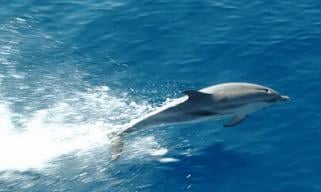
Bow riding!
The common dolphin is the fastest of the small dolphins, attaining speeds over 27 miles per hour. Friendly and sociable, it is often seen travelling in schools. The common dolphin eats herring, sardines, cuttlefish, octopus, and shrimp. Where herring and sardines are abundant, the dolphin is a common sight, but when the fish migrate or become depleted, the dolphin moves on to other feeding grounds in schools often numbering hundreds.
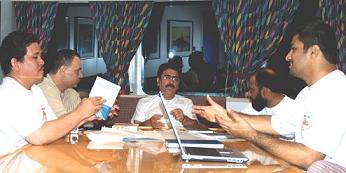
The dolphin observation team
Question for students/food for thought:
How do you think scientists identify individual dolphins? Are there any other features of a dolphin that might help scientists to identify them?
Additional information:
Today has been another very successful day. All research has gone to plan, and the film crew have been busy preparing a ‘story-board’ for next weeks filming. This will involve the use of the Golden Eye seaplane and a helicopter. They aim to get some aerial footage of the Golden Shadow, and the activities of the researchers form an aerial perspective. Remember to watch out for the film on TV later this year!