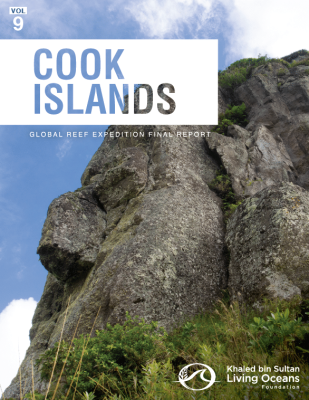
 The Khaled bin Sultan Living Oceans Foundation has published our latest findings from the Global Reef Expedition. Released today, the Global Reef Expedition: Cook Islands Final Report contains critical information on the health and resiliency of coral reef ecosystems in the Cook Islands. It provides scientists, policymakers, and stakeholders with invaluable information they can use to protect and restore these fragile marine ecosystems.
On the Global Reef Expedition, we worked closely with local partners and government officials from the Cook Islands and the Cook Islands Marine Park Steering Committee to study the reefs. Together, we completed over 400 surveys of the coral and reef fish communities surrounding Rarotonga, Aitutaki, and Palmerston Atoll.
What we found surprised the scientists. Although the reefs we surveyed in Palmerston were healthy, and most reefs around Rarotonga were doing well, the coral reefs surrounding Aitutaki were being ravaged by an outbreak of crown-of-thorns starfish (COTS).
“When we arrived in Aitutaki, it was evident immediately that there was a problem. Reefs that should have been flourishing were being eaten alive before our eyes by thousands of starfish,” said Alexandra Dempsey, the Director of Science Management at the Foundation and one of the report’s authors. The reef was in crisis. In some places in Aitutaki, COTS had damaged 80-99% of coral on the seafloor. “We couldn’t help but intervene.”
The science team collected 540 COTS from reefs around Aitutaki over the course of a few days. We returned to the Cook Islands in 2015 to assess the damage, remove any remaining crown-of-thorns starfish, and see how the reefs had changed. Based on our experience in the Cook Islands, we created a best-practices guide for dealing with future COTS outbreaks.
Despite the damage done by COTS in Aitutaki, the report’s authors are optimistic about the future of Cook Islands’ reefs. Many of the other reefs surveyed were in good shape compared to other coral reefs around the world. “With continued efforts to protect and preserve their reefs, coral reefs in the Cook Islands could become some of the best in the South Pacific,” said KSLOF marine ecologist Renée Carlton.
The Global Reef Expedition: Cook Islands Final Report provides scientists, managers, and stakeholders with valuable baseline data on the status of the reefs at a point in time. In addition to the information contained within the report, over 400 square kilometers of detailed coral reef habitat and bathymetric maps were published online. This information can help managers identify priority sites for conservation action and track changes to the reef over time.
The Foundation produced an award-winning film, Mapping the Blue, about our mapping efforts in the Cook Islands. The film stars international rugby star and conservationist Kevin Iro, who joined us on the expedition and helped to establish Cook Islands’ marine park, Marae Moana—the largest marine protected area in the world.
“We are excited to receive the report and are most appreciative of the work done by Living Oceans foundation,” said Marae Moana Ambassador Kevin Iro. “This report will definitely help with our current marine spatial planning of the Marae Moana and it also demonstrates that government and non-government organizations can work cooperatively to better understand our ocean environment.”
The Khaled bin Sultan Living Oceans Foundation is glad our research will be used in marine conservation efforts in the Cook Islands, and hope these reefs will continue to flourish for generations to come.
“It was a privilege for the Foundation to work in the Cook Islands which turned out to offer some of the more vibrant reef systems encountered on the Global Reef Expedition,” said Sam Purkis, KSLOF’s Chief Scientist as well as Professor and Chair of the Department of Marine Geosciences at the University of Miami’s Rosenstiel School of Marine and Atmospheric Science. “It was particularly reassuring to see that the conservation initiatives already in place in the country, such as the widespread use of marine protected areas and reserves, are paying dividends. It is our sincere hope that the habitat and benthic maps that we have produced for the Cook Islands from satellite, along with the extensive portfolio of field data, will serve to bolster these ongoing efforts and catalyze even more ambitious conservation actions.”
Global Reef Expedition: Cook Islands Final Report
The Global Reef Expedition: Cook Islands Final Report presents the Foundation’s findings from the Global Reef Expedition mission to the Cook Islands along with recommendations that can help preserve the reefs into the future.