Expedition Log – Day 12
One of the largest challenges for our coral surveys is the proper identification of the corals. When measuring and counting corals along transects we rarely identify them to species, mainly because there are some 450 species of corals found on Palau’s reefs – but we do compile a species list for each dive site. In many cases, even identifying a coral to genus can be tricky.
First, coral nomenclature is in a state of flux. Traditionally, species were described and named based on morphology – the shape of the corallite (the skeleton that houses the polyp), whether neighboring corallites share walls or have separate walls, whether new polyps are formed by intratentacular budding (a parent polyp divides into two) or extratentacular budding (daughter polyps form on the side of the parent), the size and shape of the septa (radial elements that divide the corallite), if they have pillar like projections on the inner margin of the septa, and many other features that are often very difficult to see under water. With new genetic tools, we’ve learned that many of the corals placed in certain families are actually more closely related to other families. As a result, about a year ago, there was a major revision, and many of the names that we had learned no longer exist.
Corals often have unique growth forms – they may be massive, branching, encrusting, columnar, foliaceous, or plate-like. Individual species can exhibit multiple growth forms however, depending on the physical environment. Wave exposure, light levels and a number of other features can cause variations in growth form, as can the biological environment and genetic control. Hence, growth form is not necessarily a feature that can be used to distinguish a species.
Within a single genus, corals can exhibit a number of different growth forms. The perfect example is Acropora, one of the most common corals found on the reef. These form digitate (finger-like) colonies, simple branches, bottle-brush branches, bushes, crusts, mounds, thick, flattened branches, and tables. Within a growth form there is even more variation. For instance table acroporiids include colonies that have tightly interwoven branches that point out, and some have very fine upward pointing branches.
Different growth forms of genus Acropora are one example of coral taxonomy challenges:
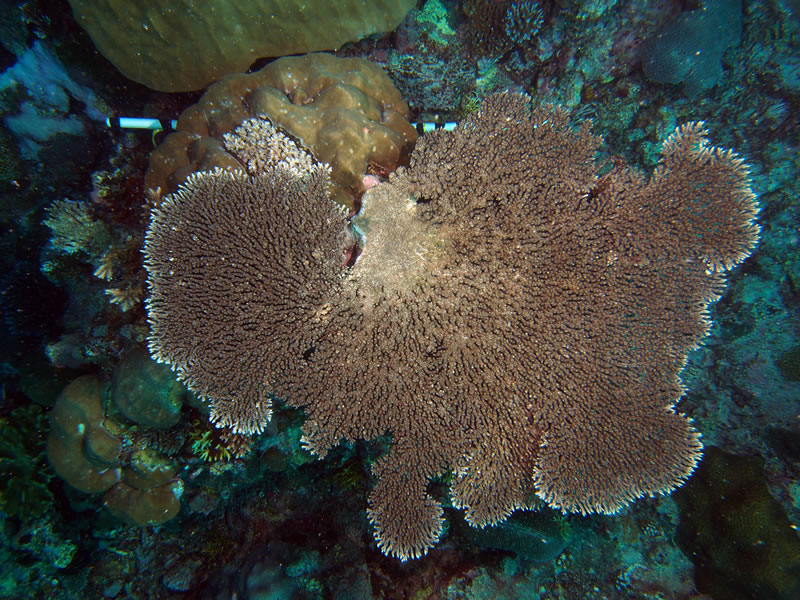
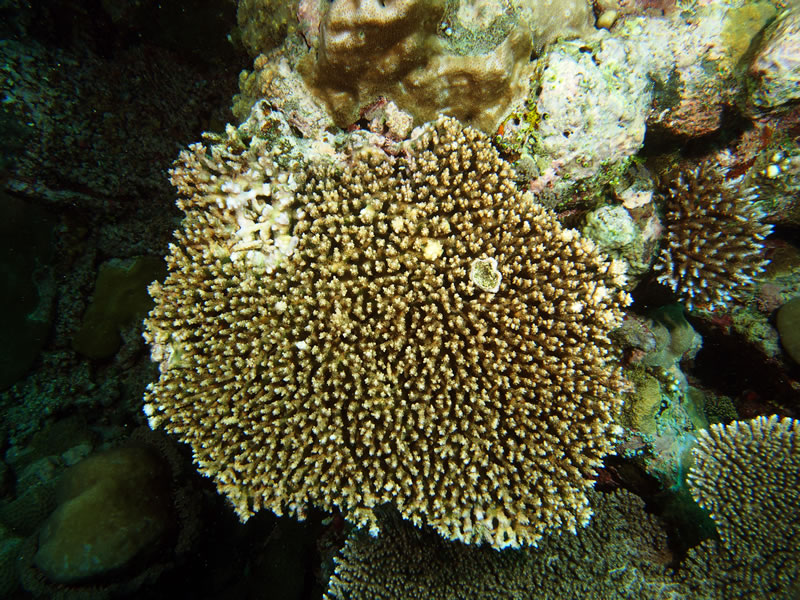
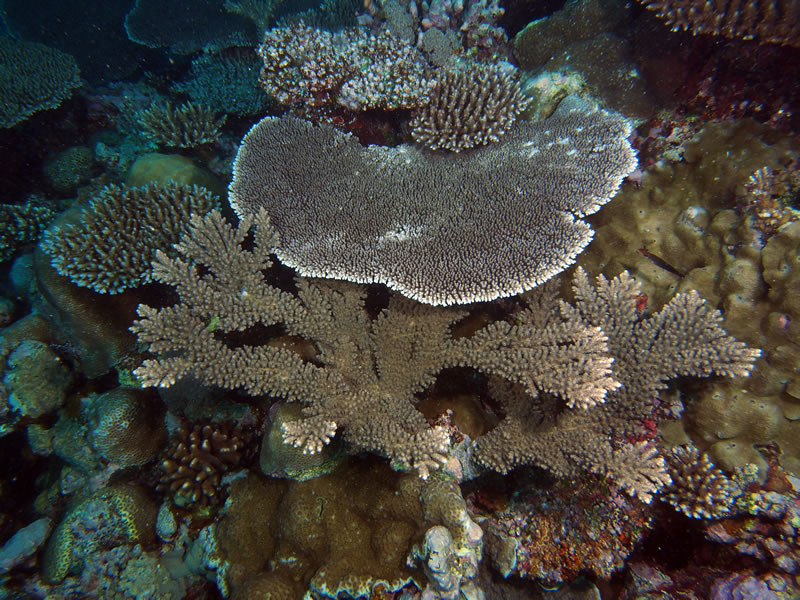
A. clathrata (left) / A. cytherea (middle) / and (right) A. hyacinthus in the center with A. spicifera beneath it
(Click-thru on images for greater detail.)
The family Faviidae is another tricky one to identify. There are some with distinct rounded star-shaped corallites with separate walls and others that have individual polyps that share walls. Also, when growing and forming new coral polyps some species bud off from one polyp (extratentacular budding), while others split in two (intratentacular budding).
Different growth forms of family Faviidae:
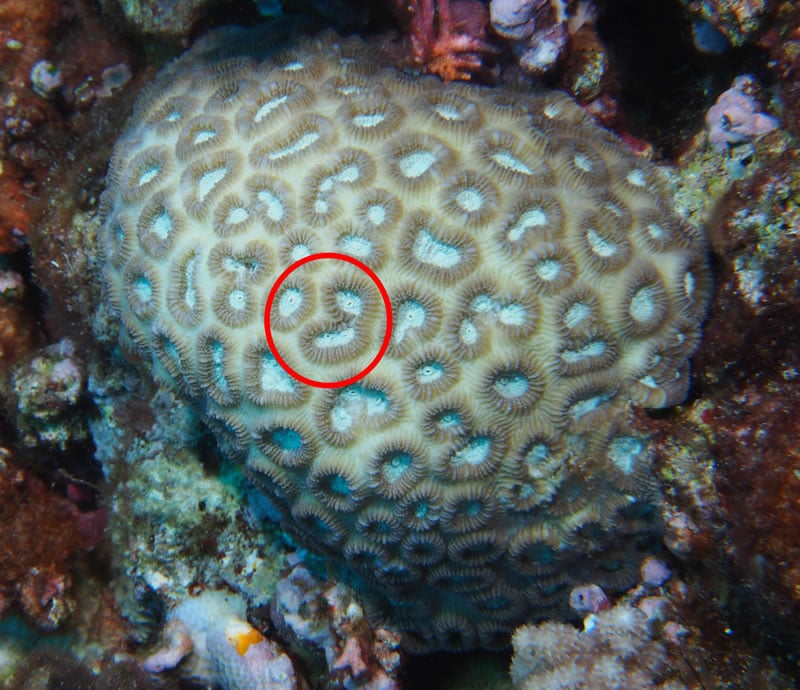
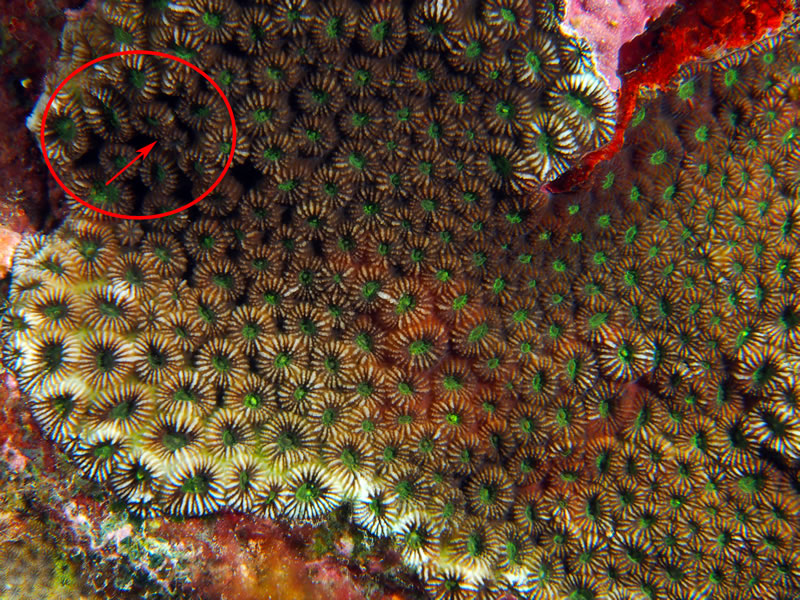
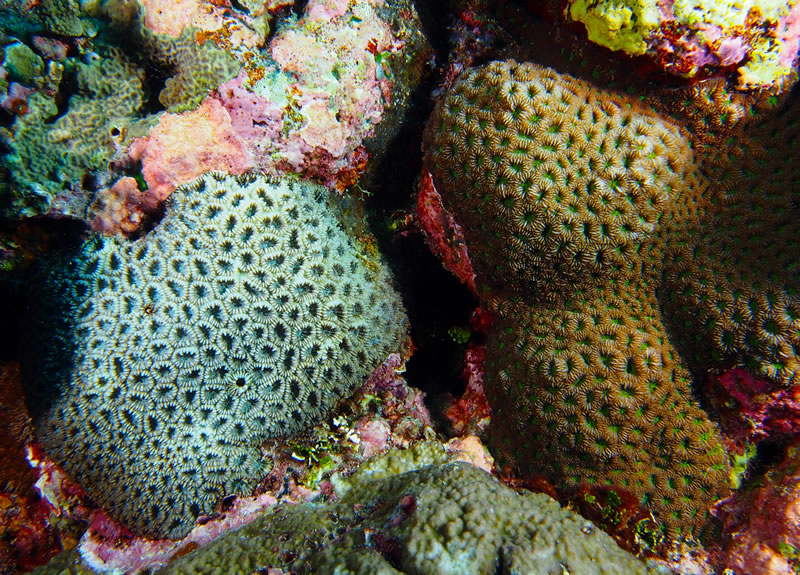
Favia favus intratentacular budding (left) / Montastrea extratentacular budding (middle) / Favia matthaii on the left side and Montastrea valenciennesi on the right side (right)
(Click-thru on images for greater detail.)
The genus Montipora is another story. It can form plates, foliaceous sheets, crusts, branches or a combination of these, and can be confused with other coral species. Many of these can only be identified in the lab, using a microscope.
Another difficult genus to identify, Montipora:
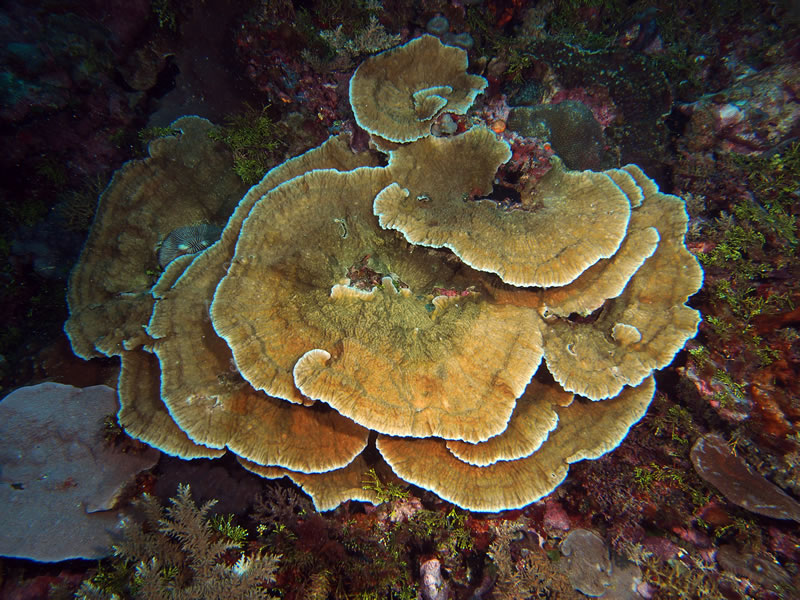
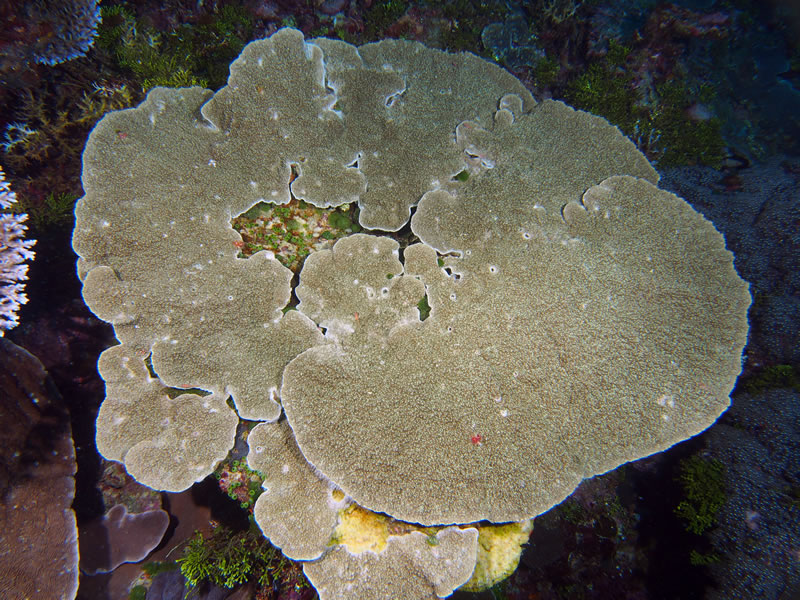
M. foliosa (left) / A different species of plating Montipora (right)
(Click-thru on images for greater detail.)
Given these challenges, our evenings on the ship are spent evaluating and studying photographs, coral identification manuals, and specimens.
Photos by Andrew Bruckner.