The response to our 2025 Science Without Borders® Challenge has been overwhelming! We’ve been blown away by the sheer number of submissions we received from aspiring young scientists and artists worldwide. Last week, we proudly unveiled the finalists in the 11-14 age group, and now, we’re ecstatic to announce the finalists in the 15-19 year-old category.
These gifted students come from all over the globe, including The Bahamas, Canada, China, Greece, Japan, Indonesia, Korea, Thailand, and the United States. Their artwork brings the 2025 theme, “Marine Keystone Species,” to life in extraordinary ways. From intricate illustrations of krill and coral to impactful portrayals of sharks, sea otters, polar bears, mangroves, and more, each piece highlights the essential roles these species play in maintaining ocean balance and biodiversity.
Without further ado, please meet our talented 15-19 year old finalists! These exceptional artists have not only showcased their incredible talents but also their unwavering passion for marine conservation.
15-19 Year-Old Finalists
"Clustered Red Flowers" by Xinyue Jia, Age 15, China
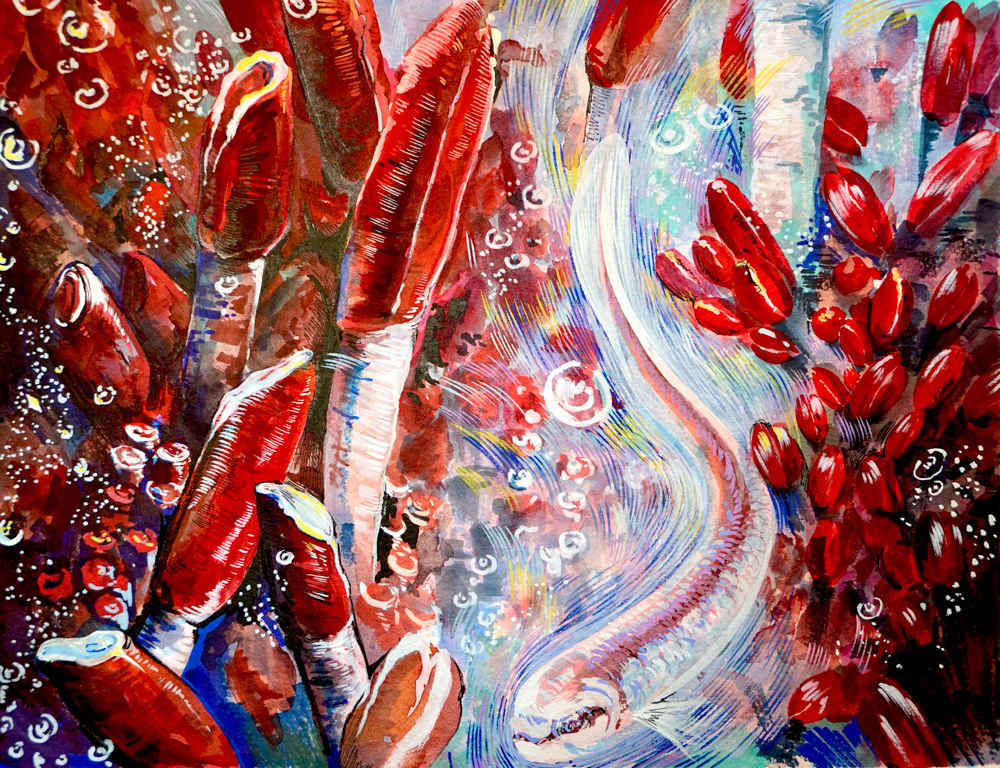
ARTIST'S STATEMENT: Riftia pachyptila gather and grow in large numbers at the seafloor hydrothermal vents, like flowers blooming in the deep. They thrive in the deep sea, where no light penetrates, so the further you move toward the edges of the canvas, the less light there is, making the scene darker and deeper. The red Riftia pachyptila intertwine and grow densely together, showing how numerous they are. In the dark depths of the deep sea, they have adapted to the extreme hydrothermal environment by growing into a vibrant red color. The bubbles emitted by the hydrothermal vents carry the minerals that the Riftia pachyptila rely on to survive. These worms coexist with bacteria that transform the minerals into energy, which fuels the life forms in the Hydrothermal Vent ecosystem. The bacteria also provide food for the deep-sea fish swimming nearby.