The 11–14 age category finalists in the 2026 Science Without Borders® Challenge bring this year’s theme, Microscopic Marine Life, into vivid focus, revealing both its beauty and its essential role in sustaining our planet.
This year’s competition received an impressive 900 submissions from 65 countries, including 434 entries in the 11–14 age category. The selected finalists represent a truly global perspective, with young artists hailing from Australia, Canada, China, New Zealand, Tajikistan, the United States, and Vietnam. Each artwork offers a unique cultural and scientific lens on life beneath the surface.
From detailed portrayals of zooplankton and phytoplankton to creative interpretations of ocean ecosystems, these artists explore organisms that are invisible to the naked eye yet essential to life on Earth. Several pieces emphasize phytoplankton as the “foundation of life,” highlighting their role in producing oxygen and supporting marine food chains. Others draw inspiration from the delicate symmetry of diatoms or the dynamic movement of drifting plankton.
Many finalists also present microscopic life as part of a larger, interconnected system. Some artworks portray these organisms as the “engine” powering Earth’s oceans, while others depict them as architects sustaining coral reefs and marine ecosystems. The theme of connection continues in pieces showing how even the largest creatures depend on microscopic organisms for nutrient recycling and balance.
Together, these artworks remind us that even the smallest forms of life can have the greatest impact. By combining art and science, these young finalists inspire us to look more closely and to better appreciate the microscopic marine organisms that keep our ocean, and our planet, alive.
Take a closer look—explore the finalists’ gallery and uncover the magic of the microscopic ocean!
2026 Science Without Borders® Challenge Finalists (Ages 11-14)
"Secrets of life" by Ashley Siswanto, Age 12, Australia
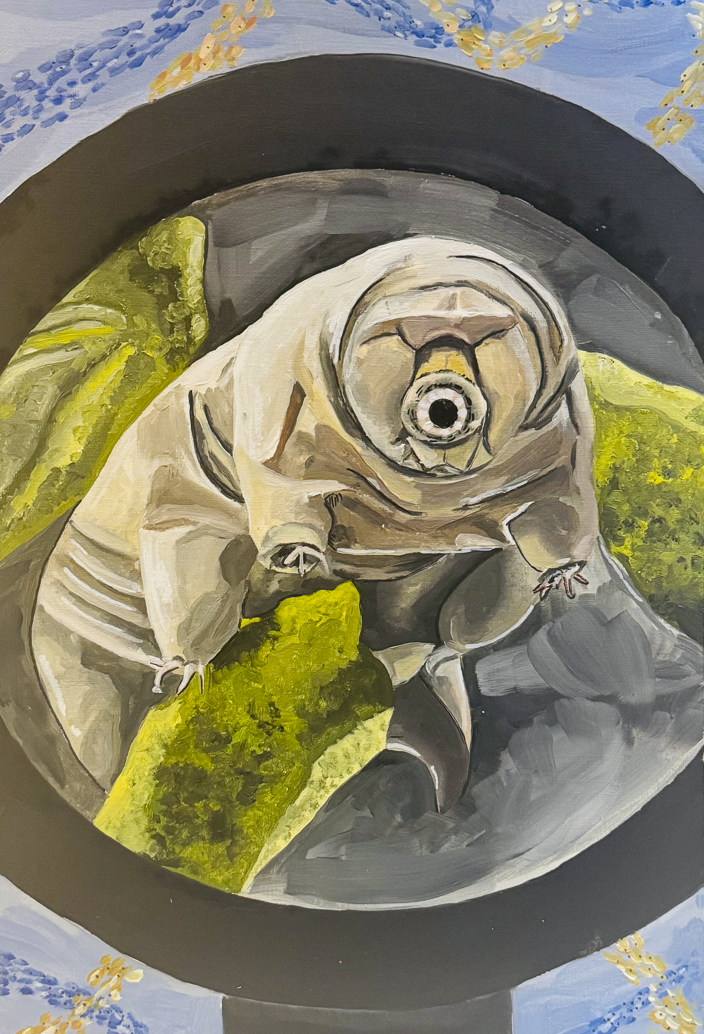
ARTIST’S STATEMENT: I would like to introduce you to one of the most amazing creatures on earth, the water bear, also known as a tardigrade. Even though it is smaller than a grain of sand, the water bear is one of the toughest animals ever discovered. It can survive extreme heat, freezing temperatures and even outer space. If the water bear encounters extreme conditions such as severe dehydration, freezing temperatures, lack of oxygen and more, they enter a state called cryptobiosis until it becomes safe. The water bear has showed us that even the smallest sizes of life can be as or even stronger than we can ever be. This was what inspired me to choose the water bear as my chosen microscopic animal. I have tried to depict the water bear as a strong animal that may not be visible by eye, but even more mighty inside. Thank you.