The 11–14 age category finalists in the 2026 Science Without Borders® Challenge bring this year’s theme, Microscopic Marine Life, into vivid focus, revealing both its beauty and its essential role in sustaining our planet.
This year’s competition received an impressive 900 submissions from 65 countries, including 434 entries in the 11–14 age category. The selected finalists represent a truly global perspective, with young artists hailing from Australia, Canada, China, New Zealand, Tajikistan, the United States, and Vietnam. Each artwork offers a unique cultural and scientific lens on life beneath the surface.
From detailed portrayals of zooplankton and phytoplankton to creative interpretations of ocean ecosystems, these artists explore organisms that are invisible to the naked eye yet essential to life on Earth. Several pieces emphasize phytoplankton as the “foundation of life,” highlighting their role in producing oxygen and supporting marine food chains. Others draw inspiration from the delicate symmetry of diatoms or the dynamic movement of drifting plankton.
Many finalists also present microscopic life as part of a larger, interconnected system. Some artworks portray these organisms as the “engine” powering Earth’s oceans, while others depict them as architects sustaining coral reefs and marine ecosystems. The theme of connection continues in pieces showing how even the largest creatures depend on microscopic organisms for nutrient recycling and balance.
Together, these artworks remind us that even the smallest forms of life can have the greatest impact. By combining art and science, these young finalists inspire us to look more closely and to better appreciate the microscopic marine organisms that keep our ocean, and our planet, alive.
Take a closer look—explore the finalists’ gallery and uncover the magic of the microscopic ocean!
2026 Science Without Borders® Challenge Finalists (Ages 11-14)
"The Alveolate Architects" by Louisa Sun, Age 13, United States of America
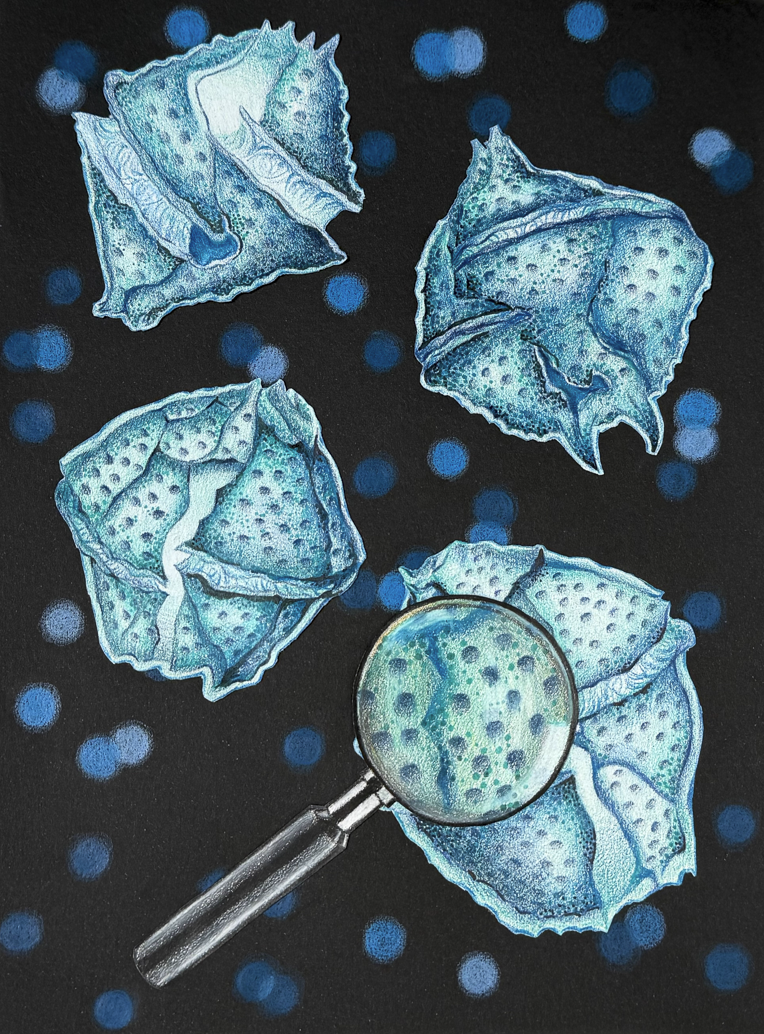
ARTIST’S STATEMENT: Dinoflagellates are the invisible architects of the sea. Despite their microscopic scale, ranging from 5 to 2,000 millimeters in size, they serve as the living backbone of aquatic ecosystems. As essential primary producers, they don't just photosynthesize, they sustain life. Through symbiosis, they inhabit corals, supplying them with carbohydrates, while also scrubbing CO2 from our atmosphere. The magnifying glass is bringing forth these “small but mighty” builders and giving them the recognition they deserve. It uncovers the intricate complexity of microorganisms that fuel the food web and preserve our reefs. The soft lights in the background depict the bioluminescent magic of dinoflagellates, a reminder that a single droplet of water holds a glowing city of life. From oxygen production to reef building, they prove that impact isn't measured by size. Dinoflagellates are the quiet engine to our healthy planet, illuminating the deep with biological wonder and ecological necessity.