Following the announcement of our 11–14 age-group finalists, the Science Without Borders® Challenge continues with the 15–19 age group. Each year, the Challenge invites students to explore the ocean through both art and science—and this year’s finalists have done just that in remarkable ways.
Representing countries across the globe, including Canada, China, the Republic of Korea, Taiwan, and the United States, these talented young artists dive into the 2026 theme, “Microscopic Marine Life,” revealing a world that is rarely seen but deeply felt. Their artworks illuminate the hidden systems that sustain our planet, from oxygen-producing phytoplankton to deep-sea microbes driving chemical cycles far below the surface.
Through a range of creative approaches, these students transform the invisible into something tangible. Some reimagine microorganisms as vast, architectural forms or glowing ecosystems, while others focus on the delicate structures and life cycles of individual species. Many works explore powerful ideas of connection—between life and death, surface and deep sea, and humanity’s reliance on organisms too small to see.
What stands out most is not just the technical skill on display but the depth of understanding behind each piece. These artists highlight how microscopic marine life forms the foundation of ocean ecosystems, regulates Earth’s climate, and ultimately makes life as we know it possible.
We’re proud to celebrate this group of finalists, whose work challenges us to look more closely, think more deeply, and better appreciate the unseen forces shaping our world.
2026 Science Without Borders® Challenge Finalists (Ages 15-19)
"The Microscopic Oxygen Factories" by Helen Miao, Age 16, United States of America
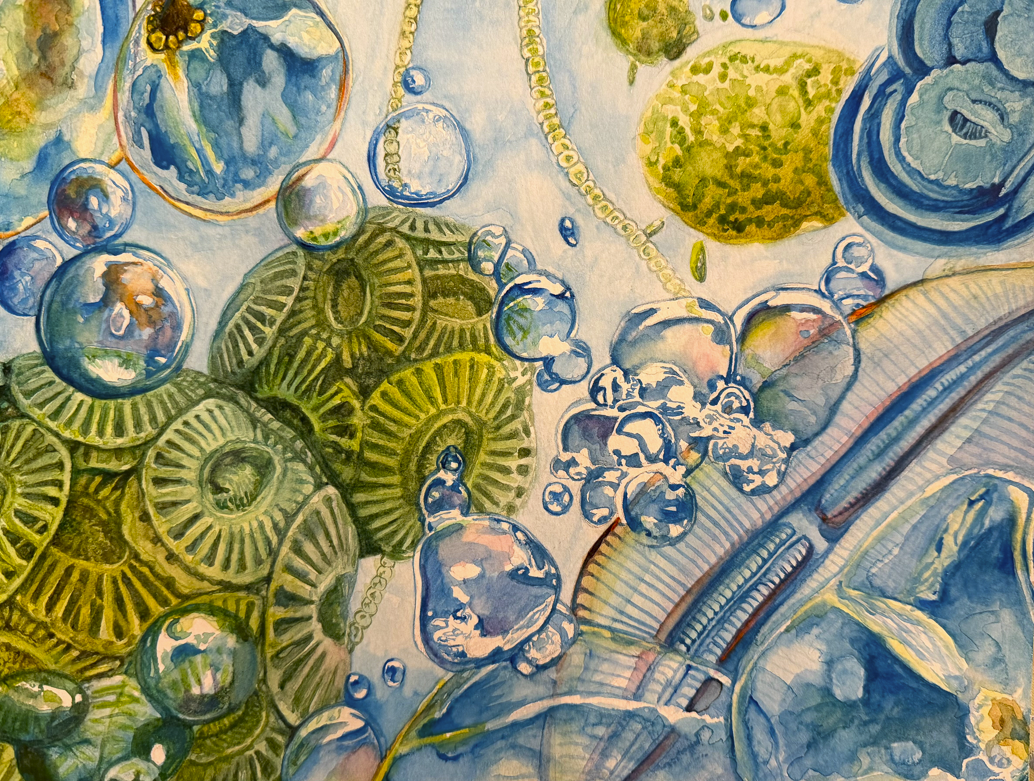
ARTIST’S STATEMENT: This artwork showcases diatoms, coccolithophores, cyanobacteria, and dinoflagellates. Microscopic marine organisms like diatoms, coccolithophores, cyanobacteria, and dinoflagellates are vital to life as they produce more than 50% of the oxygen on Earth. Driven by the sun in photosynthesis, these microscopic marine organisms convert water and carbon dioxide into sugars and oxygen. Most of life requires oxygen to perform aerobic respiration in order to have energy in the form of ATP to perform work, therefore photosynthetic microscopic marine organisms are crucial to life as we know it.
Stay tuned! We will announce the winners in the next couple of weeks.