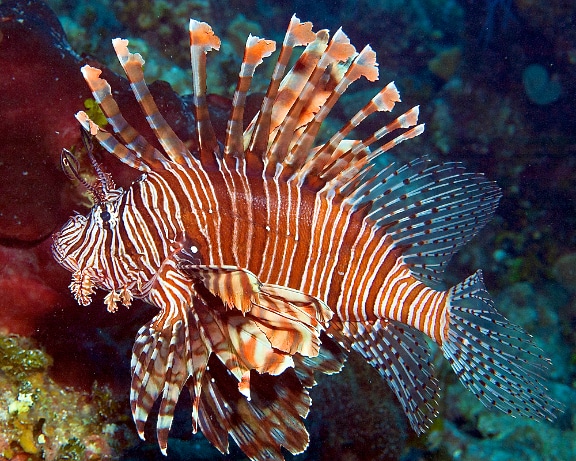
Although no one knows for certain how they came to be in these waters, Caribbean lionfish are probably here to stay. Living Oceans Foundation research divers have noted Caribbean lionfish on every dive in Great Inagua and Hogsty Reef so far. Atlantic and Gulf Rapid Reef Assessment (AGRRA) surveys first detected lionfish around Andros Island, Bahamas in 2007, although they may have been present prior to that date. Since then, their numbers have been steadily rising, as has the size of the individual lionfish observed during survey dives. Today, lionfish are present throughout the Caribbean. In fact, lionfish have been spotted in the Western Atlantic Ocean as far north as Rhode Island, and as far south as Colombia.
Originally from the Indo-Pacific, lionfish are voracious predators and have been observed indiscriminately consuming fish up to two-thirds their size. Lionfish use their exaggerated long fins to herd smaller fish and then attack them. From gut content studies, scientists have found that small wrasses and damselfish are some of their favorite prey species. However, they will eat any small fish and even crustaceans like crabs, shrimps and juvenile lobsters. Unfortunately, none of the large reef predators, such as snappers, groupers and sharks, appear to prey on these nuisance fish. A few scientists hold out hope that groupers are a potential predator for Caribbean lionfish. However, the number of large predatory groupers on most Caribbean reefs has declined drastically because it is a preferred food fish.
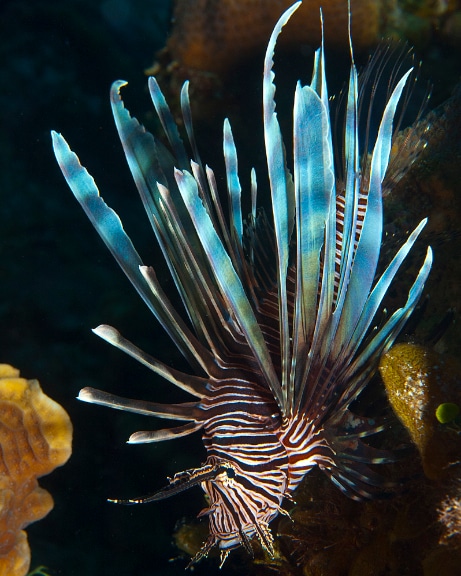
Members of the Living Oceans Foundation research team who are recording fish abundance and distribution have noted repeatedly that lionfish tend to aggregate around reef structures with plenty of vertical relief and crevasses. The lionfish will group together on these reef formations, with many individuals swimming in close proximity of one another. It appears the lionfish may favor these locations because they are full of reef fish activity. Lionfish are often found close to “cleaning stations.” A cleaning station is a location on the reef populated by small cleaner fish such as wrasses and gobies. These small fish wait for a larger parrotfish, barracuda or grouper to approach the station. This is a clear indication that it is ready to be cleaned. The cleaning is a service the small fish perform with efficiency. They eat loose skin, parasites and bacteria off of the larger fish, demonstrating another example of mutualistic symbiosis on the reef. Unfortunately, the cleaner fish also become easy prey for lionfish lying in wait for a good opportunity to strike.
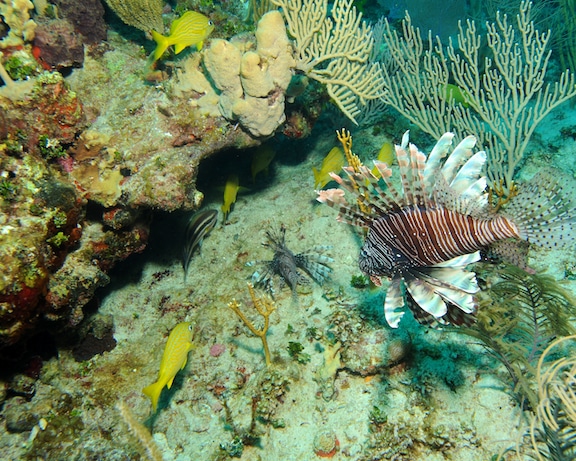
Two species of lionfish (Pterois volitans and P. miles) have become established in the Caribbean, but they are very difficult to distinguish in the wild and they have started to interbreed. Surveys indicate that the invaders are able to reach sizes that are twice the typical size they reach in their home waters of the Pacific and Indian Oceans. With females releasing 30,000-40,000 eggs at a time, perhaps as frequently as twice a week, these predators are likely here to stay. In many parts of the Caribbean, divers are encouraged to spear the fish and “Lionfish Rodeos” are becoming a popular control method in resort areas. Fortunately, once an angler cleans the fish and removes venomous spines from the back and underside of each individual, the meat is tasty.
Spearing lionfish may be helpful in keeping the populations of lionfish down on some Caribbean reefs, but with sightings of the fish down as deep as 300 meters, it is implausible to think we can easily eradicate them. Caribbean lionfish are a serious threat to the decline of biodiversity and abundance of Caribbean reef fish.
Written by Kit van Wagner
(Photo/Images by: 1 – 2 Ken Marks, 3 CAPT Philip Renaud)
To follow along and see more photos, please visit us on Facebook! You can also follow the expedition on our Global Reef Expedition page, where there is more information about our research and our team members.