Ten days ago scientists and crew from the Golden Shadow deployed a piece of equipment known as a Recording Doppler Current Profiler (RDCP). Today, team members collected it from the waters off the western side of Great Inagua. The RDCP, a type of acoustic Doppler profiler, has been suspended over the sea floor collecting data at regular intervals to provide the expedition with some critical information that would be difficult, if not impossible, to collect manually. The RDCP measures how fast water is moving as it passes over a set point from the sea floor to the surface; a vertical span is known as the water column. A secured RDCP can measure the speed of the current at regular intervals from its anchorage to the surface. The RDCP uses acoustic (sound) waves to measure water currents. Like a dolphin using echolocation, the device sends out a series of pings. These waves of sound bounce off of the surrounding environment and return to the instrument where any change in pitch is recorded.
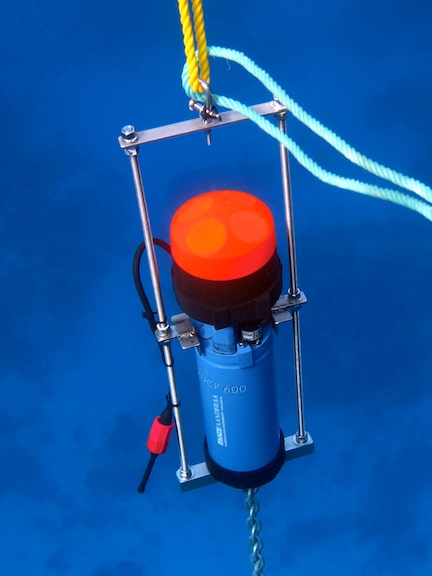
The RDCP functions using a principle of sound waves called the Doppler effect. If you have ever stood near a busy highway and noticed how the sound of an approaching vehicle grows as it approaches and then fades as it passes by, then you have experienced the Doppler effect. Essentially, sound waves have a higher pitch (or frequency), when they move towards you than when they move away. The RDCP sends out sound waves that travel through the water and bounce off bits of suspended sediment in the current, before echoing back down to the device. The sounds waves being sent out have different pitches and speeds than those coming back to the RDCP. These differences can be measured, recorded and used by the RDCP to calculate how fast the water around it is moving at many different depths.
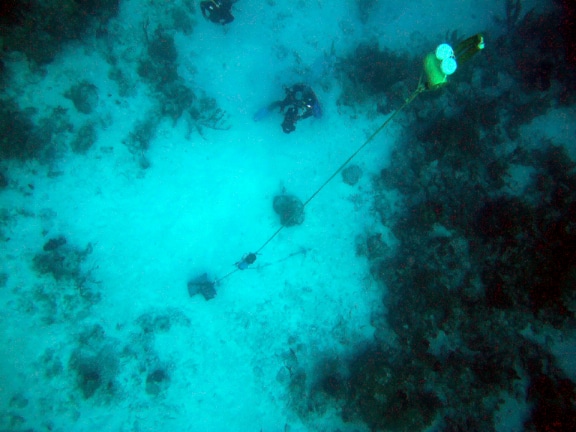
The RDCP apparatus can be lowered into the water from the surface to depths of up to 1000 meters, or attached horizontally to seawalls, bridges, pilings, and even ship hulls in motion. For the purposes of the Global Reef Expedition however, the RDCP was anchored vertically to the seafloor in 15 meters of water, which is within the depth range of our coral reef surveys. This was done in order to monitor the current speed on the west side of Great Inagua over an extended period of time. The system is also equipped with a suite of small sensors that continuously measure temperature, salinity, dissolved oxygen, and turbidity (water clarity). All of these physical oceanographic parameters affect coral reef ecology. Our objective in deploying the RDCP is to document precise measurements of physical oceanographic conditions present along the western side of Great Inagua. Currents play a critical role in reef health by constantly flushing the reef to bring in nutrients and plankton, and to stabilize salinity levels and local water temperatures. In addition, currents can whisk away any sediments, runoff or pollution.
Written by Kit van Wagner
(Photo/Images by: 1 – 2 Amanda Williams)
To follow along and see more photos, please visit us on Facebook! You can also follow the expedition on our Global Reef Expedition page, where there is more information about our research and our team members.