
search-icon
Next Stop: Navassa

After a short break in Jamaica, the M/Y Golden Shadow departed for an overnight sail to the next stop on the Global Reef Expedition: Navassa. Joining the Living Oceans science staff is a cadre of National Oceanic and Atmospheric Administration (NOAA) and University of Miami researchers. Together, they will characterize the current status, threats and resilience of Navassa’s reefs.

By revisiting past survey sites, the researchers will update information on coral reef communities examined by NOAA and other partners over the last 10 years. The current mission includes a team doing fish counts, one assessing the density of Elkhorn (Acropora palmata) and other corals, and one doing benthic transects.
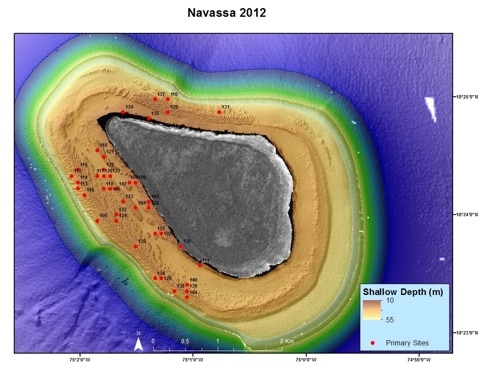
Navassa Mission primary dive sites (by Southeast Fisheries Science Center)

In addition to the researchers, Mike Trimble, a high school teacher from Corona del Sol High School in Tempe, Arizona, joined the Navassa team. Mike is documenting the research process being used by the researchers and providing updates from the field to his class in Arizona and another partner school in Gig Harbor, Washington. Periodically, students from both schools will be emailing questions to the researchers. Mike is part of new Living Oceans Foundation program called CREW (Coral Reef Educators on the Water).
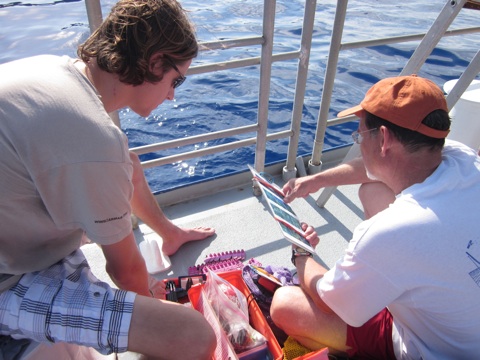
Alan Bright (left) explains coral survey equipment to Mike Trimble (right), the Navassa Mission's CREW participant.
Alan Bright (left) explains coral survey equipment to Mike Trimble (right), the Navassa Mission’s CREW participant.


Navassa has a steep profile. Most of the corals on the island are located at a depth of 20-30 meters. These deeper dives present a host of additional safety considerations. Divers carefully monitor their depth and bottom time to avoid oxygen toxicity, nitrogen narcosis, and decompression sickness.

Just before the first dive boats returned from their morning dives, a group of fishers from Haiti stopped by the Shadow to refill on fresh water, a scarce resource on Navassa. The only locally available freshwater source is a cistern on the island. Though likely contaminated by bats and other animals, fishers will still use this water source if they run dry.

Arriving in Navassa the day before from Haiti, the fishers will spend the next 10 days fishing around Navassa before returning home. Today’s catch included bar jacks, sand tilefish (some of which are used for bait), Sargassum triggerfish, blue tang, barracuda, and yellowtail snapper. The fish will be salted and dried as they continue to fish over the next week and half.
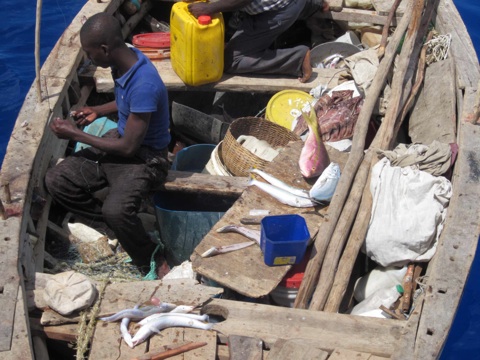
Fishers from Haiti will spend their time fishing and sleeping on a small boat.


Testing new equipment is a part of every survey mission. In order to enhance underwater communication, Phil Renaud conducted a mini-workshop on full-face masks with communication capabilities for a few of the divers. Once underwater, divers can discuss their observations and better interact with each other.
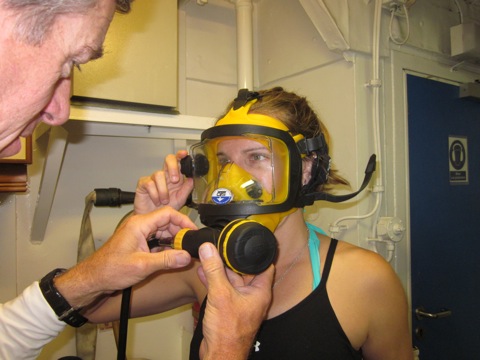
Phil Renaud helps Aurora Alifano, from Island Conservation, get a proper fit with her full-face mask.


(Photos/Images by: 1 SEFSC, 2-4 Eddie Gonzalez)

To follow along and see more photos, please visit us on Facebook! You can also follow the expedition on our Global Reef Expedition page, where there is more information about our research and our team members.
 

Related Posts

After the Storm: Standing with Our J.A.M.I.N. Family in Jamaica

There are moments in this work that feel heartbreakingly familiar.

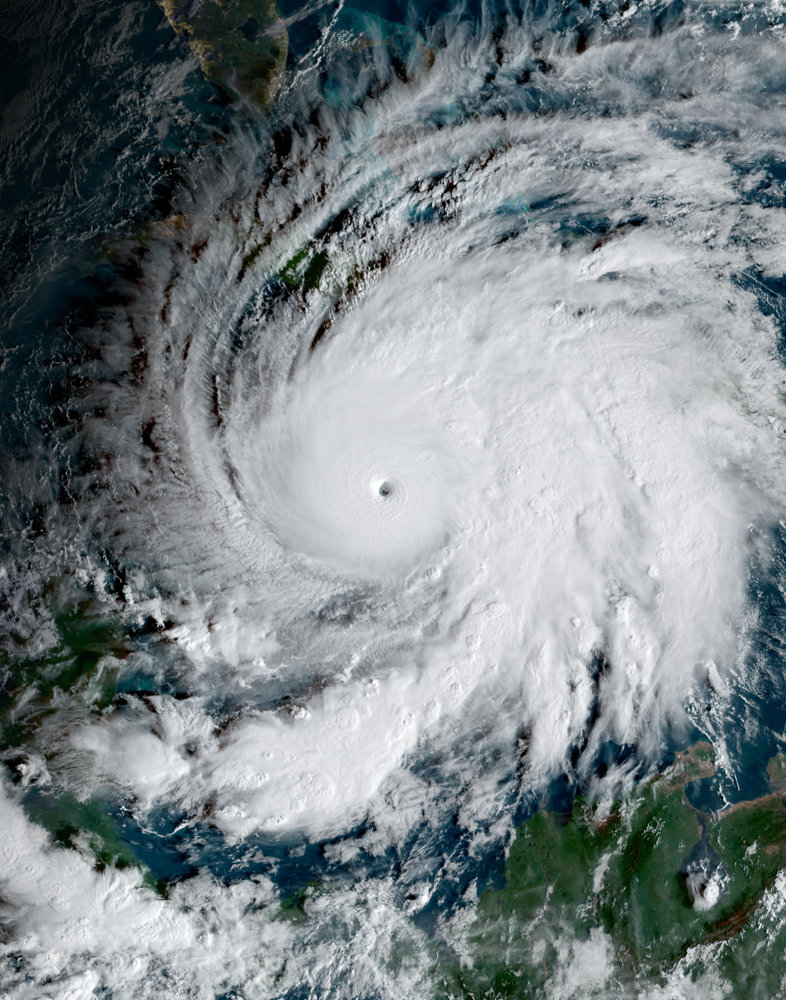
Two weeks after we completed our Jamaica Awareness of Mangroves in Nature (J.A.M.I.N.) programming, Hurricane Melissa made landfall. A powerful Category 5 hurricane, Melissa is now tied with Hurricane Allen in 1980 for the strongest winds ever recorded in an Atlantic storm. Like Hurricane Dorian, which devastated The Bahamas in 2019, Melissa will be remembered as one of the strongest hurricanes on record in the region.

For 11 years, the University of the West Indies Discovery Bay Marine Laboratory and William Knibb Memorial High School have been more than program partners. They have welcomed us into their classrooms and labs, shared meals and laughter, and committed themselves to educating their students about mangroves and coastal resilience. These colleagues and students are not distant collaborators. They are family.

And they were hit hard…

Read More

B.A.M. Turns 10: A Year of Milestones, Resilience, and Growth

The 2025–2026 academic year was one of those defining years for our Bahamas Awareness of Mangroves (B.A.M.) and Jamaica Awareness of Mangroves in Nature (J.A.M.I.N.) programs. It was a year marked by celebration, challenge, growth, and powerful full-circle moments, and a reminder of why mangrove education matters.

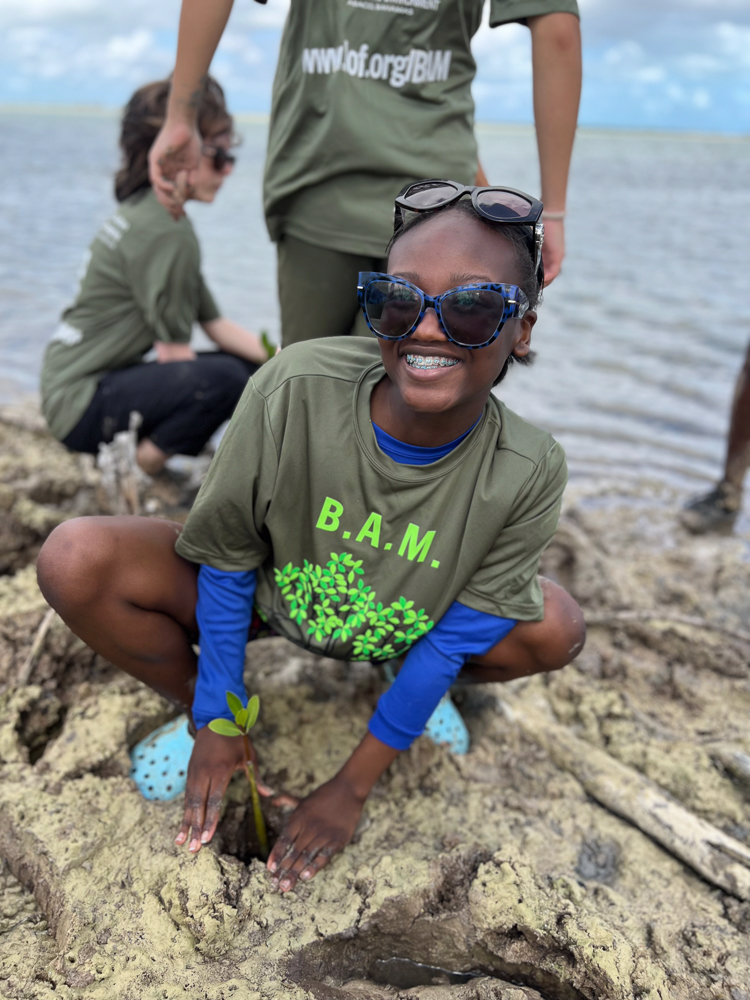
In The Bahamas, B.A.M. reached a major milestone: ten years of partnership and environmental education in Abaco. Since 2015, in collaboration with Friends of the Environment, we have worked alongside Patrick J. Bethel High School and Forest Heights Academy to bring hands-on mangrove science into classrooms and into the field. This year, we were proud to expand the program to S.C. Bootle High School, increasing access for students who live…

Read More
Privacy Overview

This website uses cookies so that we can provide you with the best user experience possible. Cookie information is stored in your browser and performs functions such as recognising you when you return to our website and helping our team to understand which sections of the website you find most interesting and useful.  You can view our complete Privacy Policy here.

Strictly Necessary Cookies

Most of our cookies are used to improve website security and reduce spam. These cookies should be enabled at all times. They also enable us to save your preferences for cookie settings.

3rd Party Cookies

This website uses Google Analytics to collect anonymous information such as the number of visitors to the site, and the most popular pages. Keeping this cookie enabled helps us to improve our website.