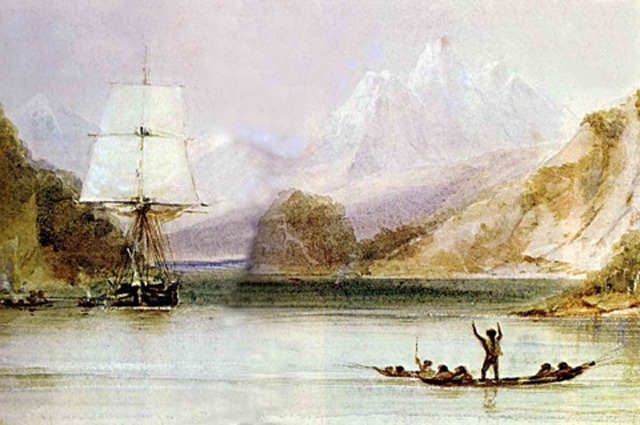
The story of how these not-incredibly-attractive islands in the middle of the Pacific became world famous starts on December 27, 1831, when the H.M.S. Beagle sailed from Plymouth, England on a five-year round-the-world voyage. On board was an unpaid naturalist named Charles Darwin, age 22.
The Beagle followed the coastline of South America and reached the Galapagos in September 1835. Darwin spent 19 days ashore on the islands of San Cristóbal, Floreana, Santiago, and Isabela, collecting samples, observing animals and taking notes. What he discovered provided crucial clues to what some have called “the single best idea anyone has ever had.”
Origins of Darwin’s Theory of Evolution in Galapagos
Darwin had left England a firm believer in the Biblical story of creation, but already he had seen things that challenged the idea: dinosaur bones in Argentina, fossilized seashells high in the Andes. In the Galapagos, he pondered tortoise shells and finch beaks that were similar, but noticeably different from island to island. Could these somehow have come from a single common ancestor, molded by their different environments?
It took over two decades for Darwin to refine his theories, and in 1858 he and fellow scientist Alfred Russell Wallace formally presented the theory of evolution to the public for the first time. On November 24, 1859, Darwin published On the Origin of Species by Means of Natural Selection, one of the most influential books in history.
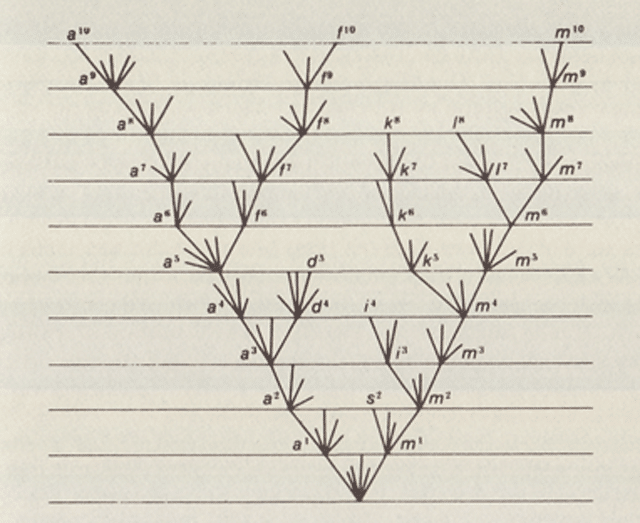
The book proposed an idea that seems so simple in hindsight, but at the time was practically blasphemous: that living things changed over time in response to their surroundings. Anyone could see plants and animals produced more offspring than could survive, and that some of these offspring were slightly different from their parents, for better or worse. Darwin proposed that those whose “modifications” made them better suited to survive were “naturally selected” and passed these adaptations on to their own offspring, and the process repeated through the generation in a snowball effect that led to entirely new species.
The mechanism was still a mystery (the science of genetics was still a century away) and the religious implications are still being debated. But the accumulation of evidence was overwhelming, and today the theory of evolution is the cornerstone of biology.
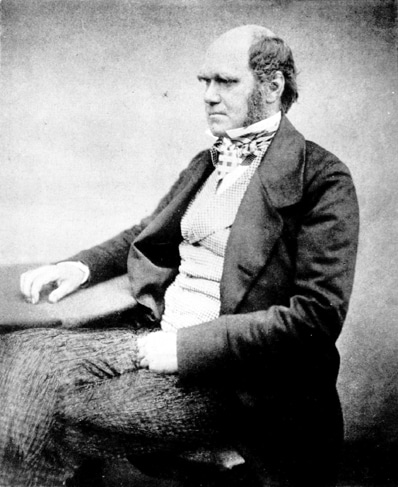
Darwin tried his best to stay out of the row his ideas caused in conservative Victorian society, especially after he applied the the theory of evolution to people in The Descent of Man and Selection in Relation to Sex in 1871. Chronically ill, he retreated to the English countryside to study orchids and raise eight children with his wife (and first cousin) Emma. He died on April 19, 1882 and was buried next to Sir Isaac Newton in Westminster Abbey in London.
If Charles Darwin had any misgivings about his world-changing revelation, it was that the process was “clumsy, wasteful, blundering, low and horribly cruel.” But he was a scientist, and facts were facts. He addressed the contradiction in the last paragraph of The Origin of Species: “Thus, from the war of nature, from famine and death, the most exalted object which we are capable of conceiving, namely, the production of the higher animals, directly follows…[and] from so simple a beginning endless forms most beautiful and most wonderful have been, and are being evolved.”
(Images by: 1-3 Wikimedia Commons)
To follow along and see more photos, please visit us on Facebook! You can also follow the expedition on our Global Reef Expedition page, where there is more information about our research and team members.