search-icon
Hao Atoll at Eye Level

Research dives can be distilled down to lists of what is seen and what is not seen. Surveying the reef means figuring out what is there and what is missing. For the last few days, the science team has been jumping into a variety of research sites inside the lagoon and outside the perimeter of Hao Atoll. As dive buddy teams enter the water, they scatter across the reef to deploy their instruments, gauges, transect lines, and quadrats with efficiency and purpose. It’s an amazing sight.
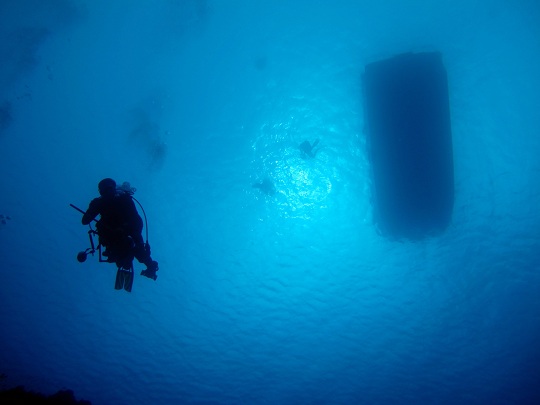
Research Dives: Divers descend to the reef to begin their surveys.

Clip boards and cameras record the species, size, distribution, abundance, and health of corals, sponges, fish, and invertebrates. By aggregating the observations from our research dives thus far, some early assessments are possible. For example, as in the other French Polynesia research sites, branching corals such as cauliflower coral (Pocillopora), table and staghorn corals (Acropora), thin crusts of corrugated leaf coral (Pavona), and fire coral (Millepora) are the more the common corals seen so far in Hao.
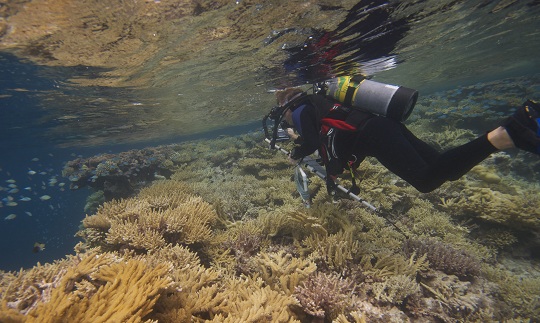
Dr. Andrew Bruckner, LOF Chief Scientist, scans the variety of coral.
LOF Chief Scientist, Dr. Andrew Bruckner, scans the variety of coral.

After research dives, the conversation on the dive boat quickly turns to the highlights. Fish ecologist, Badi Samaniego, caught a glimpse of the uncommon Chabanaud’s soapfish. On another dive, a giant manta ray (Manta alfredi) glided past the science team in the outer lagoon. Each of our research dives reveals more about the aquatic ecosystems at Hao Atoll.
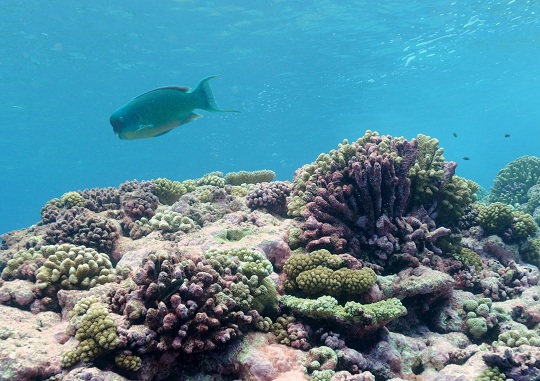
A parrotfish, Chlorurus microrhinos, swims along the reef.

(Photos by: 1 Brian Beck, 2 Joao Monteiro, and 3 Phil Renaud)
Related Posts

World Oceans Day: Protecting the Ecosystems That Protect Us

This World Oceans Day, the global community is being challenged to think differently about the ocean.

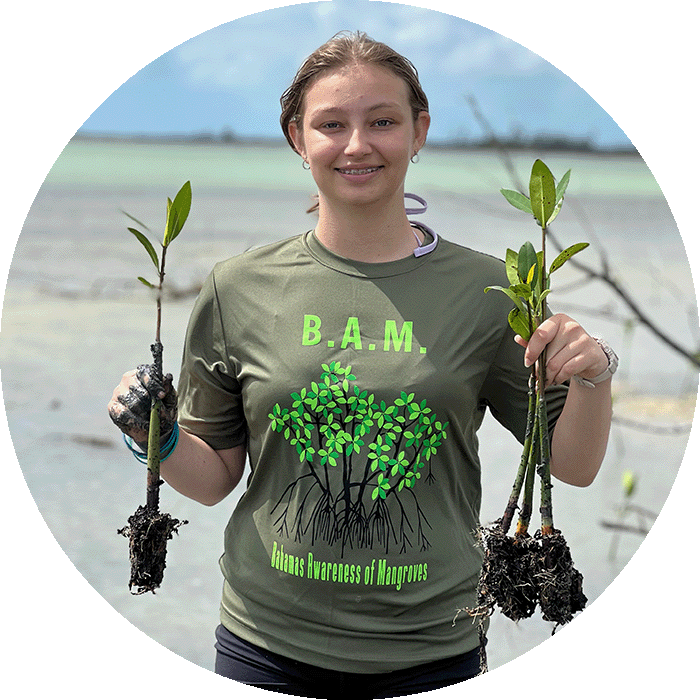
The 2026 World Oceans Day theme, “Reimagine: Beyond the World We Know, A New Relationship With Our Ocean,” invites us to recognize that the ocean is not something distant or separate from our lives. It regulates our climate, supports our economies, provides food for billions of people, and sustains the natural systems that make life on Earth possible.

Few places illustrate this connection more clearly than the coastal ecosystems that protect our shores and support marine life. While coral reefs, mangrove forests, and seagrass meadows are often…

Read More

After the Storm: Standing with Our J.A.M.I.N. Family in Jamaica

There are moments in this work that feel heartbreakingly familiar.

Two weeks after we completed our Jamaica Awareness of Mangroves in Nature (J.A.M.I.N.) programming, Hurricane Melissa made landfall. A powerful Category 5 hurricane, Melissa is now tied with Hurricane Allen in 1980 for the strongest winds ever recorded in an Atlantic storm. Like Hurricane Dorian, which devastated The Bahamas in 2019, Melissa will be remembered as one of the strongest hurricanes on record in the region.

For 11 years, the University of the West Indies Discovery Bay Marine Laboratory and William Knibb Memorial High School have been more than program partners. They have welcomed us into their classrooms and labs, shared meals and laughter, and committed themselves to educating their students about mangroves and coastal resilience. These colleagues and students are not distant collaborators. They are family.

And they were hit hard…

Read More
Privacy Overview

This website uses cookies so that we can provide you with the best user experience possible. Cookie information is stored in your browser and performs functions such as recognising you when you return to our website and helping our team to understand which sections of the website you find most interesting and useful.  You can view our complete Privacy Policy here.

Strictly Necessary Cookies

Most of our cookies are used to improve website security and reduce spam. These cookies should be enabled at all times. They also enable us to save your preferences for cookie settings.

3rd Party Cookies

This website uses Google Analytics to collect anonymous information such as the number of visitors to the site, and the most popular pages. Keeping this cookie enabled helps us to improve our website.